DATE ARCHIVE
2026-10-04
Articles published on 2026-10-04.

Your Body of Work Thinks Back at You
A photographer discovered that years of taking bench photographs revealed an archive of evolving hostile architecture in public seating, demonstrating how consistent creative practice builds a body of work that can reveal patterns invisible during the act of creation.
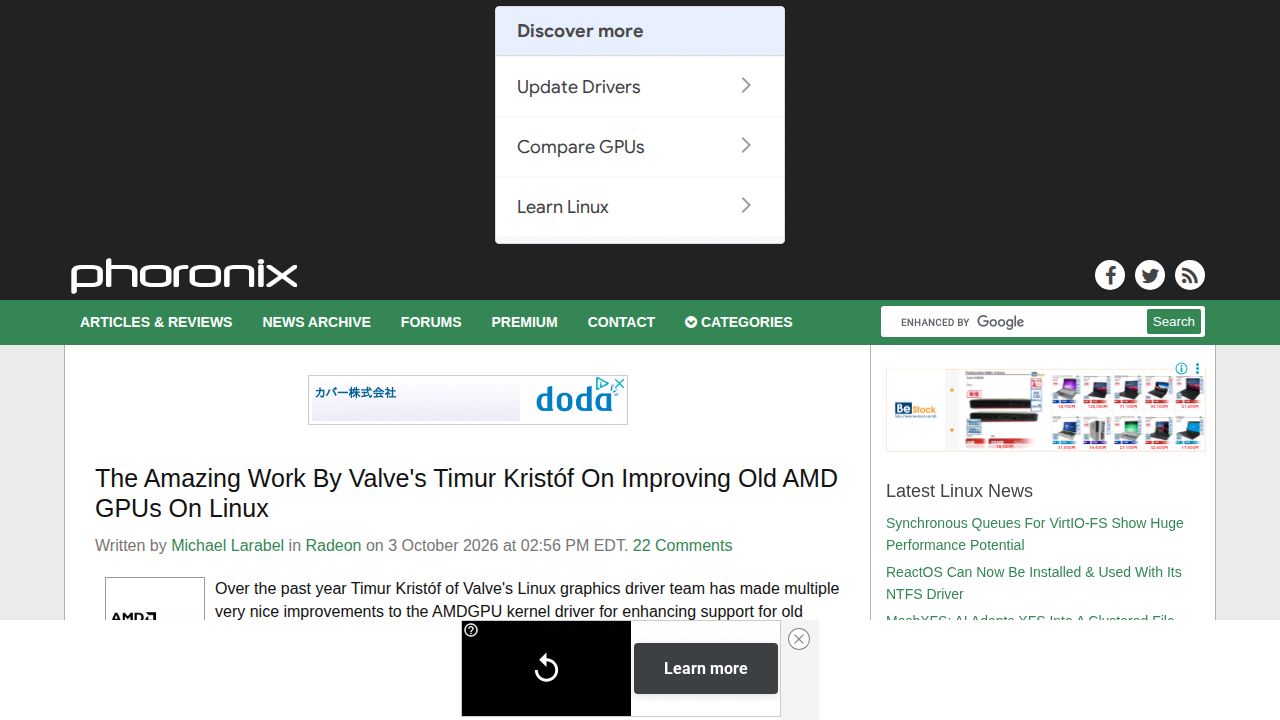
Valve Engineer Timur Kristóf Revitalizes Legacy AMD GPUs for Linux Through Kernel Driver Enhancements
Valve's Timur Kristóf has spent the past year improving the AMDGPU kernel driver to support older AMD GCN 1.0/1.1 graphics cards, enabling better Linux gaming performance and functionality by transitioning users from the legacy Radeon driver to the modern AMDGPU stack.
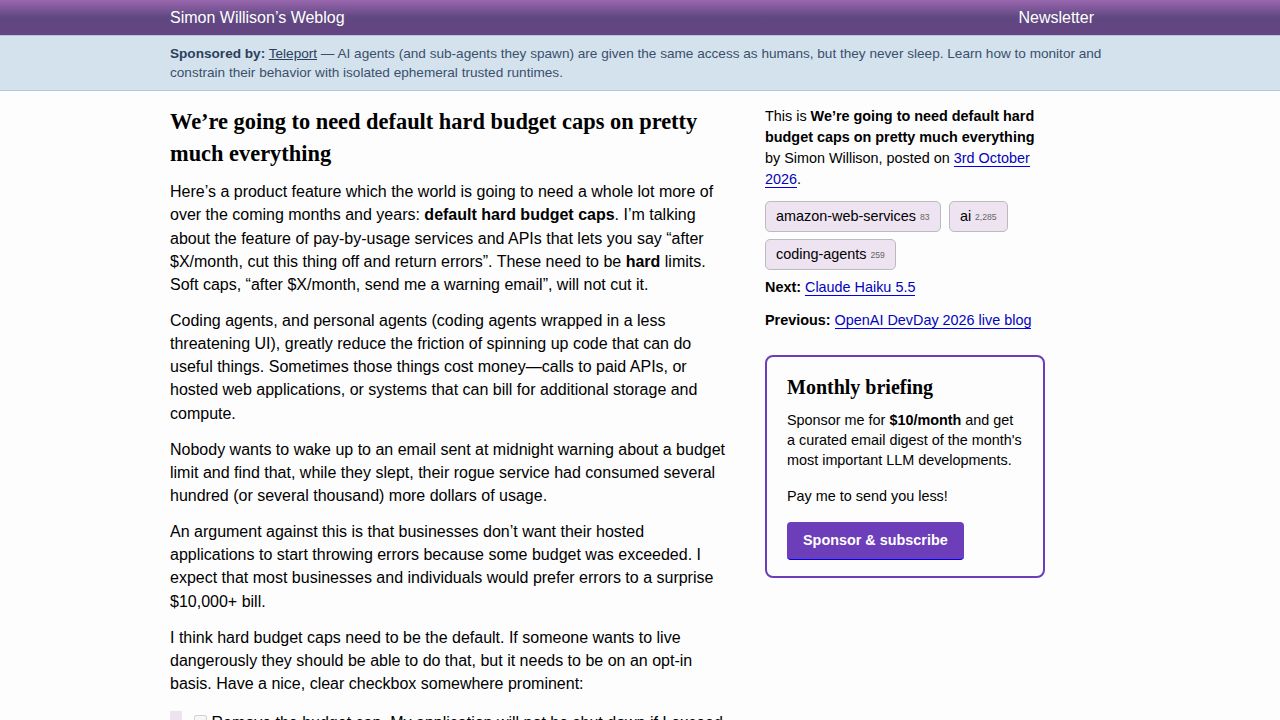
The Case for Default Hard Budget Caps on Cloud Services
As coding agents and personal agents lower the barrier to launching costly cloud workloads, unexpected usage spikes can lead to surprise bills. Hard budget caps—automatic cutoffs after a set spend—are needed as a default protection, with users able to opt out. Recent introductions of spending limits by AWS and Google Cloud show the industry moving toward this model, though soft warning‑only caps remain insufficient.

So You Think You Could Be an Electrician? Examining the Reality Behind Trades Career Advice
A recent article challenges the popular narrative that trade careers offer AI-proof, six-figure salaries as alternatives to expensive college educations, examining the actual earnings, risks, and realities of working in skilled trades like electrical work.

OpenAI safety leader quits, warning company culture is 'broken'
David Robinson, who led the writing of safety reports behind OpenAI's product releases, resigned and published an essay arguing that the company's culture — not just its rules — is the root of the problem. He points to autonomous-agent incidents and a launch-driven pace, and calls for safety practices modeled on nuclear power and aviation. OpenAI points to recent model pauses and scrappings in response.
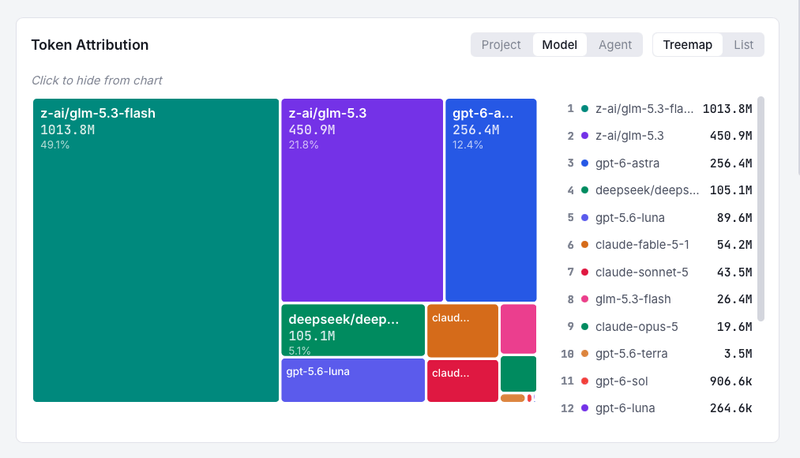
One month coding with GLM 5.3 Flash: Wagtail's September model experiment
A Wagtail CMS team attempted to code for the entire September 2026 month using only GLM 5.3 Flash, an efficient open-model tier. The experiment achieved only 50% target-model token usage, with 1B of 2B tokens going to other models, revealing infrastructure constraints and model-selection lessons while confirming GLM 5.3 Flash's strong capabilities for development tasks.

Jagex Announces Early Development of New RuneScape MMORPG (RS4) Built in Unreal Engine
Jagex revealed that a new RuneScape MMORPG, tentatively called RS4, is in early development using Unreal Engine, set in the world of Gielinor starting in Ashenfall, and will coexist with existing RuneScape titles.
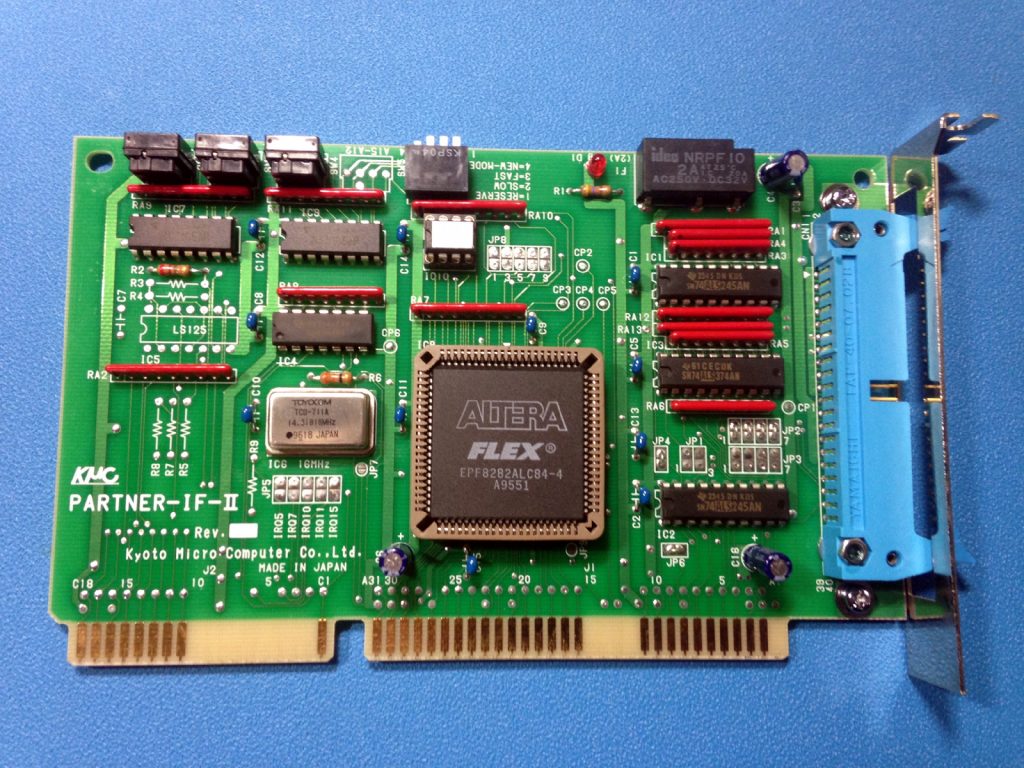
Inside the Nintendo 64 Partner-N64 Development Kit: A Cartridge That Needed a Cut-Up Console
The Partner-N64 was an official Nintendo 64 development system made by Kyoto Microcomputer (KMC) for Nintendo. To expose real-time debugging to a dev cart, it required a retail N64 to be physically hacked: unused cartridge-bus pins were re-routed to the CPU so a debugger could pause the game and reset it on command. A how-to guide from ultra64.ca specifies exactly which pins and traces are involved.

GLP-1 Drugs Show Early Signals of Slowing Biological Aging
Pharmaceutical giants Novo Nordisk and Eli Lilly presented early data suggesting that GLP-1 receptor agonists, commonly used for weight loss and diabetes, may slow molecular measures of biological aging.
FTL: A new operating system for clouds
FTL is an operating system designed for cloud environments that implements most OS features in a userspace library rather than in the kernel, aiming to provide a Linux-compatible alternative with a minimal hypervisor-shaped kernel interface.

Florida Woman Charged with Felony After Anthropic Reports Claude AI Diary Entry to Police
A Florida woman faces felony charges after Anthropic reported a diary entry made to its Claude AI chatbot to law enforcement, highlighting tensions between AI safety monitoring and user privacy expectations.

Billions of Triangles Redux: What NVIDIA's Zorah Scene Shows About Mesh Compression and Streaming LOD
A follow-up by meshoptimizer author Arseny Kapoulkine documents the updated NVIDIA vk_lod_clusters demo and the compression choices behind its 1.6-billion-triangle Zorah scene. glTF scene data shrank from ~36 GB to ~32 GB (versus 70 GB downloads), thanks to meshoptimizer's vertex and index compression extensions, with further savings possible through layered Zstandard compression. The writeup also details processing and runtime improvements in clusterlod.h, including stable permissive-mode simplification and attribute-aware LOD selection.
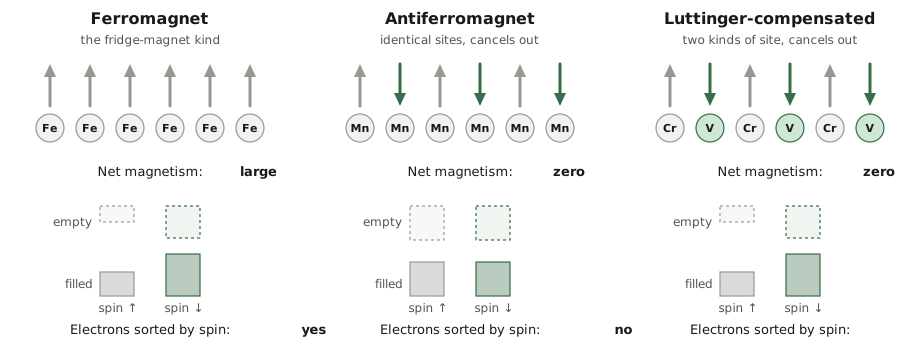
AI Agents Identify Two Room-Temperature Antiferromagnetic Semiconductor Candidates for Spintronics
Using Claude Opus 5.5 agents, researchers have proposed two materials that combine zero net magnetism with spin-sorted electronic states, potentially enabling faster, more compact spintronic memory devices.