The popular narrative suggests that with college costs soaring and AI threatening knowledge work, trade careers like electrical work offer AI-proof, six-figure salaries as a smarter alternative. However, a closer examination reveals a more complex reality about earnings, costs, risks, and workplace dynamics in the skilled trades. <p>Contrary to claims that trades salaries consistently surpass those of college graduates, research shows that college graduates still earn more than those without degrees due to their academic credentials. While the college wage premium has fluctuated over time, rigorous causal research finds substantial long-term income effects from obtaining a four-year degree, often amounting to hundreds of thousands of dollars over a career, though this varies by major. <p>The actual cost of college may also be lower than commonly portrayed. While sticker prices for four-year colleges have risen dramatically over the past 30 years, most students pay significantly less than the advertised rate. The average net paid price for public in-state college tuition and fees was under $2,500 per year in 2024 and has been declining since 2016. <p>Physical risks represent another important consideration often overlooked in promotional narratives. Trades work carries inherent dangers that desk jobs largely avoid, with certain professions facing specific hazards: electrical linesmen risk electrocution, ironworkers and roofers face fall-related dangers, and arborists encounter multiple risks from heights, falling trees, or electrical contact. Many tradespeople know colleagues who have suffered permanent disability or death from work-related incidents. <p>Within the blue-collar workforce, trades occupations occupy a privileged position, but access is not equal. The median blue-collar worker is more likely to be an Amazon delivery driver earning around $40,000 annually than a union electrician making six figures. Trades jobs, particularly specialized union positions, often require extensive training, social connections, certifications, licensing, and technical competence that create barriers to entry for those lower in the blue-collar hierarchy. <p>The impact of artificial intelligence and automation on trades work presents a nuanced picture. As physical dexterity demands have decreased through mechanization (such as pneumatic nailers replacing hand nailing), trade work has become more cognitively demanding. AI could potentially reverse this trend by reducing cognitive burdens through technologies like smart glasses that provide real-time guidance on complex tasks such as HVAC system configuration, which might otherwise require memorizing hundreds of reference points. <p>Those considering trades careers should receive honest counsel that acknowledges both the positives and negatives of this path. Rather than promoting trades as a simple solution to college costs and AI disruption, advice should frank about the physical risks, hierarchical barriers to high-paying positions, and evolving nature of work in an increasingly automated world.
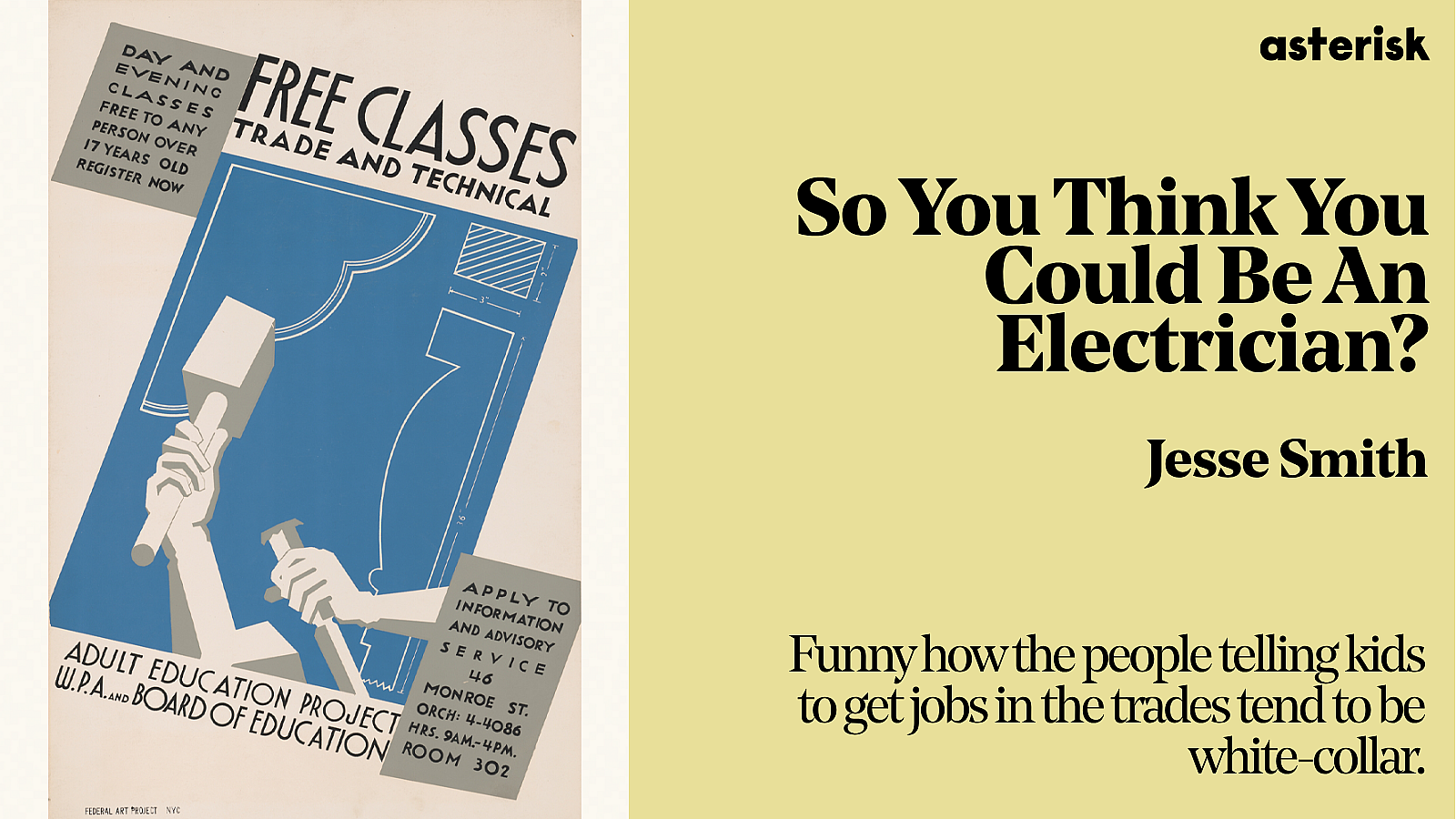
This image of Jesse Smith represents the blue-collar workforce discussed in the article, which covers topics such as earnings, physical risks, and the impact of AI on trades.