Spintronic devices rely on sorting electrons by their spin orientation to store and read information, a task normally performed by ferromagnetic materials. However, ferromagnets produce stray magnetic fields that interfere with neighboring components and switch relatively slowly. Antiferromagnets cancel out net magnetism, allowing tighter packing and faster switching, but their electron spins are typically mixed across energy levels, making spin sorting difficult. Luttinger‑compensated (LC) antiferromagnets overcome this by placing spin‑up and spin‑down atoms in inequivalent environments, restoring spin‑sorted bands while keeping the net moment zero.
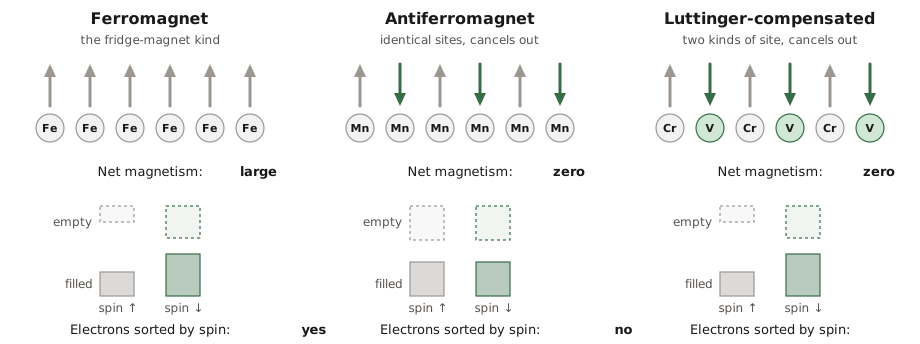
This image illustrates the core concept discussed in the article's opening paragraph: Luttinger-compensated antiferromagnets overcome the limitation of conventional antiferromagnets by placing spin-up and spin-down atoms in inequivalent environments, which restores spin-sorted bands while keeping net magnetic moment zero.
Using Claude Opus 5.5 agents, the team designed a new LC oxide, YBaMnFeO₅, composed of yttrium, barium, manganese, iron and oxygen. Density‑functional theory at the HSE06 level predicts a 2.35 eV band gap, with spin‑sorted windows of 1.0 eV for holes and 1.4 eV for electrons—far larger than the ~26 meV thermal fluctuation at room temperature. The raw simulation shows magnetic order persisting to about 420 K, rising to roughly 490 K after calibration against a known magnet. However, the material requires a perfect checkerboard arrangement of Mn and Fe atoms, which disorders above ~950 K, potentially complicating low‑temperature synthesis.
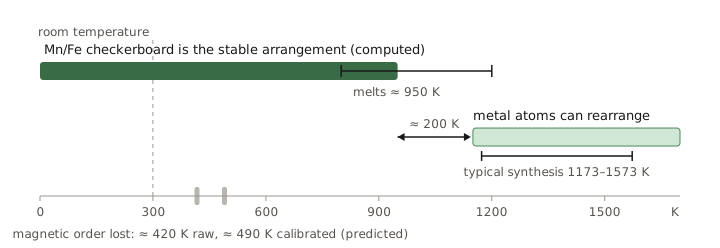
This image explains the materials synthesis challenge for the YBaMnFeO5 candidate: while simulations predict magnetic ordering up to ~490K, the required checkerboard arrangement of manganese and iron atoms disorders above approximately 950K, complicating low-temperature fabrication of the pure phase.
The agents also identified an existing compound, KV[Cr(CN)₆], first reported in 1999 as a Prussian‑blue analogue. HSE06 calculations give a ~2.1 eV band gap and spin‑sorted windows of 2.6 eV for holes and 1.6 eV for electrons. The 1999 sample remained magnetically ordered up to 376 K (103 °C), confirming room‑temperature stability. Because chromium binds to the carbon end of each cyanide and vanadium to the nitrogen end, the two magnetic ions occupy distinct sites, fulfilling the LC condition. The main uncertainty is the effect of residual water in the powder sample, which simulations suggest may reduce the hole‑spin window.
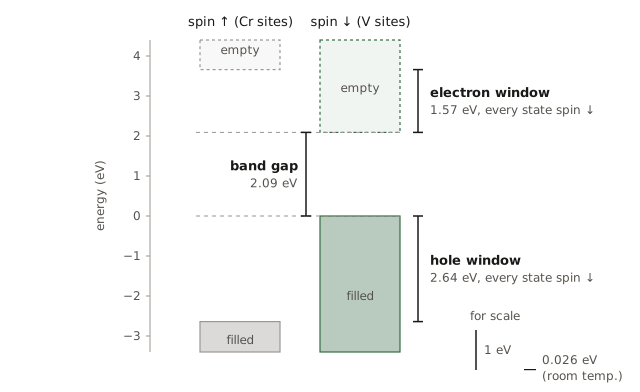
This image clarifies the concept of spin windows mentioned for both candidate materials: the energy gap between spin-up and spin-down electronic bands that enables spin filtering, with values of 1.0eV (holes) and 1.4eV (electrons) for YBaMnFeO5 and 2.6eV (holes) and 1.6eV (electrons) for KV[Cr(CN)6].