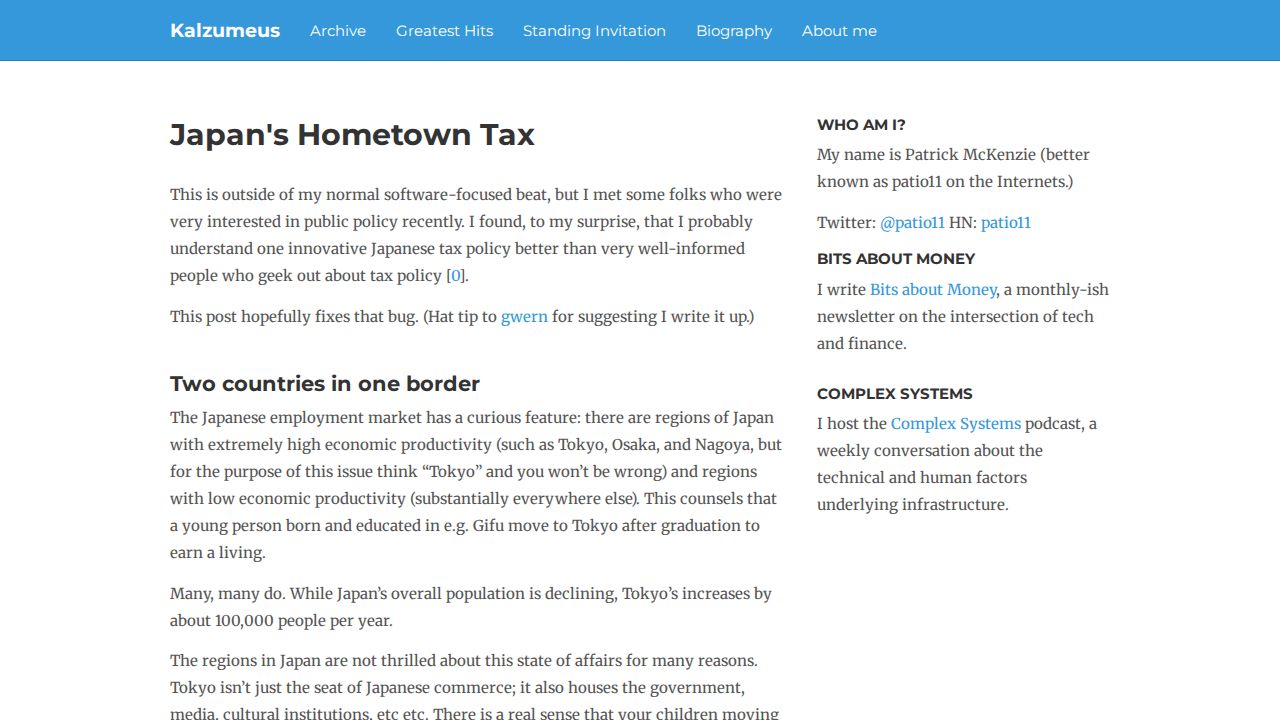
Japan's Furusato Nouzei, or 'Hometown Tax' system, allows residents to redirect up to 40% of their residence taxes to any municipality of their choice in exchange for a 1:1 tax credit. This policy addresses a significant economic imbalance where rural regions fund the education of youth who then migrate to high-productivity urban centers like Tokyo, effectively allowing those regions to reclaim a portion of the public expenditure they invested in human capital.
The Mechanism of Tax Redirection
A substantial portion of Japan's income-based taxes are residence taxes, typically paid to the city and prefecture where a person lives. Under the Furusato Nouzei system, individuals can choose to donate a portion of this tax to a different municipality, receiving a 1:1 credit on their residence tax for the following year.
Because most Japanese residents do not file annual tax returns—as employers typically remit taxes directly—participating in this system requires a deliberate act of friction. This opt-in structure ensures that the redistribution of funds is a conscious choice by the taxpayer rather than an automatic reallocation of revenue.
“The Furusato Nouzei system does not define what a “hometown” is. This is mostly by design; Japan historically has a very long-lasting official record of birthplaces which follows one throughout life called the Family Register, and (for reasons outside the scope of this post) it is a major societal issue.”
— Japan's Hometown Tax | Kalzumeus Software
Incentives and the Culture of Reciprocation
To encourage participation, city governments began offering tangible rewards in return for donations. This practice leverages a Japanese cultural norm of reciprocating gifts, where a donation is often met with a 'token of appreciation' such as locally produced food or specialized services.
Some municipalities have become highly creative with these offerings. For example, certain towns offer to send a representative to clean a donor's grave and provide a photo of the offering for a donation of $100 or more. These gifts serve to cement relationships between the municipality and the 'internal diaspora' of people who moved away but still have ties to the region.
The Emergence of a Bidding War
Because the system does not define what a 'hometown' is, any city can bid for a taxpayer's donation. This has led to a competitive market where rural towns offer increasingly high-value rewards to attract donors. To manage this, the central government eventually stepped in to cap the value of these rewards at 50% of the donation amount.
The system is heavily supported by large internet giants like Rakuten and Yahoo, which provide e-commerce platforms to bundle gifts and process donations. While these intermediaries may soak up an estimated 5% to 10% of the total donated amount, the infrastructure makes the process socially viral and easy for taxpayers to navigate.
Sustainability and Trade-offs
The system successfully allows rural areas with declining tax bases to fund material projects while Tokyo takes a hit to its revenue. However, the 'bidding war' remains a point of contention, as cities are often opposed to administrative caps on the value of the gifts they provide.
While the system is somewhat inefficient due to the costs of the brokerage platforms, it functions as a novel redistribution program that achieves its primary goal: ensuring that the regions responsible for raising and educating the youth receive a share of the economic rewards produced by those citizens.
What Hacker News readers are saying
- Alternative: One commenter who uses the system shared their experience of sending tax portions to their home prefecture in exchange for local agricultural goods, while expressing a wish for a similar system in the United States. comment ↗
- Skeptical: Another commenter suggested that the dynamic mirrors a common cultural divide where urban centers and rural areas hold mutual perceptions of superiority or disdain, similar to the relationship between Paris and its surrounding villages. comment ↗
Summarized opinions from the Hacker News thread, not verified facts. Read the full discussion ↗