A Debian server and its associated services—including SSH, HTTP, and SMTP—became completely unreachable following an update to the 6.1.0-55 kernel. The issue, reported as a critical severity bug, results in a total system freeze that requires a hardware reboot to recover.
Symptoms of the Kernel Regression
After installing the 6.1.0-55 package and rebooting, a user reported that their server stopped responding to all network protocols. This included standard remote access methods like SSH and web services like HTTP, effectively locking out administrators.
While the system remained unresponsive to remote commands, a local login via a VGA screen revealed a 'big error message' indicating a kernel 'Oops.' This suggests a kernel panic or a severe internal error that halted system execution.
“After updating to 6.1.0-55 package, and reboot my system, I found my server not responding remotely after few minutes (imap, smtp, http, ssh...)”
— #1154101 - linux-image-6.1.0-55-amd64: System freeze after update to linux-image-6.1.0-55-amd64 - Debian Bug report logs
Diagnostic Evidence and Recovery
The reporter confirmed that the system remains stable when running the previous kernel version, 6.1.0-54. In testing, the server was able to run for at least 45 minutes without any crashes or freezes on the older version.
The bug report identifies the issue as being found in version linux/6.1.192-1. The provided dmesg logs show a standard boot sequence, but the specific 'Oops' message that triggers the freeze is not fully captured in the initial boot output.
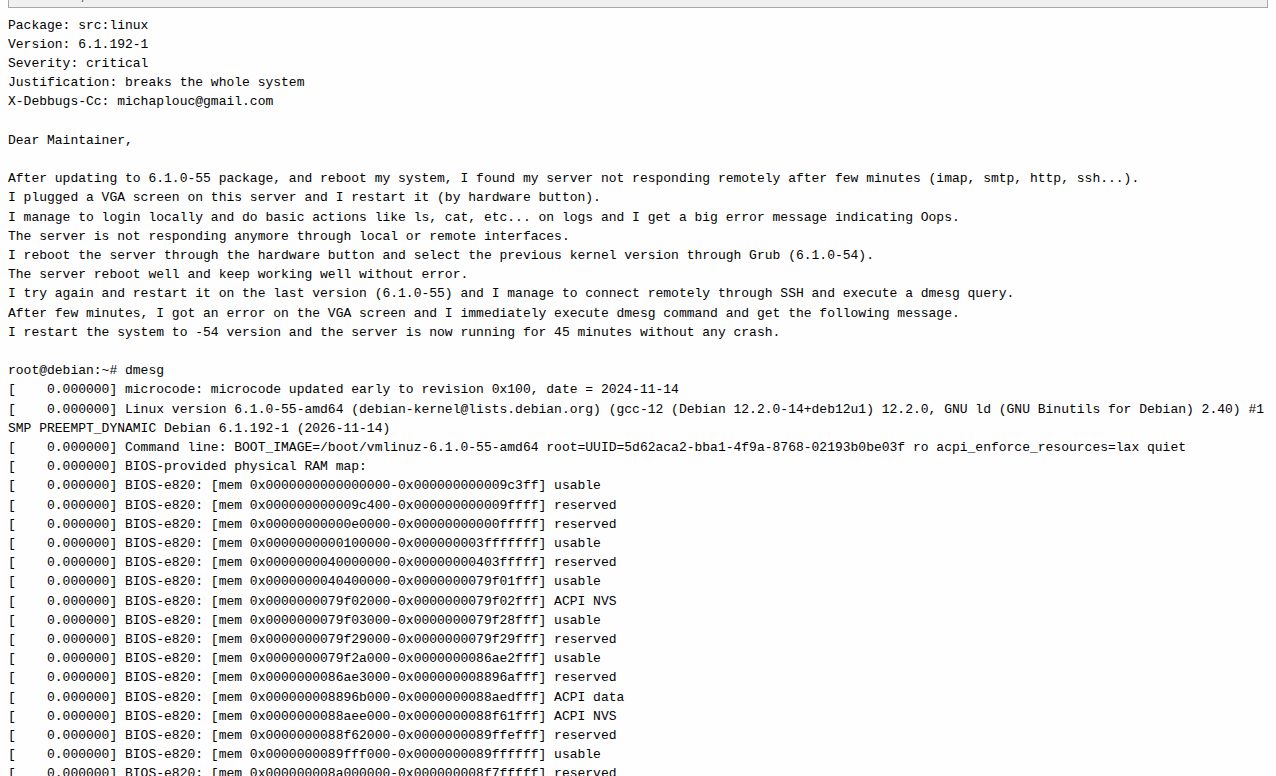
This image shows the initial dmesg logs provided by the reporter to document the system's behavior during the boot sequence.
These logs provide further diagnostic evidence regarding the kernel's behavior following the update.
Scope and Impact
This issue is classified as critical because it breaks the entire system's availability. It affects users running the 6.1.0-55-amd64 kernel, which may be utilized in various Debian configurations, including those using backported kernels on older stable releases.
The primary limitation of the current report is the lack of a specific root cause analysis. While the 'Oops' confirms a kernel-level failure, the exact code path or hardware interaction causing the freeze remains under investigation by the Debian Kernel Team.