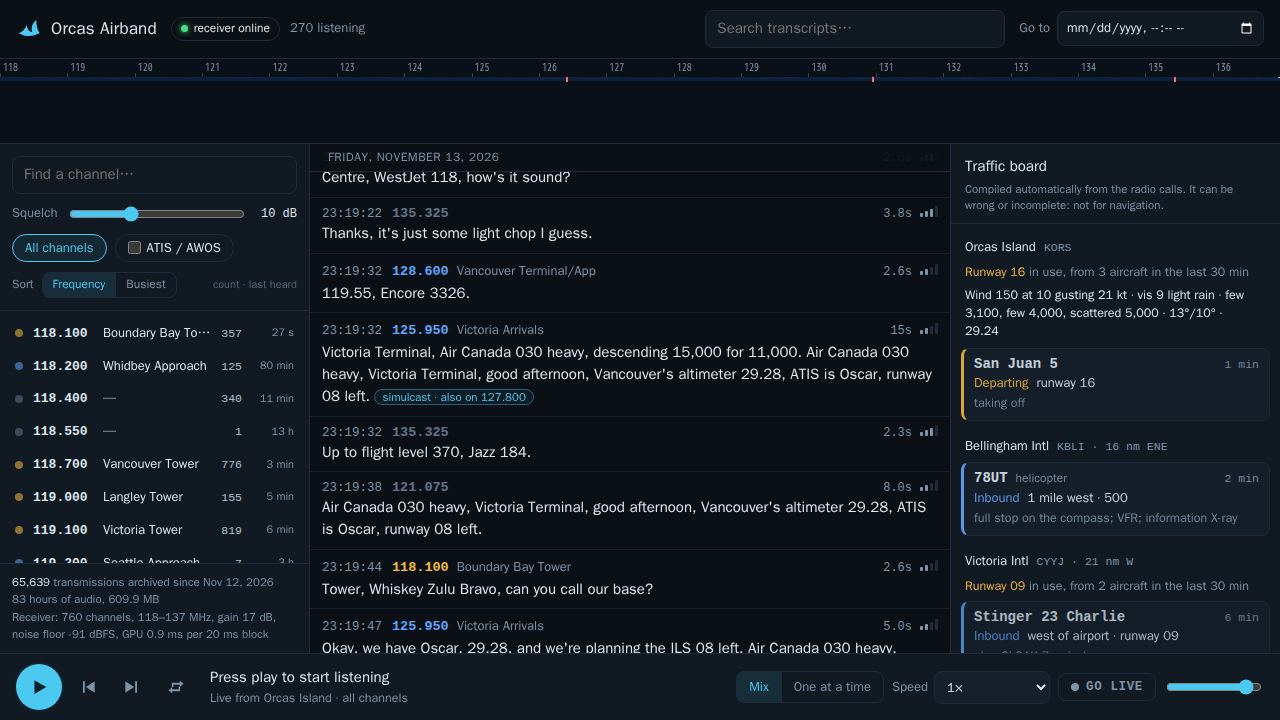
During a recent ground stop in the San Juan Islands, a custom-built aviation monitoring system provided pilots with a real-time situational awareness picture of the airspace. Developed by user mmaunder, the system captures the entire airband simultaneously to help pilots monitor chatter regarding communication issues and alternate flight plans.
System Architecture and Data Pipeline
The hardware foundation consists of an ETTUS B210 Software Defined Radio (SDR) connected to a dual NVIDIA 4090 GPU box. This setup allows the system to act as a polyphase channelizer, taking in the entire airband and using CUDA code to process the data on the GPU.
The software pipeline demodulates the signals, detects active transmissions, and automatically discards data transmissions. The remaining voice traffic is fed through a voice model created by the developer for transcription.
Once transcribed, a separate Large Language Model (LLM) reads the text to create a situational awareness picture of the airspace. The developer expressed interest in open-sourcing this setup for others with high-quality SDRs and local GPU machines.
Real-World Application During Ground Stops
The system's utility was highlighted during a recent ground stop in the San Juan Islands. It allowed pilots to monitor specific chatter regarding communication issues and the development of alternate plans for flights unable to proceed to their destinations.
For example, the system captured a 2151Z interaction on the 134.800 Vancouver Centre frequency. In the transcript, a pilot discussed an alternate plan because they could not show a reason why they were out of communication with Seattle.
While the system provides a valuable overview, the developer notes that the compiled traffic board can be wrong or incomplete and is explicitly not intended for navigation purposes.
Signal Quality and Listener Perspectives
Commenters on Hacker News discussed the difficulty of understanding garbled transmissions. One commenter, writing as plipt, observed that they could barely understand 50% of the transmissions, highlighting the skill required by professionals to interpret the audio.
Another commenter, keito, explained that these recordings are often weaker than what is heard in a cockpit or by Air Traffic Control (ATC). This is due to the clear line-of-sight pilots have to ground transmitters and the specialized receivers ATC uses to cover their specific areas.
A commenter named ultrarunner added that discerning nuance in these transmissions is a learned skill. They suggested that with experience, listeners can automatically identify the three most common types of information based on the context of the conversation.