Created by Marko Maček in 1997, IceWM is a stacking window manager for the X Window System designed to provide a 'good look and feel' without sacrificing system performance. By utilizing C++ for its core architecture, the project maintains a low memory and CPU footprint, making it an enduring choice for users who prioritize efficiency over modern, resource-heavy desktop environments.

This image illustrates the 'good look and feel' of the IceWM stacking window manager and its integrated taskbar.
Core Design and Resource Efficiency
The primary goal of IceWM is to provide a desktop experience that does not get in the user's way. It achieves this by maintaining a relatively low usage of both memory and CPU, which allows it to run smoothly on a wide variety of hardware configurations.
Unlike many modern desktop environments that rely on heavy compositing layers, IceWM focuses on speed and simplicity. This efficiency makes it particularly suitable for older machines or low-power devices like the Raspberry Pi.
“The goal of IceWM is speed, simplicity, and not getting in the user’s way.”
— IceWM
Customization and Themeability
IceWM is highly themeable, allowing users to change the visual appearance through a collection of settings and small images. The project supports a vast library of themes, including those that replicate the aesthetics of Windows 7 and OS/2.
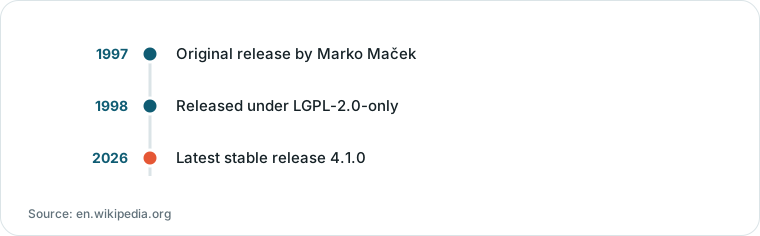
Chart drawn by HN Digest from figures reported by en.wikipedia.org; values are shown as written in the source.
Configuration is managed through plain text files located in the user's home directory. This approach allows users to easily copy, share, and modify their desktop setups without needing complex graphical configuration tools, though external GUI programs are available for those who prefer them.
Integrated Features and Distribution Support
The window manager comes with several built-in features, including a taskbar with a dynamic start menu, a task list window, and an Alt+Tab task switcher. It also supports multiple workspaces and various focus models that can be selected via a menu.
Because of its lightweight nature, IceWM has been adopted as the default graphical interface for several Linux distributions, such as Absolute Linux and antiX. It also serves as the default lightweight GUI for openSUSE on Raspberry Pi 3 hardware.
Technical Limitations and Scope
While IceWM provides a robust and efficient environment, it is primarily a stacking window manager for the X Window System. Users seeking modern Wayland-based compositors or complex, high-level desktop abstractions may find its minimalist approach to be a trade-off.
The sources do not provide specific performance benchmarks comparing IceWM to contemporary lightweight managers like Openbox or Sway, leaving the exact performance delta on modern high-resolution displays as an area for user exploration.
What Hacker News readers are saying
- Experience: One commenter shared their experience using IceWM as a low-resource desktop environment for a headless remote desktop system, noting that its out-of-the-box configuration of the panel and menu is a major benefit. comment ↗
- Experience: A user who worked for a commercial Linux distribution in the mid-2000s recalled using IceWM as a default desktop because it ran well on a wide variety of customer machines. comment ↗
- Skeptical: One commenter argued that modern performance issues are often an excuse for sloppy programming, suggesting that CPU and RAM have actually progressed much faster than the growth of screen resolution. comment ↗
Summarized opinions from the Hacker News thread, not verified facts. Read the full discussion ↗