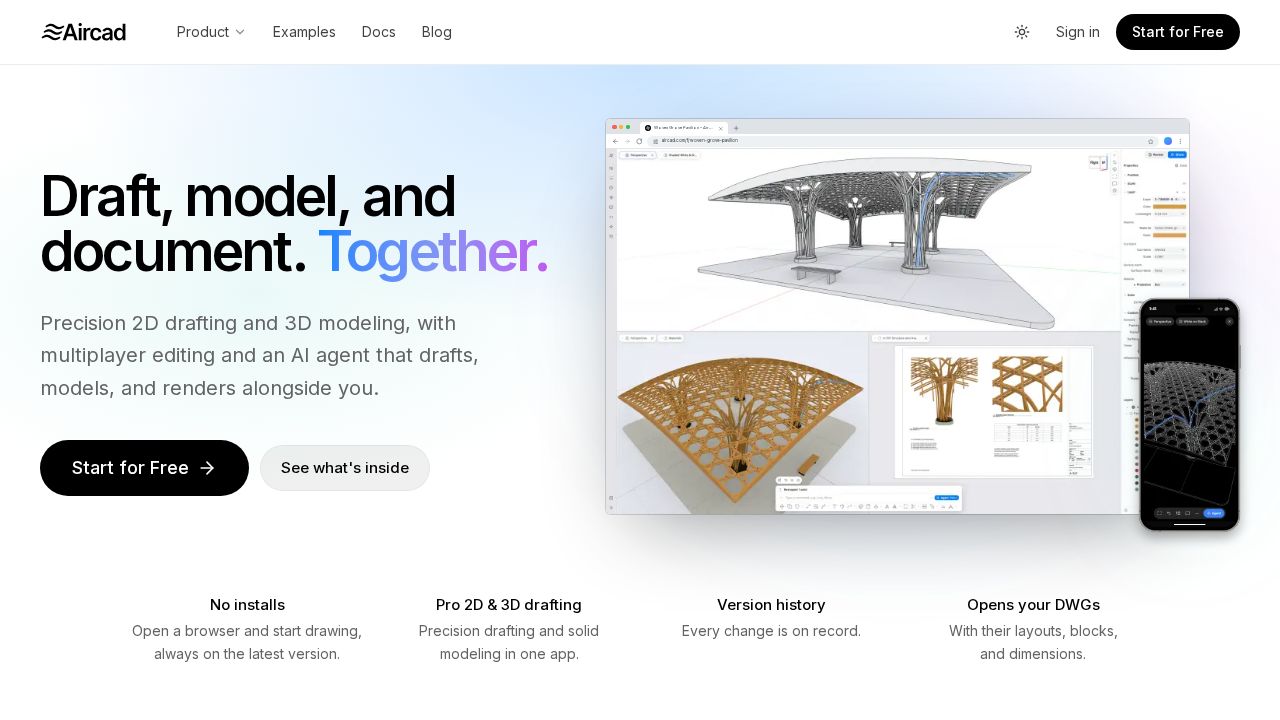
Aircad has launched a professional CAD system that allows users to perform complex drafting and 3D modeling directly in a web browser without the performance degradation typically associated with cloud-based tools. By utilizing a C++ engine compiled to WebAssembly, the platform executes geometry operations entirely on the client side, enabling it to handle high-density models that would otherwise require server-side processing.
Core Architecture and Performance
The system is built on the OpenCASCADE (OCCT) kernel, which provides the foundation for booleans, fillets, and STEP file support. To overcome the performance bottlenecks of the standard OCCT mesher at scale, the developers implemented custom algorithms for hidden line rendering and tessellation.
By running the C++/WASM engine on a single thread that owns the model, selection, and WebGL2 renderer, Aircad avoids the overhead of copying data back and forth between different components. This architecture, combined with multithreading and SIMD optimizations, allows the software to maintain responsiveness even during complex operations.
Collaboration and AI Integration
Aircad addresses the 'fragile' nature of traditional CAD collaboration by integrating version history and forking directly into the platform. This approach aims to keep design artifacts connected to their source files, unlike many existing workflows that rely on separate, file-based exports like PDFs.
The platform also features a built-in AI agent and a comprehensive scripting API. Users can leverage the AI to write new scripts and commands, allowing for the creation of repeatable, shareable workflows that can perform complex modeling operations more efficiently than manual interface interactions.
Hacker News Discussion and Community Feedback
In the Hacker News discussion, the poster (peetle) clarified that the system supports 3D printing workflows through the import and export of STL and OBJ file formats. He noted that the software is a general solid modeler where users can convert models into meshes for manufacturing.
Commenters on Hacker News discussed the technical limitations of existing kernels, with one user (YuechenLi) noting that many browser-based projects wrap OCCT WASM but face issues with per-entity tolerance. Another commenter (brudgers) expressed caution regarding the software's reliability for high-stakes industrial use, suggesting that established tools like AutoCAD remain the standard for mission-critical projects.