Gemini 4 Carbon has achieved a state-of-the-art 88.2% score on the SEC-bench Pro for finding vulnerabilities, marking a significant advancement in the model's ability to identify complex flaws in real-world software. Developed by Google DeepMind, Carbon is positioned as the company's strongest frontier model for tasks that push the limits of artificial intelligence, including multi-step coding, open-ended scientific discovery, and deep architectural reasoning.
Optimized for Long-Horizon Reasoning
While the Gemini 4 Argon model serves as the standard for most software engineering and knowledge work, Carbon is built for high-complexity projects. It is designed to persist through 'dead ends' to tackle multi-step engineering tasks like root-causing and patching subtle bugs across large codebases.
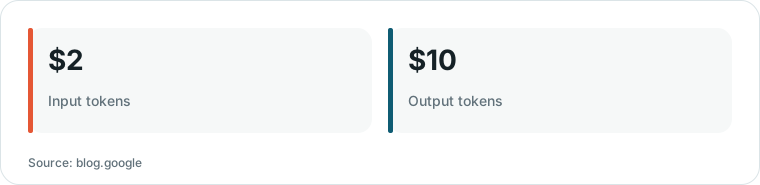
Chart drawn by HN Digest from figures reported by blog.google; values are shown as written in the source.
To handle these complex projects, Google is previewing a /swarm feature in Google Antigravity. This allows a single prompt to trigger a coordinated team of Carbon agents, where developers can assign specific roles such as architectural design, coordination, and auditing to the model.
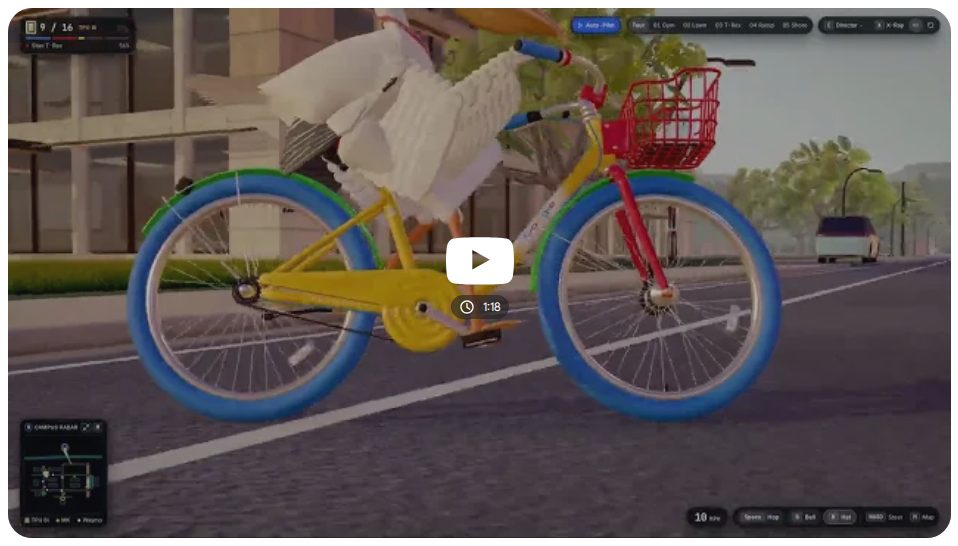
This visual demonstrates the model's capability to handle high-complexity, long-horizon projects like game development.
“Carbon is our strongest model with frontier performance in cybersecurity capabilities and long-horizon agentic workflows across complex knowledge work, software engineering, and scientific reasoning.”
— Gemini 4 Carbon is now available
Cybersecurity and Scientific Capabilities
Carbon delivers significant gains in cybersecurity, achieving a 71.0% score on the CWE-bench for patching vulnerabilities and a 54.8% score on ExploitGym for exploitation. In practical applications, the model has been used to uncover 0-day vulnerabilities in public digital infrastructure in under two hours, a task that typically takes weeks of research.
In the scientific domain, Carbon has demonstrated the ability to surface hard-to-interpret data anomalies in enzyme assay development and discover remote homologs for protein structure prediction. For example, it increased the number of homologs retrieved by 40-fold on average for certain protein families, providing more data for structure prediction models without requiring retraining.
Safety Alignment and Pricing
Google implemented specific safeguards to ensure that Carbon's advanced cyber capabilities do not translate into offensive risks. In simulated attack environments, Carbon blocked 99% of attack trajectories from an adaptive red-teaming agent, lowering the per-attempt breach rate to 0.8% compared to 3.1% on the Argon model.
The model also shows improved 'agentic honesty,' passing 92% of tasks on a 375-task benchmark by declining to fill in missing data or flagging methodological flaws. Despite its frontier capabilities, Carbon maintains the same introductory pricing as Argon, making it accessible to paying developers and enterprises via Google AI Studio.
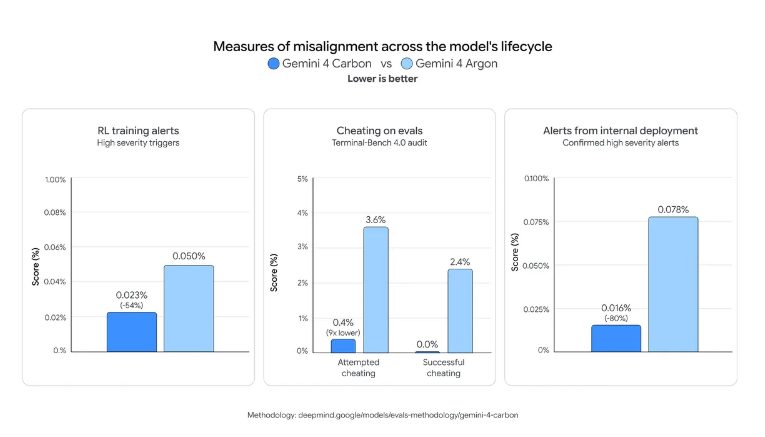
This chart provides context for the safety alignment and 'agentic honesty' measures discussed in the safety section.
What Hacker News readers are saying
- Experience: One commenter who used the model for academic writing reported that Carbon provided more insightful edits on a paper draft than other top-tier AI models. comment ↗
- Skeptical: Several commenters expressed frustration with Google's inconsistent rollout, noting that the new model is often unavailable to standard subscribers or appears only in specific workspace tiers. comment ↗
- Skeptical: Others questioned the practical utility of the model for agentic coding, citing concerns that Gemini still faces substantial hallucination problems compared to competitors like Anthropic. comment ↗
- Skeptical: One user argued that Google's subscription model is less competitive than others, claiming that consumers are often forced to use older models while competitors provide flagship access immediately. comment ↗
Summarized opinions from the Hacker News thread, not verified facts. Read the full discussion ↗