Meta's new Muse Ember model can match the performance of Claude Haiku 5.5 at approximately one-third of the cost, positioning it as a high-efficiency option for 'agentic' workflows. Designed specifically for repeatable tasks such as tool calls, routing, and long document parsing, the model aims to provide high intelligence per dollar for developers building automated systems.

This abstract illustration serves as the primary visual for the Muse Ember announcement, representing the model's role in complex agentic workflows.
Efficiency on the Frontier
Muse Ember is engineered to sit on the 'efficiency frontier' of the Artificial Analysis leaderboard, meaning no other model currently scores higher for less cost per task. In testing, it demonstrated a superior balance of intelligence and price compared to both Claude Haiku 5.5 and GPT-6 Luna across various reasoning settings.
The model is priced at $0.10 per million input tokens and $0.50 per million output tokens. These costs are intended to facilitate 'subagent' work, where a larger model delegates smaller, structured steps to a faster, cheaper foundation.
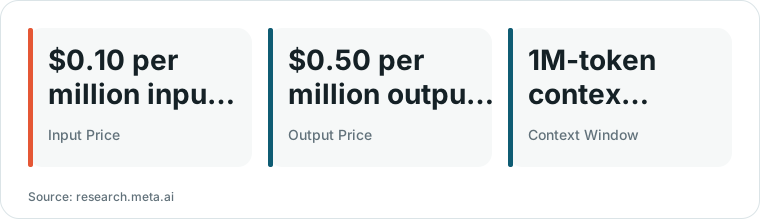
Chart drawn by HN Digest from figures reported by research.meta.ai; values are shown as written in the source.
Meta estimates the cost of Muse Ember at roughly $0.14 per Artificial Analysis task, a price point intended to make it accessible for high-volume production use across various products.
“Muse Ember delivers more intelligence per dollar than Claude Haiku 5.5 or GPT-6 Luna at any reasoning setting: it matches Haiku's best score at about a third of the cost and beats every Luna setting.”
— Introducing Our Smallest, Most Efficient Model: Muse Ember
Performance in Coding and Automation
In coding benchmarks, Muse Ember showed significant advantages in latency and token efficiency. For example, in testing by You.com, the model completed coding quests with a p95 latency of 2.2 seconds, which was 4x to 13x faster than leading open-weight models while using 36–48% fewer output tokens.
The model also excelled in automation benchmarks, scoring 37.8% on AutomationBench-AA, nearly double the score of Claude Haiku 5.5 (13.9%). This makes it a candidate for end-to-end business workflows, such as screening candidates against detailed briefs or scoring contracts against negotiation playbooks.
The model is built for the specific coding subtasks an agent sends off hundreds of times a session, such as reading files, running tests, and making targeted fixes.
Safety and Deployment Limits
Meta evaluated Muse Ember under its Superintelligence Scaling Framework, covering risks such as cybersecurity and loss-of-control. The model remained below high-risk thresholds and received the same core safety training as Meta's larger frontier models.
Despite its efficiency, Muse Ember is not intended to be a general-purpose replacement for the most difficult reasoning tasks. Meta's strategy involves a tiered approach: Muse Wonder handles the hardest problems, while Muse Ember manages the high-volume, repeatable tasks that agents perform throughout a session.
Evidence Boundaries
While the primary source highlights Muse Ember's efficiency and performance in coding and automation, it does not explicitly confirm a 1M-token context window or native support for audio and video modalities in the provided text. These specific technical specifications remain unverified by the supplied documentation.
The source also notes that some evaluation results, such as those for OSWorld 2.1, are marked as 'partial' or 'binary,' indicating that certain performance metrics may have limitations in scope or scoring methodology.
What Hacker News readers are saying
- Alternative: One commenter noted that the model's performance did not seem to improve with more reasoning tokens, observing that the visual quality of the output remained similar across different effort levels. comment ↗
- Skeptical: One user suggested that the current scoring system for model refusals is flawed because it treats a refusal to perform a task the same as a lack of capability. comment ↗
- Experience: A commenter expressed a desire for Meta to release these models for local use to help build a user base while the company trails behind competitors. comment ↗
Summarized opinions from the Hacker News thread, not verified facts. Read the full discussion ↗