Canada has launched the Real-Time Rail (RTR), a national payment infrastructure designed to enable instant speed and settlement for transactions 24 hours a day, every day of the year. Managed by Payments Canada, the system provides a modern foundation for the national economy by allowing financial institutions, credit unions, and payment service providers to move money with real-time cash-flow visibility.

This photo depicts the key figures associated with the official launch of the Real-Time Rail system.
Modernizing National Payment Infrastructure
The Real-Time Rail (RTR) transforms how payments move across Canada by replacing traditional batch processing with instant settlement. By providing a shared technical language and infrastructure, the system allows participating members to exchange and clear payments securely without the delays associated with older banking channels.
The initiative is described as a 'made-in-Canada' platform designed to support a diverse economy, including small businesses, newcomers, and rural communities. It aims to provide a more dynamic and competitive digital economy by expanding choice and creating new opportunities for long-term growth.
“The launch of Canada’s Real-Time Rail lays the foundation for a more dynamic and competitive digital economy, driving innovation, expanding choice and creating new opportunities for Canadians while positioning our country for long-term growth.”
— Canada launches the Real-Time Rail, bringing 24/7 payment infrastructure to the national economy | Payments Canada
Economic Impact and Technical Standards
Economic projections from the C.D. Howe Institute suggest the RTR could generate $16 billion in economic gains, a figure expected to grow to $27 billion as new functionalities are introduced. These gains are driven by lower processing costs, reduced float—the period where funds are temporarily unavailable—and a decrease in the reliance on physical cheques.
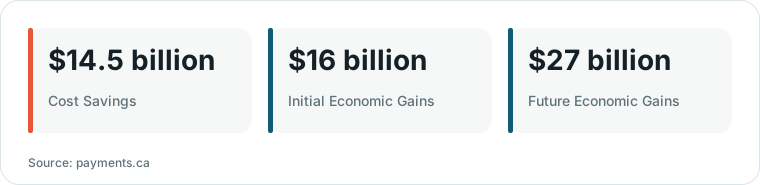
Chart drawn by HN Digest from figures reported by payments.ca; values are shown as written in the source.
Technically, the RTR leverages ISO 20022, a global standard for data-rich messaging. This shared technical language is intended to strengthen Canada’s economic sovereign autonomy while ensuring the system remains compatible with international standards for global competitiveness.
Security and Fraud Safeguards
To mitigate risks associated with instant payments, Canada is the first G7 country to implement mandatory centralized fraud services at launch. These services act as a coordinated layer of defense alongside the existing fraud controls of individual participating institutions.
Specific security measures included at launch consist of a 'confirmation of payee' service for consumer accounts, a fraud transaction 'safety' score, a repository of fraud risks and indicators, and a dedicated fraud reporting and intelligence platform.
Rollout Strategy and Participation
The initial cohort of participants includes a mix of fintechs and financial institutions, such as Wealthsimple, Questbank, and Bank of America. While the launch features a specific group of active members, the rollout is designed to scale rapidly to include all major Canadian financial institutions.
The Bank of Canada will oversee the system to ensure it operates safely and reliably. While the system is expected to be available to more than nine in 10 Canadians within the first year, the specific timeline for the full onboarding of all major banks remains a sequenced part of the rollout.
What Hacker News readers are saying
- Technical note: One commenter clarified that the system is intended for financial institutions to settle transactions rather than for direct consumer use. comment ↗
- Skeptical: A commenter expressed skepticism regarding the system's impact, arguing that it lacks the network effects of systems like Brazil's Pix because the initial participants are small players. comment ↗
- Experience: One user shared their experience with current systems, noting that security measures can sometimes render mobile transfers unusable for those on certain operating systems, forcing a return to paper cheques. comment ↗
- Alternative: Another commenter pointed out that blockchain networks like Solana or Stellar could serve as global alternatives for 24/7 low-fee transfers, unlike a domestic-only rail system. comment ↗
Summarized opinions from the Hacker News thread, not verified facts. Read the full discussion ↗