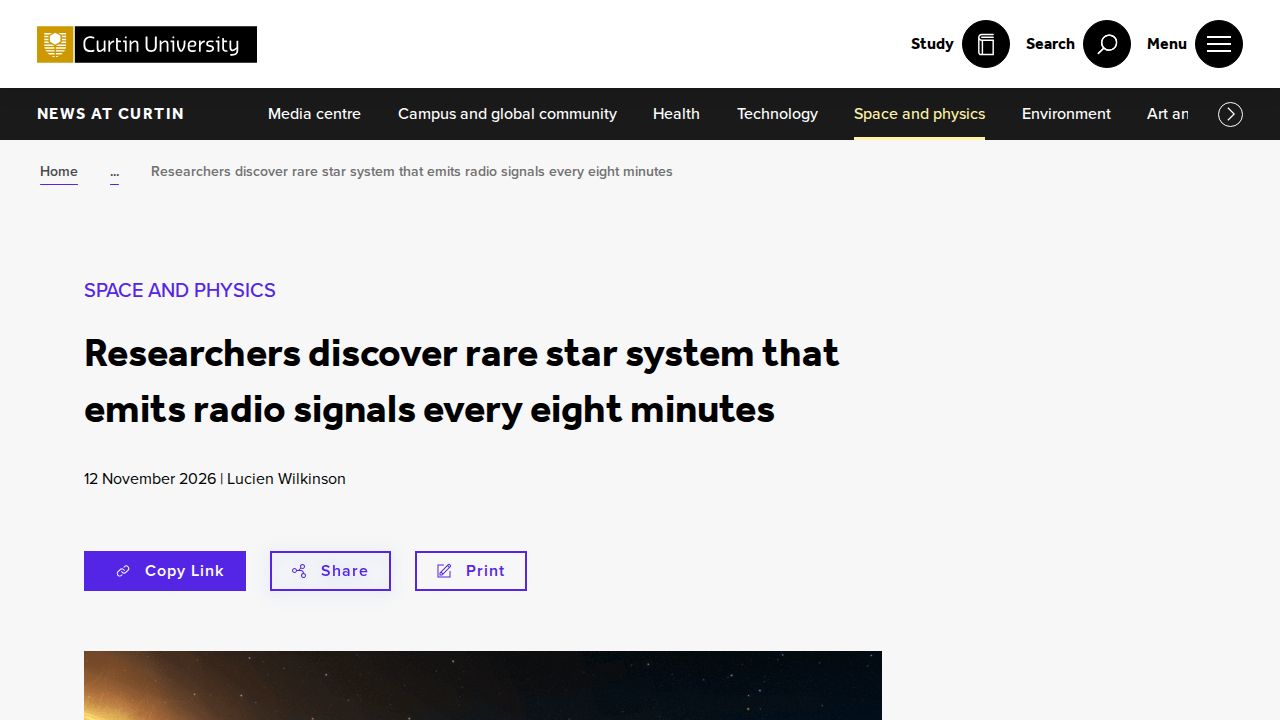
A rare star system has been identified that emits radio signals at a regular eight-minute interval, a discovery that highlights the diversity of celestial phenomena. While the periodic nature of the signals might resemble a deliberate transmission, researchers and observers note that the behavior is consistent with a rotating celestial body emitting a directed beam of radiation.
The Nature of the Periodic Signal
The primary source reports the discovery of a star system that emits radio signals every eight minutes. However, commenters on Hacker News clarified that the system likely emits a constant radio beam that only appears to pulse because it periodically aligns with our viewing cone.
This mechanism is similar to a lighthouse; the beam is steady, but the rotation of the star causes it to sweep across Earth's position at regular intervals. One commenter, writing as sandworm101, noted that this creates a linguistic tension where a 'star' can be defined as either a point of light in the sky or a physical object emitting a beam as it rotates.
Astrophysical Context and Classification
The eight-minute pulse is categorized as a 'long-period transient.' Commenters on Hacker News pointed out that this is a relatively slow rotation compared to pulsars, which can rotate at frequencies as high as 716Hz.
The system's composition likely involves a red or white dwarf that was captured by another star. Commenters, such as metalman, suggested that such a capture event would likely 'wreck havoc' on any original planets in the system, making the existence of stable, habitable environments less likely.
Natural Phenomenon vs. Organic Intent
The regularity of the eight-minute interval serves as a key indicator of the signal's origin. One commenter, Kuyawa, argued that a fixed interval would instantly label the signal as a natural phenomenon rather than an organic transmission.
If the signal were of organic intent, a random interval might be more likely to avoid immediate identification as a natural process. The discussion highlighted the immense energies involved in these systems, noting that such phenomena are governed by complex astrophysical forces rather than technological ones.