Nick Popovich, a veteran of the 'super repo' industry, has repossessed over 1,300 jumbo jets in a career defined by high-stakes recoveries from 'corrupt landowners' and 'fat cats' with thinning balance sheets. Unlike standard vehicle repossession, these operations involve retrieving assets like Gulfstreams and 747s—which can cost up to $260 million—from hostile environments ranging from jungle hideouts in South America to guarded airfields in the United States.
Operational Tactics and Expertise
A successful recovery requires a hybrid skill set of a cat burglar, F.B.I. agent, and con artist. Agents must be capable of flying aircraft in extreme conditions, such as navigating a plane at night with zero electricity and no lights.
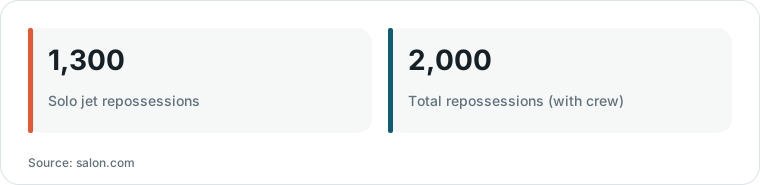
Chart drawn by HN Digest from figures reported by salon.com; values are shown as written in the source.
In some cases, recovery teams hire SWAT teams to secure the asset. Others, like mechanic Kevin Lacey, may pose as maintenance workers to gain access to a plane's cockpit and avionics before attempting to fly it out.
Economic Drivers and Logistics
The demand for these services spikes when the 'easy credit' of the previous decade dries up, leading to a downward spiral for high-rollers who splurged on luxury toys. When a debtor misses payments, the bank initiates a process to recover the collateral, often leading to a multi-month game of hide-and-seek.
The logistics of these jobs can be massive; for example, one operation involved moving a fleet of 240 corporate helicopters from 51 different locations across the country within a 24-hour window.
Physical Risks and Legal Conflict
The profession is inherently dangerous. Agents have faced armed militias, been jailed in Haitian prisons, and dealt with 'nasty-looking thugs' wielding shotguns during airfield retrievals.
The industry also faces internal legal friction regarding the commercialization of these stories. Popovich filed a lawsuit against a journalist, alleging that the sale of his business secrets to a film studio 'destroyed the marketability and value' of his life story rights.
Uncertainties and Limitations
While the source material details the high-value nature of these retrievals, it does not provide specific data on the success rate of these missions or the exact percentage of repossessed assets that are successfully returned to the bank versus those that are stripped for parts.
Discussion Digest
The original post by Marc Weingarten describes the life and work of Nick Popovich, a 'super repo man' who specializes in recovering high-value aircraft from high-profile debtors. Weingarten details Popovich's history, including his time as a pilot and his experiences facing armed militias and imprisonment in Haiti.
Commenters on Hacker News discussed the extreme nature of the work, with one commenter noting that the story was not the only outcome of the interview. Another commenter suggested reading about Max Hardberger, who recovers cargo ships from pirates. A third commenter shared an anecdote about a sheriff's officer who was locked in the bridge of a supertanker for three days to prevent it from leaving after a lien was obtained.
One commenter pointed out a potential mathematical inconsistency in the article regarding Popovich's age and his start date as a pilot, noting that the timeline would imply he was flying commercial jets at age six.
What Hacker News readers are saying
- Alternative: One commenter suggested a similar real-world example involving the recovery of stolen cargo ships from pirates in various international waters. comment ↗
- Experience: A commenter shared a family anecdote about a sheriff's officer who spent three days on a supertanker to secure a lien for unpaid harbor fees. comment ↗
- Skeptical: One commenter expressed skepticism regarding the feasibility of quickly operating an unfamiliar aircraft, noting that different jet types require specific, extensive preparation. comment ↗
Summarized opinions from the Hacker News thread, not verified facts. Read the full discussion ↗