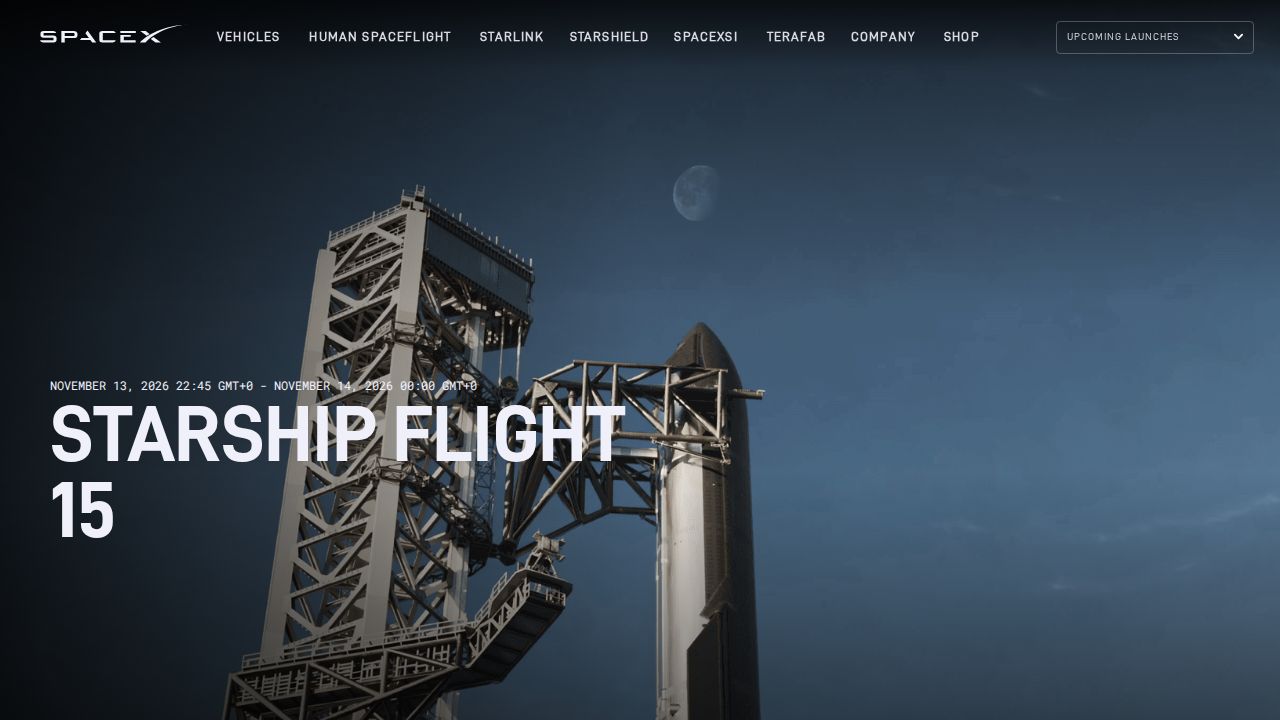
SpaceX is preparing to attempt the first full recovery of an orbital launch system by catching both its Super Heavy booster and the Starship spacecraft at the launch site during Flight 15 on November 13, 2026. If successful, the mission will demonstrate a critical capability for the company's long-term goal of rapid, low-cost space access through a fully reusable fleet.
Mission Objectives and Recovery Plan
The upcoming flight is planned to be the first to return both Starship and Super Heavy to the launch site for a catch. According to the mission plan, the launch window is set for November 13, 2026, pending regulatory approval.
Coverage of the flight is planned to continue through the ship catch, with the potential for hours of live views from Starship as it orbits Earth. The recovery process utilizes the same 'chopsticks' hardware for both the booster and the ship, as noted by commenters on Hacker News.
A successful catch would mark the first full recovery of an orbital launch system. This milestone is intended to demonstrate the viability of SpaceX's reusable architecture for frequent orbital missions.
Payload Capacity and Testing Strategy
Flight 15 is scheduled to carry 26 Starlink v3 satellites. Commenters on Hacker News observed that this represents approximately 52t of payload, which is roughly half of the ship's advertised 100t capacity.
There is community discussion regarding why the ship is not fully loaded. One commenter, writing as tristanj, suggested that a lower payload might provide more options in engine-out situations or serve as a de-risking strategy for a program still characterized as testing.
Another perspective offered by commenters suggests that the ship's current dispenser configuration may only fit 26 satellites, and increasing this capacity would require hardware modifications that could delay the flight schedule.
Competitive Landscape and Technical Trade-offs
The successful recovery of both components is seen by some commenters as a move that could give SpaceX an 'astonishing lead' over competitors. Some participants in the discussion noted that while critics have long argued that Starship would not work, the system is now demonstrating operational capabilities.
Technical trade-offs remain a point of discussion, particularly regarding the duration of the ship's orbit. One commenter, writing as xixixao, noted that the planned 22-hour coasting period is significantly longer than previous flights, raising questions about potential issues with propellant boil-off.
The mission remains dynamic, and the schedule is subject to change based on regulatory approvals and real-time testing results.
Uncertainties and Technical Constraints
While the mission plan is public, specific technical details regarding tower arm configurations for ship catches versus booster catches remain unconfirmed in the provided sources.
The exact reasons for the partial payload load remain speculative. While some suggest it is a de-risking measure to limit variables during testing, others argue that the value of the launch capacity might outweigh the risk of losing a smaller number of satellites.