A small business providing appointment services to local contractors saw its Stripe account closed after a single $1,500 invoice was blocked. Despite providing company documents and an appeal letter, the company was told the decision was final because their business model presented an 'unacceptable level of risk.'
The Incident and Stripe's Response
The business owner reported that their first client agreed to a service via a recorded call and saved a card through a $1 Stripe payment link. When the business later attempted to charge the saved card for $1,500 for three completed appointments, Stripe blocked the payment.
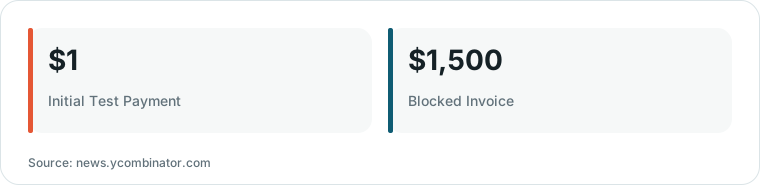
Chart drawn by HN Digest from figures reported by news.ycombinator.com; values are shown as written in the source.
Following the block, the account was closed within two days. The owner attempted to appeal by submitting company documents and the invoice, but Stripe rejected the appeal, stating the business model presented a level of risk they were unable to support.
The owner noted that Stripe refused to review primary evidence, such as the recorded call with the client or messages with the customer, and maintained that the decision was final even after an internal escalation by a Stripe employee.
“Support told us our "business model presents a level of risk we're unable to support" and that the decision is final.”
— Ask HN: Stripe closed us after one $1,500 invoice and never asked for evidence
Fraud Detection and Pattern Matching
Commenters on Hacker News pointed out that the specific transaction sequence—a small initial payment followed by a significantly larger charge—is a classic pattern used by criminals to test stolen credit card numbers. This pattern often triggers automatic rejections from both banks and payment processors.
One commenter suggested that the business model might resemble patterns used by high-risk industries, such as escort services, which can make it difficult for automated systems to distinguish between legitimate and fraudulent activity. Another user noted that the business might have been able to avoid this by using 'off-session' payment configurations, which are designed for charges made when the customer is not actively present in the checkout flow.
Community Advice and Alternatives
To avoid similar issues, some commenters suggested using Stripe's native invoicing system, which can provide more flexibility and better verification. Others recommended moving to payment processors that specialize in 'high-risk' accounts, such as Paykings, to ensure more stable service for non-traditional business models.
The discussion also touched on the perceived decline in customer support from large platforms. One commenter, writing as breue, claimed that Stripe had become a 'ruthless/soulless company' that no longer provides meaningful support to its long-term customers or small businesses.