A new Internet-Draft proposes the addition of HTTP status code 483, titled "I'm Not a Freezer," to clarify the boundary between digital instructions and physical temperature-control operations. The draft addresses a specific ambiguity where a server might receive a request intended for a refrigeration appliance—such as a command to freeze food—but lacks the physical capability to perform the task. By providing a specific error code, the proposal aims to prevent clients from repeating requests, selecting incorrect fallback services, or mistakenly placing perishable goods near standard computing equipment.
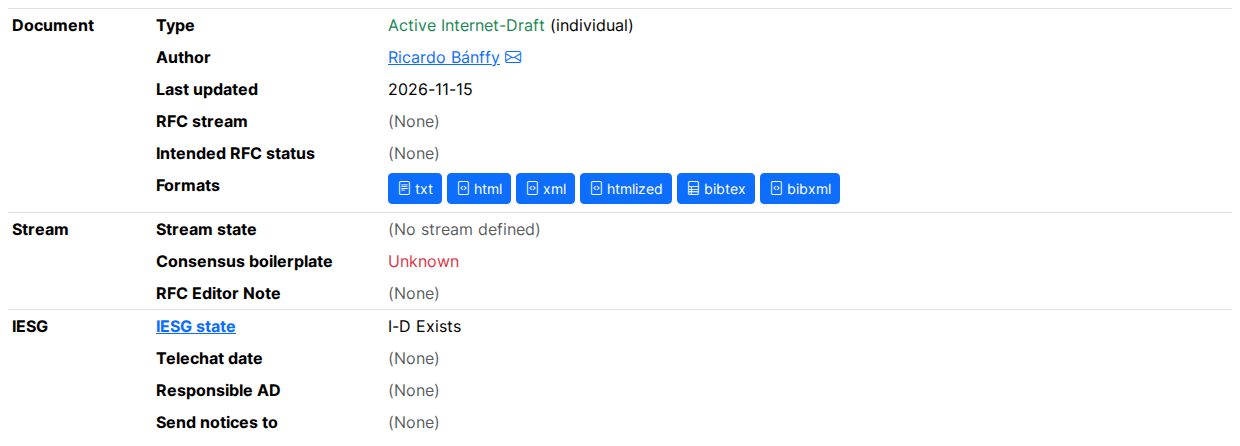
This table provides the formal definitions and parameters for the proposed 483 status code.
Defining Physical vs. Digital Cold
The draft establishes strict definitions to ensure the status code is not misused for software states. A 'freezer' is defined strictly as an apparatus capable of maintaining contents below the freezing point of water for a sustained period.
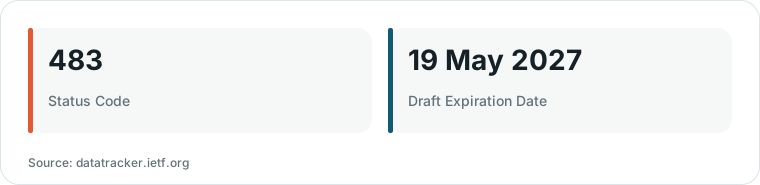
Chart drawn by HN Digest from figures reported by datatracker.ietf.org; values are shown as written in the source.
Conversely, the document clarifies that software containers, frozen software processes, and online services advertising 'cold storage' (such as offline cryptographic wallets or infrequently accessed data) do not qualify as freezers. This distinction ensures that 483 remains a hardware-capability indicator rather than a software-state indicator.
“A server returns this status code when it understands a request that requires freezing or refrigeration capabilities but is not capable of providing those capabilities.”
— The Hypertext Transfer Protocol Status Code 483 (I'm Not a Freezer)
Mechanisms for Status Code 483
A server may return a 483 response only when it can parse and understand a request that requires a physical temperature-control operation, but the server itself lacks that capability. For example, an HTTP-controlled kitchen appliance might receive a request to freeze food; if the specific server handling the request is not a freezer, it should return 483.
The draft specifies that the response should include a plain-text representation explaining the lack of refrigeration capability and, where possible, identifying a freezer-capable alternative. It also instructs clients not to interpret a 483 response as evidence that the server is a refrigerator, as the code only communicates a lack of freezer capability.
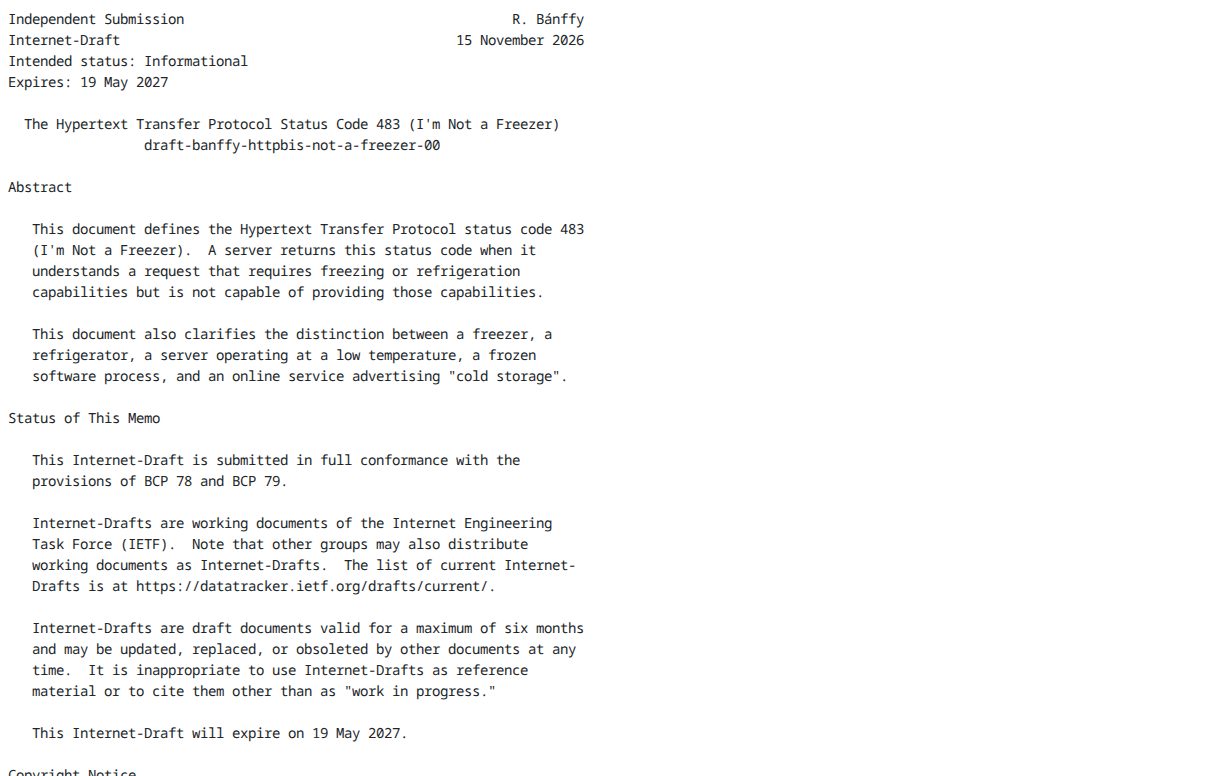
The draft specifies how the response should be structured to communicate a lack of refrigeration capability.
Intermediaries and Caching
The proposal includes specific rules for intermediaries and caching to maintain the integrity of the 'cold chain.' Intermediaries are prohibited from replacing a 483 response with a success message unless they have successfully arranged for a freezer-capable service to perform the task.
Regarding caching, a 483 response is not heuristically cacheable. While it can be cached if explicit freshness information is provided, the draft suggests using short freshness lifetimes because a server's freezer capability might change through hardware repair, relocation, or appliance discovery.
Limitations and Status
As an Internet-Draft, this proposal is a 'work in progress' and does not currently have formal standing in the IETF standards process. It is intended for informational use and will expire in May 2027.
One unresolved question involves the classification of the error: while the draft treats 483 as a functional response to a request, some observers have questioned whether it should be categorized as a client error (4xx) or a server error (5xx) since the server's lack of freezer capability is an inherent property of the hardware.
What Hacker News readers are saying
- Alternative: One commenter suggested that instead of a new code, the existing 418 status could be extended with a header to specify what the server is not. comment ↗
- Skeptical: A commenter expressed concern that a new status code could be exploited by attackers to deter requests, which would make the indicator meaningless. comment ↗
- Skeptical: Another user argued that the proposal creates ambiguity, as listing multiple things a server is not might lead a receiver to assume it is one of those things. comment ↗
- Skeptical: One reader pointed out that the proposal is derivative of the 418 Teapot joke and appeared to be generated by AI. comment ↗
Summarized opinions from the Hacker News thread, not verified facts. Read the full discussion ↗