Approximately 64% of cloud environments currently host resources vulnerable to CVE-2026-119618, a critical race condition in the Apache HTTP Server's HTTP/2 module (mod_http2). This flaw allows remote, unauthenticated attackers to trigger heap memory corruption, potentially granting them the ability to execute arbitrary commands with the same privileges as the web server process.

This screenshot provides a clear reference for the specific versions of Apache HTTP Server (2.4.55 through 2.4.70) and mod_h2 builds that are affected by the vulnerability.
Mechanism of the Heap Corruption
The vulnerability, identified as CVE-2026-119618, stems from a concurrent execution race condition. When the mod_http2 module handles shared resources, the assign_headers() function fails to properly synchronize threads, leading to memory corruption.
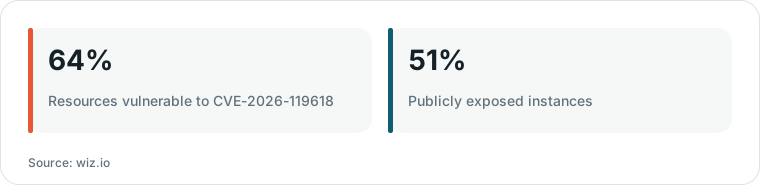
Chart drawn by HN Digest from figures reported by wiz.io; values are shown as written in the source.
By exploiting this lack of synchronization, an attacker can corrupt the heap memory of the hosting server. This memory corruption is a high-severity flaw because it serves as a direct path to Remote Code Execution (RCE).
“If successfully exploited, a remote, unauthenticated attacker can corrupt heap memory to achieve arbitrary code execution (RCE).”
— Critical RCE Vulnerability in Apache HTTP Server: Everything You Need To Know | Wiz Blog
Cloud Environment Exposure
Data from Wiz suggests significant risk for cloud-based infrastructure. Because a compromised Apache instance can serve as an entry point, attackers may use the breach to move laterally into adjacent microservices or access cloud metadata endpoints.
The scale of the issue is notable: while 64% of cloud environments are vulnerable, more than half of those instances are publicly accessible, increasing the likelihood of successful exploitation by threat actors.
Remediation and Mitigation Steps
The primary fix involves upgrading the Apache HTTP Server to version 2.4.71 or newer. For those managing standalone mod_h2 builds from GitHub, the module must be updated to a version newer than 2.0.42.
If an immediate upgrade is not feasible, security teams can mitigate the risk by disabling HTTP/2 support entirely. This is achieved by editing the configuration file (e.g., httpd.conf) to remove h2 and h2c references, restricting the server to HTTP/1.1 only.
What Hacker News readers are saying
- Alternative: One commenter questioned the technical leap from memory corruption to remote code execution, suggesting that memory corruption alone does not always equate to a functional RCE. comment ↗
- Skeptical: A reader expressed skepticism regarding the accuracy of the report's metadata, questioning if the attribution of the module to GitHub was a result of automated content generation. comment ↗
- Technical note: Another commenter argued that controllable memory corruption can potentially lead to arbitrary actions or kernel-level access depending on the process's permissions. comment ↗
Summarized opinions from the Hacker News thread, not verified facts. Read the full discussion ↗