While some high-profile online surveys suggest that nearly 29% of work days in the United States are performed remotely, a closer examination of data collection methods and job feasibility suggests the actual figure is closer to 20%. This discrepancy highlights how 'online bias' and the practical limitations of specific industries can skew public perception of the remote work landscape.
The Gap Between Online and Offline Surveys
Different data collection methods yield significantly different results for remote work prevalence. The Survey of Working Arrangements and Attitudes (SWAA) and the Census Bureau’s Household Pulse Survey (CHPS) both report remote work rates near 29%.
In contrast, the Current Population Survey (CPS) reports only 14.3% of hours worked as remote. This discrepancy may stem from 'online bias,' where individuals who opt into online surveys systematically differ from the general population in their remote work habits.
The American Time Use Survey (ATUS), which covers the same sample of people as the CPS but asks them to report everything they have done in the past 24 hours, yields a more moderate 19.8% remote work rate.
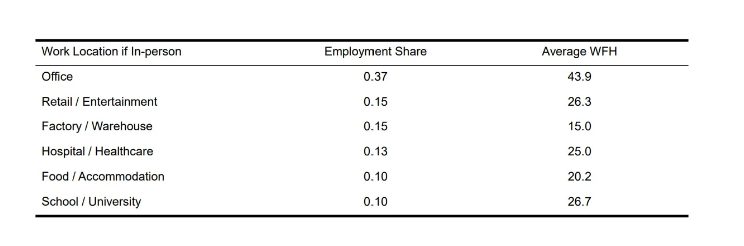
This screenshot captures the primary data visualization used in the source article to contrast different survey results.
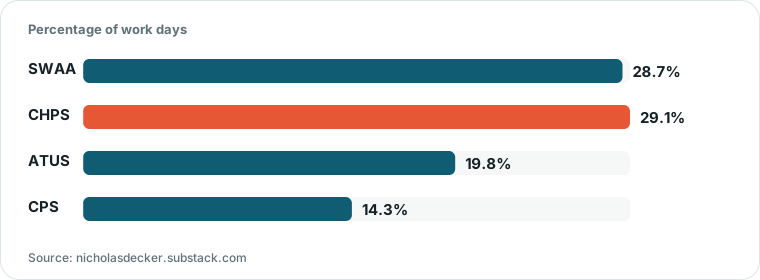
Chart drawn by HN Digest from figures reported by nicholasdecker.substack.com; values are shown as written in the source.
“Everything points to the ATUS number being the correct one. Somewhere around 20% of work days are remote.”
— How Many People Work From Home?
Testing Feasibility Against Reported Data
A key way to validate these numbers is to compare the reported remote work rate against the number of jobs that can actually be done from home. Research by Dingel and Neiman (2020) initially suggested that 37% of jobs could be done remotely, but this included roles like education that are not practically remote in a standard work environment.
When stripping out education and refining the criteria to what people can actually do on a regular basis, the share of 'remotable' jobs drops to 25%. If 29% of work days were remote, it would imply that 70% of all remotable jobs are being done remotely—a figure that appears high when contrasted with the 19.8% reported by the ATUS.
Economic and Innovation Trade-offs
While remote work provides clear benefits for some, it carries measurable trade-offs in professional development. Studies indicate that workers may accept a wage cut of up to 8% to secure a remote position, suggesting a high personal value placed on the arrangement.
However, evidence suggests that remote work can create 'friction' in professional growth. Research tracking junior employees shows that even small increases in physical distance can lead to substantial reductions in learning from senior staff.
While remote work may allow for an increase in individual surplus, it may also lead to reduced wages and GDP due to mismeasured labor input, alongside a potential long-term reduction in innovation.
What Hacker News readers are saying
- Experience: One commenter who has worked remotely since the pandemic noted that while remote work allows for long stretches of focused productivity, it can also lead to aimless drifting by removing the external structure provided by an office environment. comment ↗
- Experience: A commenter who transitioned to remote work after a period of in-office employment shared that they appreciate the ability to be present for their children, though they admitted that their social skills initially required improvement. comment ↗
- Experience: One individual who works as a self-employed subcontractor argued that they prefer renting a private commercial office space over working from home to achieve better focus and superior equipment. comment ↗
- Experience: Another commenter shared that full-time remote work negatively impacted their emotional well-being and social interactions, suggesting that the experience is not suitable for everyone. comment ↗
Summarized opinions from the Hacker News thread, not verified facts. Read the full discussion ↗