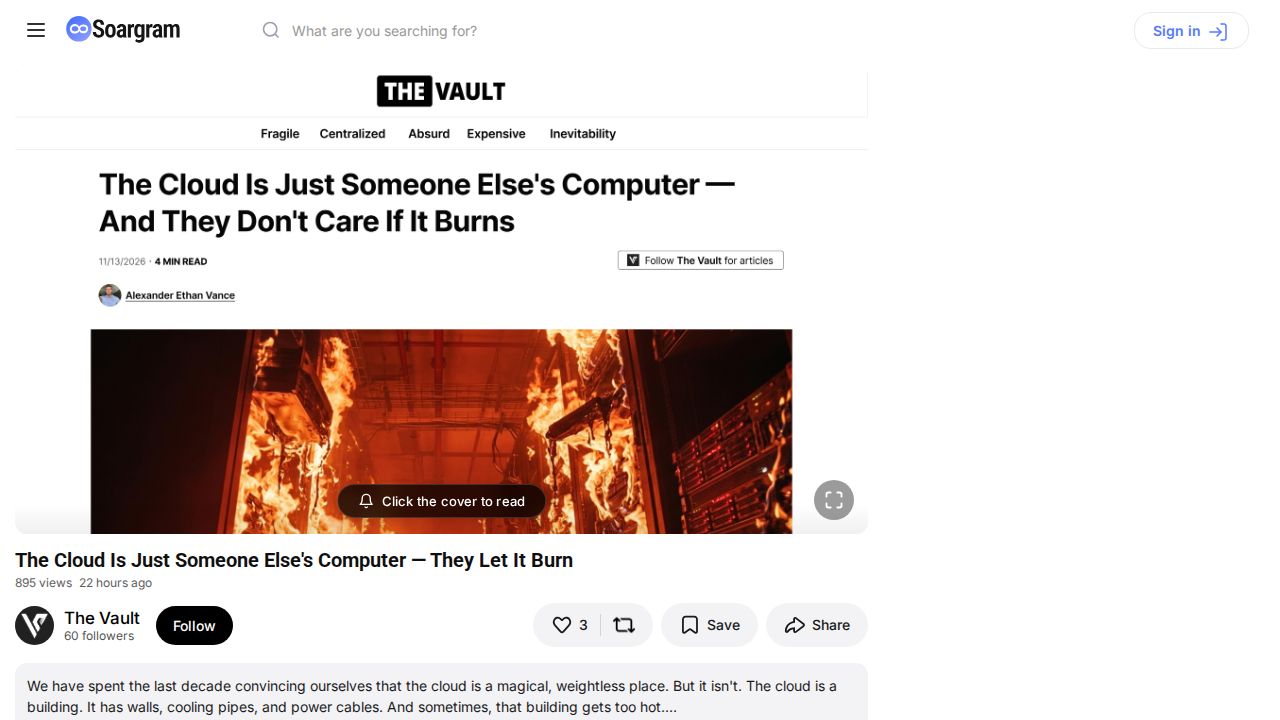
A single broken air conditioner in a Virginia data center was enough to take Coinbase offline last May, illustrating that the 'cloud' is not a weightless digital abstraction but a physical building with cooling pipes and power cables. This vulnerability highlights a growing tension in software engineering: the trade-off between the convenience of massive cloud providers and the inherent fragility of centralized infrastructure.
The Physical Reality of the Cloud
The primary source argues that the tech industry has spent a decade treating the cloud as a magical, weightless space. In reality, cloud computing is anchored in physical buildings that require constant power and cooling.
When these physical systems fail, the consequences are immediate and visible. The author cites a specific instance where an AWS data center overheated, leading to a service blackout for Coinbase, and a single script typo at Cloudflare that rendered thousands of websites invisible.
“The cloud is a building. It has walls, cooling pipes, and power cables. And sometimes, that building gets too hot.”
— The Cloud Is Just Someone Else's Computer — They Let It Burn
The Shift Toward Bare Metal
In response to these vulnerabilities, some engineers are advocating for a return to 'bare metal' infrastructure. This approach involves running applications on dedicated physical servers rather than shared cloud environments.
One commenter on Hacker News, writing as __MatrixMan__, suggested that for many users, compute needs do not exceed a single server rack. They argued that decentralizing to a private 'data closet' can avoid the downsides of being one of a million customers on a massive provider.
Discussion on Resilience and Responsibility
The Hacker News discussion revealed a divide on whether the cloud is inherently 'fragile.' One commenter, writing as tracerbulletx, argued that the fear of cloud infrastructure is similar to the fear of commercial real estate; the goal is to avoid being the landlord or operator, not to fear the building's existence.
Conversely, another commenter, writing as falsemyrmidon, argued that the outages described are often the result of users failing to follow AWS recommendations for availability zone resilience. They suggested that the 'cloud is dead' narrative is a misinterpretation of poor architectural choices by the companies using the service.