The OOS project enables users to bypass the proprietary software of Rigol DHO800 and DHO900 series oscilloscopes by installing a Linux 6.12 kernel and a custom application written in Rust. By running independently from the stock system on the device's own SD card, OOS grants users deeper access to hardware features and a more customizable measurement environment.
Architecture and Hardware Integration
OOS functions by replacing the scope's original software with a Linux environment that runs alongside the stock system. It is designed to be non-destructive, specifically avoiding the FPGA flash, factory calibration data in the /rigol/data directory, and the uboot, trust, and parameter partitions.
The project utilizes its own self-calibration system, which stores data in its own files rather than modifying the manufacturer's factory settings. This allows the system to maintain its own calibration state independently of the original hardware configuration.
Expanded Measurement Capabilities
The Rust-based application introduces several features not found in the standard firmware, such as 25 protocol decoders (including UART, I2C, SPI, and CAN-FD) and 8 math channels that support free formulas like sqrt(CH1^2+CH2^2).
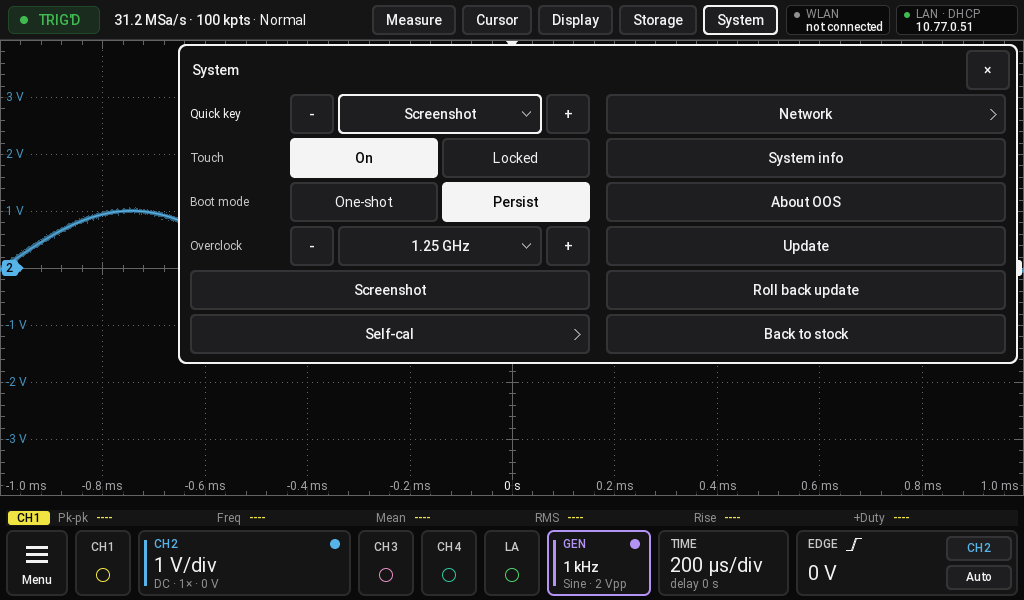
This image shows the custom interface provided by the Rust-based application described in the article.
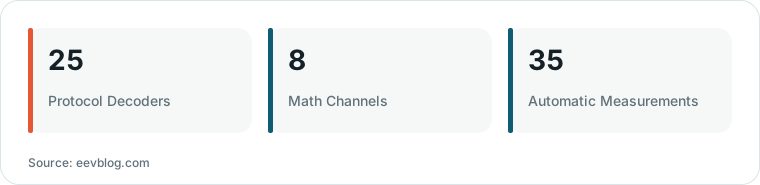
Chart drawn by HN Digest from figures reported by eevblog.com; values are shown as written in the source.
Users can access a spectrum analyzer with harmonics, THD, and SNR measurements, as well as an eye diagram with jitter breakdown. The system also supports a logic analyzer and a built-in generator for sine, square, ramp, and noise waves.
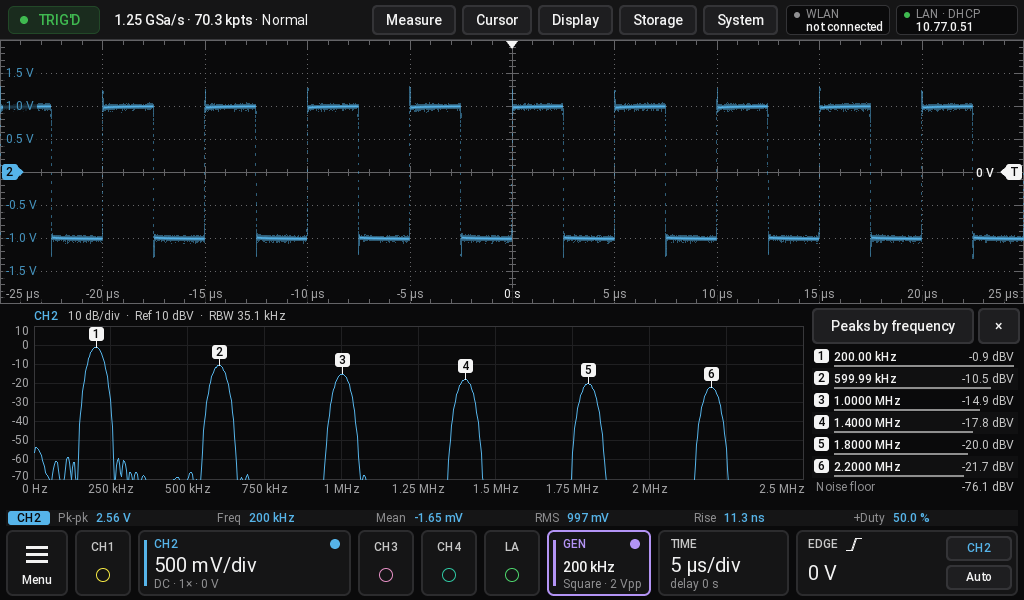
This image illustrates the spectrum analyzer functionality mentioned in the expanded measurement capabilities section.
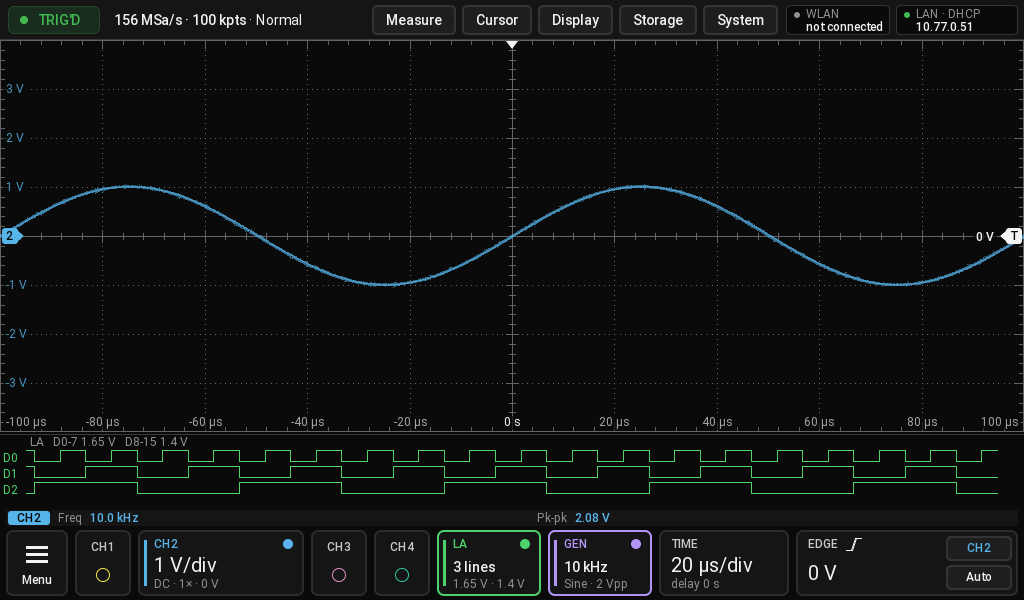
This visual demonstrates the logic analyzer feature described in the expanded measurement capabilities section.
Remote Access and Installation
OOS provides extensive remote control options, including SCPI over Ethernet or a WLAN stick, a web remote with a live screen and touch interface on port 8080, and a root shell via telnet. It also supports LXI identification and MCP for AI assistants.
Installation is performed by cloning the original SD card and installing the OOS image on a second card. Users can switch between the two systems by swapping the cards, and the project includes a tool to shrink the file system to fit on smaller SD cards.
Experimental Status and Limitations
Because OOS is an experimental project, it carries significant risks; the developer notes that measurements are not calibrated to any standard and should be used at the user's own risk. Some functions have not yet been tested on real hardware, and many protocol decoders were only verified using simulated signals.
While the project currently supports the DHO924S and DHO804, it does not support the DHO1000, HDO, or MHO boards. The software's development is ongoing, with the project currently at version 0.1.5.
What Hacker News readers are saying
- Experience: One commenter shared their experience with a Rigol device that had disabled decoders, expressing hope that this open-source software would make the hardware a more capable tool. comment ↗
- Experience: A commenter praised the project as an impressive feat of engineering, noting that replicating the signal processing and UI functionality of a professional scope is a significant undertaking. comment ↗
- Technical note: Another user pointed out the technical difficulty of reverse-engineering the FPGA components, noting that the signal processing and acquisition logic are much harder to replicate than the host software. comment ↗
Summarized opinions from the Hacker News thread, not verified facts. Read the full discussion ↗