More than 80 percent of Microsoft's network gateway servers became unresponsive during a massive outage that left global users unable to access Exchange Online and Outlook. The failure was triggered by a latent software defect introduced in a July 2026 update, which remained dormant until a specific combination of high load and reduced server capacity pushed the system into a cascading collapse.
The Mechanism of the Failure
The outage was rooted in a software defect that caused lock contention within an internal Windows process. This contention led to the exhaustion of critical system resources, specifically CPU and memory, on the network gateway servers.

This figure illustrates the specific mechanism of the software defect that caused the network gateway servers to become unresponsive.
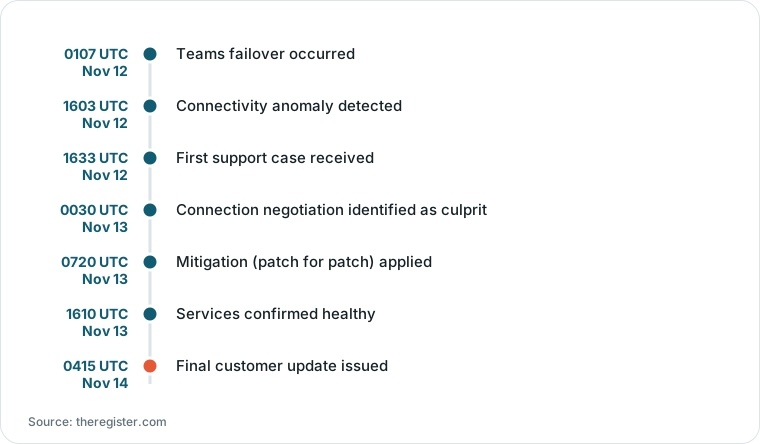
Chart drawn by HN Digest from figures reported by theregister.com; values are shown as written in the source.
Crucially, the defect behaved differently depending on the hardware. Microsoft's preliminary report noted that the contention issue was actually worsened on machines with more cores and newer hardware, which are standard in modern production environments.

This visual supports the claim that the defect behaved differently depending on the hardware, specifically worsening on newer, high-core-count machines.
“The contention issue is worsened on machines with more cores and newer hardware.”
— Microsoft blames monster email outage on software defect introduced in July fix
Testing Gaps and Cascading Effects
The defect escaped detection during the July deployment because Microsoft's load testing tended to focus on weaker hardware with fewer cores. Because the bug only manifested significantly on high-spec machines, the update appeared stable during the initial testing phase.
When the outage began, it followed a classic cascading failure pattern. As individual servers lost connectivity due to resource exhaustion, traffic was automatically rerouted to the next healthy endpoints. These endpoints then encountered the same defect and failed, eventually causing the entire fleet to become unresponsive within two hours.
Recovery Challenges and Resolution
Standard recovery procedures were ineffective because the servers were in a broad unresponsive state that the automated systems were not designed to handle. Furthermore, a straightforward rollback was impossible because the defective code had been in production for months.
To restore service, engineers had to develop a specific update to return the code path to a previously known good state. Service was restored gradually as this 'patch for the patch' was applied to groups of servers, eventually stabilizing the Exchange Online infrastructure.
What Hacker News readers are saying
- Technical note: One commenter pointed out that the discrepancy between low-end testing environments and high-end production machines likely hid a concurrency bug, questioning if such a testing gap is a common or acceptable trade-off. comment ↗
- Technical note: A commenter who analyzed the specific hardware mentioned that if the testing machines were significantly lower in core count than production servers, the failure to catch lock contention would be a significant oversight. comment ↗
- Skeptical: One reader argued that the incident highlights the risks of relying on automated systems and suggested that as human labor is reduced, resolving such complex outages will become increasingly difficult. comment ↗
- Skeptical: Another commenter suggested that the outage might be a symptom of latent technical debt caused by rapid development cycles and the increasing use of AI-generated code. comment ↗
Summarized opinions from the Hacker News thread, not verified facts. Read the full discussion ↗