More than 430 million people who use Microsoft 365 apps are currently navigating a global service disruption that has paralyzed communications for government agencies, healthcare providers, and major tech firms. The outage, which began on Thursday, has been reported in over 70 countries and continues to affect core services including Outlook, Teams, and the Copilot AI software.
Infrastructure Strain and Recovery Hurdles
Microsoft identified the root cause of the outage as 'elevated load' on its infrastructure. This occurred because a number of servers became 'unexpectedly unavailable,' which forced the remaining infrastructure to cope with the excess traffic.
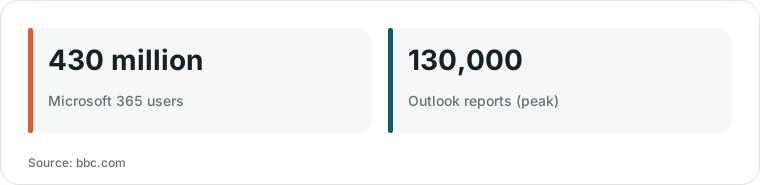
Chart drawn by HN Digest from figures reported by bbc.com; values are shown as written in the source.
The company's recovery process has faced significant hurdles. While Microsoft initially reported 'positive results' for service stability, it later clarified that fixes were not 'taking as expected' and that it was seeing only 'marginal success' in its efforts to treat the incident.

The image illustrates the type of connectivity failure experienced by users during the outage.
“Microsoft says its attempts to fix the issue are not "taking as expected”
— Microsoft outage updates: Attempts to fix global outage not going 'as expected' - follow live
Impact on Public Services and Critical Infrastructure
The outage has moved beyond corporate inconvenience to affect essential public services. In the UK, the National Pharmacy Association reported that the outage is affecting access to the NHS email system, which limits the ability of pharmacies to communicate with GP practices and patients.
Governmental bodies have also been hit; Japan's shared IT platform was disrupted, and Australian spy and federal police agencies reported issues specifically related to email. In the UK, several police forces reported that online form submissions may be affected by the service issue.

The image depicts the headquarters of a major Australian government agency that reported service disruptions.

The image shows the website of a UK police force mentioned as being impacted by the outage.
Systemic Risks of Centralized Technology
The incident highlights the risks of relying on a single technology provider for critical operations. Because Microsoft infrastructure is used by other tech companies, the outage caused knock-on effects for firms like OpenAI and Anthropic.
Experts and government officials have noted that such incidents underscore the need for more resilient systems and robust contingency plans. While some entities, such as major UK airports, reported minimal impact on operational systems, the broader reach of the outage emphasizes the fragility of centralized IT dependencies.
Remaining Uncertainties
Microsoft has stated it will provide full details of the 'root cause' in a post-incident report once the issue has been fully mitigated. At this time, the company continues to monitor server performance and expand capacity across affected regions to improve stability.
What Hacker News readers are saying
- Alternative: One commenter suggested that the ongoing issues might be a result of a 'brain drain' or a lack of experienced staff who understand the underlying systems. comment ↗
- Skeptical: Several commenters expressed skepticism regarding the quality of the status updates, with some suggesting the responses appeared to be generated by AI rather than identifying a root cause. comment ↗
- Skeptical: One commenter argued that users are unlikely to migrate away from the platform, suggesting that companies will instead double down on their existing contracts despite the outages. comment ↗
Summarized opinions from the Hacker News thread, not verified facts. Read the full discussion ↗