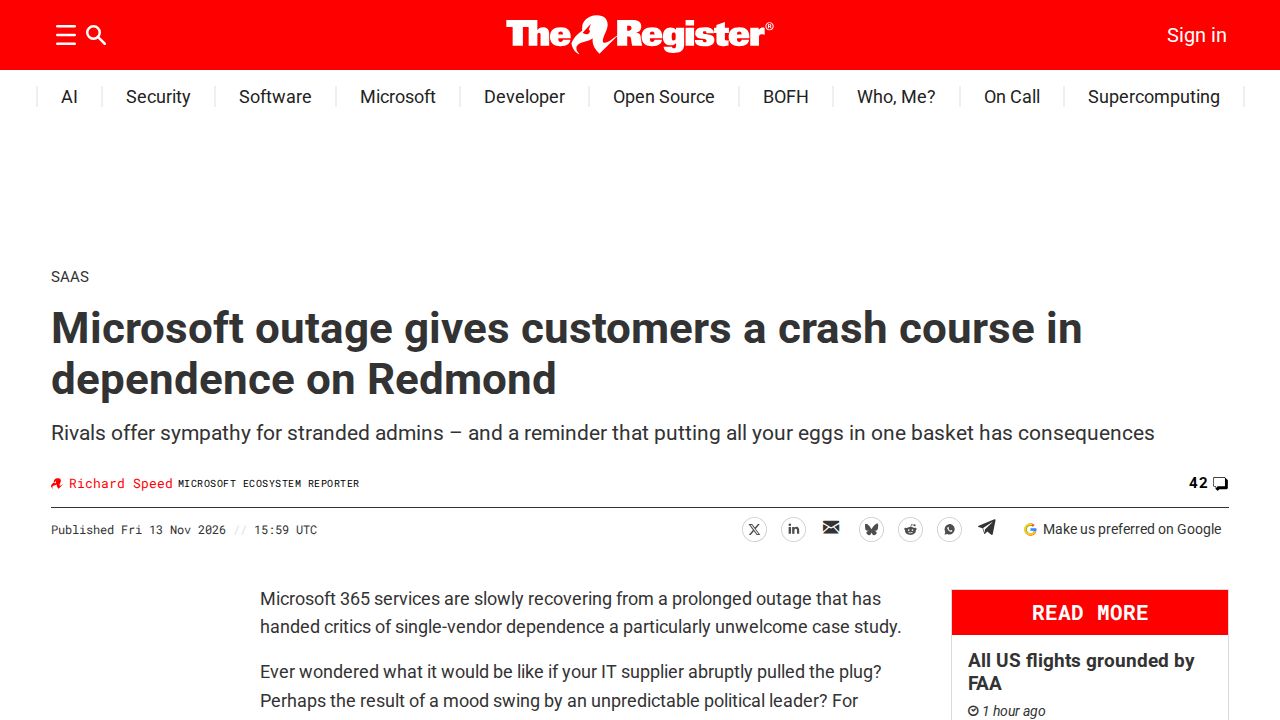
Starting at 1826 GMT on November 12, 2026, a significant service degradation began affecting core Microsoft 365 functions, including Exchange Online, Microsoft Teams, and Copilot. The outage effectively paralyzed essential communication and collaboration tools for organizations worldwide, providing a stark demonstration of what happens when a primary IT supplier's infrastructure fails.
Scope of the Service Degradation
Microsoft described the incident as a 'Service Degradation' that affected a wide array of productivity tools. Beyond the loss of email via Exchange Online, users reported issues viewing recently used files within the Microsoft 365 application and intermittent failures with Microsoft Teams messaging.
The disruption also reached into specialized sectors, notably affecting Microsoft 365 Education. While Microsoft reported improvements in service availability by the following day, the outage served as a practical case study for the consequences of deep integration into a single software suite.
“The real concern isn't that Microsoft has suffered an outage. It's that we've allowed so much of our critical infrastructure to become concentrated in the hands of so few companies, creating enormous single points of failure.”
— Microsoft outage gives customers a crash course in dependence on Redmond
The Risks of Monopolistic Infrastructure
The outage prompted criticism regarding the lack of resilience in modern digital infrastructure. Critics and industry peers noted that when an organization's entire operation hangs on a single vendor, it becomes nearly impossible to switch providers quickly or maintain a secondary, independent setup to keep working during an attack or failure.
The concentration of critical infrastructure in the hands of a few companies creates a systemic risk. As one industry observer noted, these monopolies increase the risk of stalling businesses globally because there is no 'air-gapped' alternative readily available when the primary cloud provider goes offline.
Trade-offs and Future Dependencies
The incident occurs as Microsoft simultaneously warns users that older on-premise Exchange versions (2016 and 2019) are now 'permanently vulnerable.' This creates a complex trade-off for administrators: while moving to Exchange Online mitigates some security risks of legacy software, it replaces those risks with a heavy dependency on Microsoft's cloud uptime.
While some organizations may look toward alternative platforms to increase resilience, the sheer scale of integration makes such transitions difficult. The outage may lead to more difficult conversations regarding service level agreements and infrastructure redundancy during upcoming contract renewals.
What Hacker News readers are saying
- Experience: One commenter who has experience with connection leaks suggested that the error messages and status updates indicated connection pool exhaustion, which can cause servers to stop responding despite low utilization. comment ↗
- Skeptical: Several commenters expressed skepticism that these outages would lead to significant change, suggesting that the risk of a rare outage is often seen as minimal enough that customers will continue to rely on the provider. comment ↗
- Alternative: One commenter argued that businesses should implement 'chaos monkey' events to test their systems, suggesting that any company whose operations are taken offline by a SaaS provider lacks sufficient resilience. comment ↗
Summarized opinions from the Hacker News thread, not verified facts. Read the full discussion ↗