The Nintendo Entertainment System (NES) is experiencing a 'Second ReNESance,' a period where developers are leveraging decades of research to produce a new cornucopia of third-party titles for the vintage console. Unlike the first wave of games that saved the industry in North America, this modern movement focuses on creating new experiences that respect and utilize the specific hardware constraints of the 8-bit era.
Balancing Modern Design with 8-Bit Constraints
Modern developers for the NES must navigate strict hardware limitations to create playable experiences. For example, the game 'Anguna' was ported from the Game Boy Advance and Atari 2600 to the NES, maintaining a design where no more than two enemies appear on screen at once. This mirrors the limitations of early NES titles like 'Double Dragon' while providing a 'Zelda-like' exploration experience.
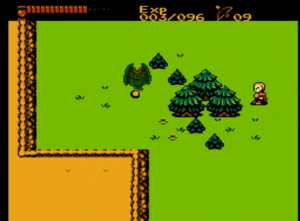
This image illustrates the specific example of 'Anguna' mentioned in the text, showing its 8-bit aesthetic and mechanics.
“An interesting experience made with strict hardware limitations.”
— 25 of my favourite modern NES games – The Scribbler of the Rueful Countenance
Diverse Development and Porting Methods
The development pipeline for these games varies significantly. Some titles, like 'Alwa’s Awakening,' began as PC games with pseudo-NES limitations and were later ported to the console. Others are built from the ground up for the system, such as 'Blazing Rangers,' which features co-op firefighting mechanics and a dedicated theme song.
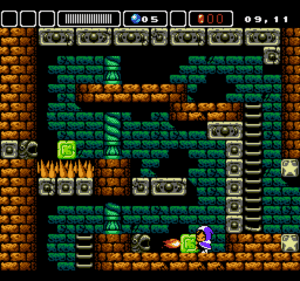
This visual supports the discussion of 'Alwa's Awakening' as a game that transitioned from PC to the NES.
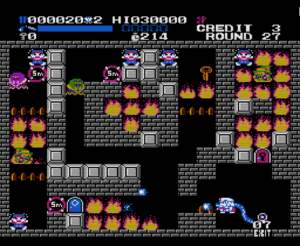
This image provides a visual for 'Blazing Rangers,' a title built from the ground up for the system.
Technical tools like Famitracker are used to compose soundtracks that remain compatible with the NES's audio limitations. These methods ensure that modern indie aesthetics, such as the 'Metroidvania' genre, can be translated into the 8-bit space without losing their core appeal.
Accessibility and Physical Media
Players can access these modern titles through several channels. Most are available as affordable digital downloads directly from developers or publishers, while some are also distributed via Steam. For enthusiasts seeking a 'hi-fi' experience, many of these games are also produced as physical cartridges for use on original hardware.
The availability of physical media remains a significant factor for the community, though some titles may be limited to secondhand markets or specific production runs. This dual availability allows for both modern convenience and the preservation of the original hardware experience.
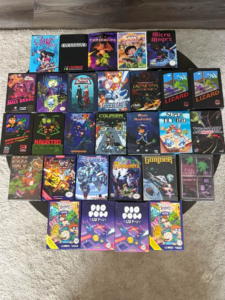
This image illustrates the physical media aspect of the modern NES scene described in the final section.