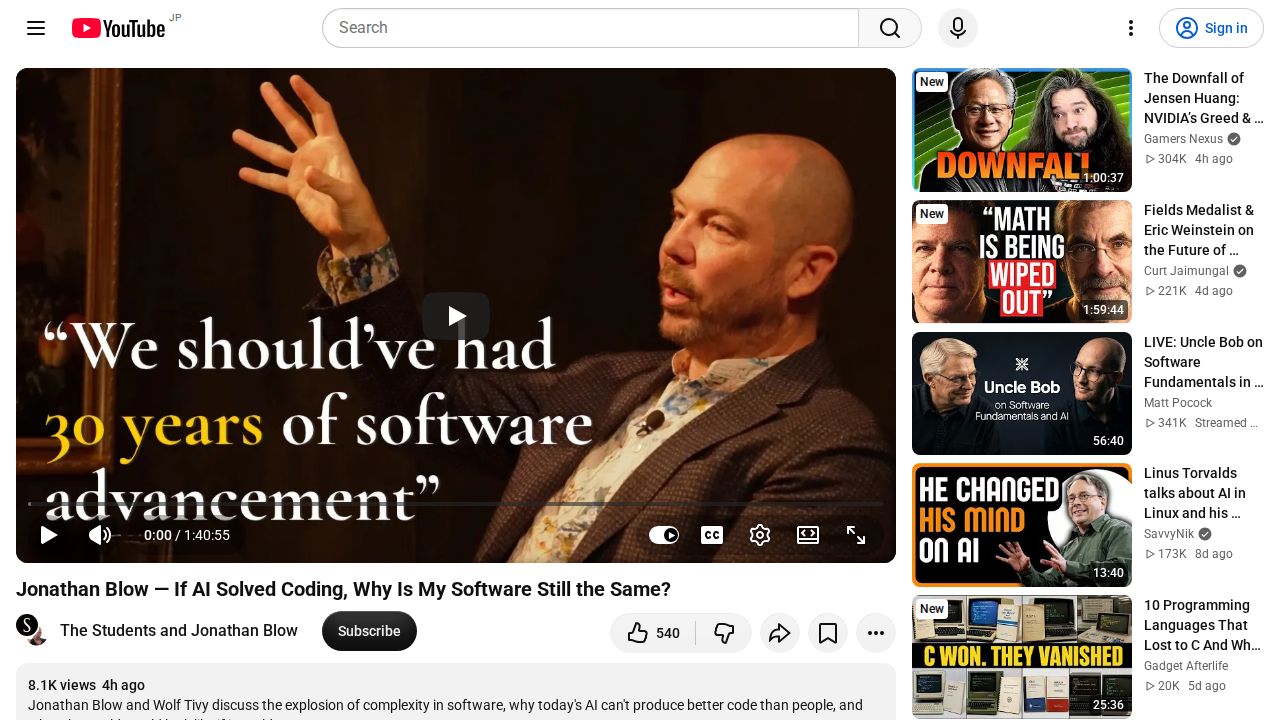
Game developer Jonathan Blow argues that despite the rapid rise of artificial intelligence, the fundamental nature of software development has remained largely stagnant since the early 2000s. This perspective suggests that while AI can accelerate the production of existing ideas, it does not inherently solve the underlying problems of software architecture or organizational goals.
The Argument for Software Stagnation
In a video presentation, Jonathan Blow argues that software development has seen little fundamental advancement since the early 2000s. He suggests that the core challenges of software remain unchanged, implying that the current technological shift is not creating a new paradigm for what software can achieve.
The core of this argument is that software remains the same because the goals of the people and organizations building it have not changed. As one commenter noted, AI provides more of what people already want, but it does not automatically redefine those desires or the culture of the company.
This perspective implies that AI is a tool for acceleration rather than a catalyst for structural innovation in the software industry.
Personalized Software and Efficiency Gains
While large-scale organizational software may seem stagnant, some commenters pointed to a significant shift in how individuals interact with software. Users are increasingly using AI to build personalized tools to replace expensive subscription services, which can be highly effective for specific, personal use cases.
One commenter highlighted that this allows individuals to replace services that previously cost thousands of dollars with low-cost, AI-assisted custom solutions. This represents a move toward 'vibe coding'—where the perception of enterprise software shifts from 'magic' to something that can be quickly prototyped or customized.
Another commenter noted that for some companies, AI is already enabling 'huge swings' that would have been impossible without it, such as the recent release of an AWS emulator.
The Bottleneck of Imagination and Culture
A recurring theme in the discussion is that coding was never the primary bottleneck for many organizations. Commenters argued that the real challenge lies in identifying interesting problems to solve and having the imagination to architect new solutions.
One commenter suggested that the 'imagination crisis' is a result of people who understand software architecture spending their time on social media rather than seeking out new problems. They argued that the people who claimed building software wasn't the hard part were correct: the difficulty lies in finding meaningful things to build.
Others observed that the primary impact of AI in some corporate environments is internal efficiency. For example, one commenter mentioned a friend in management who noted that AI has 'cut the tails' of manual coding tasks, making management jobs easier by streamlining existing workflows rather than creating new software types.
Contrasting Views on Indie Development
Not all participants agreed with the premise of stagnation. One game developer argued that the indie space has seen a massive leap in quality and complexity over the last three years, specifically citing the rise of high-performance RTS games from very small teams.
This commenter suggested that the higher bar for indie games is a result of tooling becoming easier and more common. They argued that small teams are now outperforming AAA studios in terms of complexity and performance, even if they lack the same level of spend or art production.
This highlights a tension in the discussion: while the 'software' itself might follow old patterns, the ability of small teams to execute complex systems is reaching new heights due to better tools.