A 2011 tweet from Burger King, originally intended to direct customers to a restaurant locator, suddenly began sending users to a Wikipedia page listing Nazi concentration camps. This was not the result of a hack on Burger King's social media account, but rather a 'link hijacking' event where a third party successfully reclaimed the unique Bitly identifier used in the decade-old post.
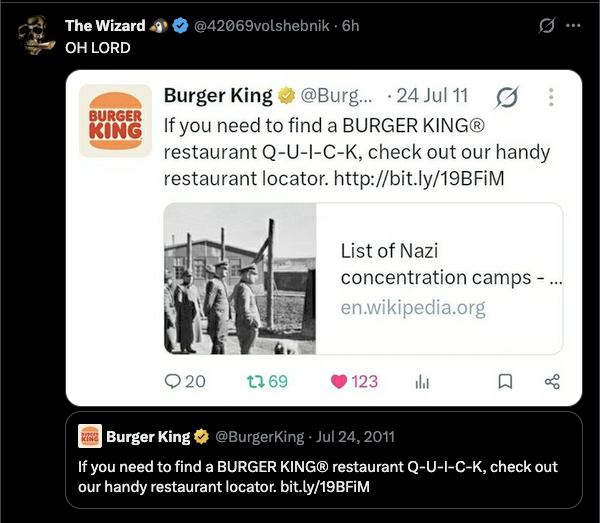
This image illustrates the specific hijacking event involving Burger King's historical social media content.
The Mechanism of Link Hijacking
Bitly short links consist of a prefix and a 'back-half'—the unique string of characters that determines the destination. Under normal circumstances, Bitly's policy states that these back-halves cannot be reused, even if the account that created them is deleted.
However, a flaw allowed bad actors to register these same back-halves again. When a link is 'hijacked' in this way, the original tweet or advertisement remains unchanged, but the destination is swapped. This allows attackers to redirect traffic from high-authority historical posts to malicious sites, spam, or unrelated content without needing to compromise the original brand's credentials.
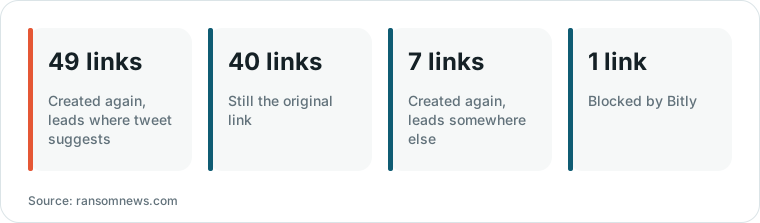
Chart drawn by HN Digest from figures reported by ransomnews.com; values are shown as written in the source.
“The links changed hands on Bitly’s side, so the old tweets send readers wherever the new owners choose.”
— Old Bitly links hijacked in Burger King, McDonald’s and Trump tweets
Evidence of Historical Hijacks
Analysis of historical tweets revealed several high-profile examples of this behavior. A McDonald's tweet from June 2011 was found to redirect to a Wikipedia article on the September 11 attacks, while a Burger King tweet from July 2011 was redirected to a list of Nazi concentration camps.
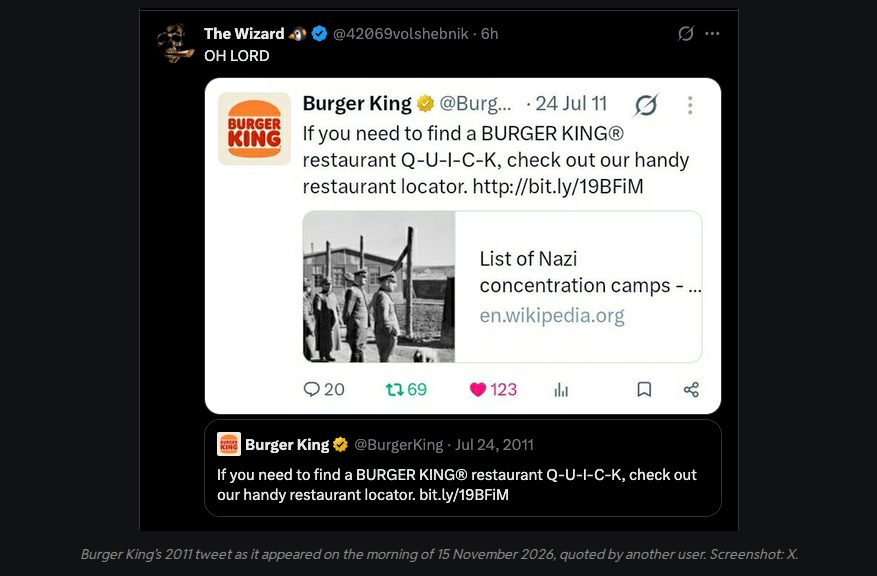
This visual provides evidence of the hijacked link's destination as observed by users in late 2026.
A review of 97 Bitly links in Donald Trump's tweets from 2009 to 2013 showed that 49 were recreated at a later date, mostly in a single 17-minute window in May 2023. Other links were hijacked as recently as November 2026, pointing to Roblox profiles, YouTube videos, and Wikipedia pages regarding Jeffrey Epstein.
Technical Discrepancies and Brand Impact
Researchers verified the hijacking by checking Bitly's public information pages, which show the creation date of a link. For the hijacked Burger King link, the creation date was listed as November 15, 2026, despite the tweet appearing in 2011. This discrepancy confirms that the identifier was issued a second time.
The incident highlights a significant trade-off in using link shorteners: while they provide brevity and tracking, they introduce a 'zombie link' risk. If a brand does not maintain its short links or if the service provider fails to lock identifiers, old content can become a vector for redirected traffic to unintended destinations.
What Hacker News readers are saying
- Alternative: One commenter shared that their company uses a self-hosted link shortener to ensure security and improve QR code reliability in poor lighting, noting that such services are relatively simple to build internally. comment ↗
- Experience: Another user described experiencing spam from old domains that were previously used by reputable organizations via CNAMEs, suggesting that domain managers should actively monitor and decommission these links. comment ↗
- Skeptical: One commenter questioned the actual value proposition of using link shorteners for companies or customers in the current landscape. comment ↗
Summarized opinions from the Hacker News thread, not verified facts. Read the full discussion ↗