A new arcade of browser-based games demonstrates the capabilities of Claude Fable 5.2, an agentic workflow from Anthropic that can build complete 3D and 2D games autonomously from a single prompt. These games are delivered as self-contained .html files, meaning they require no external assets, servers, or build steps to run in a modern web browser.
The One-Shot Agentic Workflow
The core mechanism behind these games is a 'one-shot' prompt, where a single detailed instruction defines the entire project's theme, mechanics, and constraints. Instead of a human developer iteratively writing code, the Claude Fable 5.2 model executes an autonomous session to build the project from start to finish.
The source material describes this as a process where the model can 'plan, write, test and refine a complete game over several hours of agentic work, with no human writing code in between.' This allows for the creation of diverse titles, from first-person shooters like 'Saltline' to sports simulations like 'Pocket Soccer 3D'.
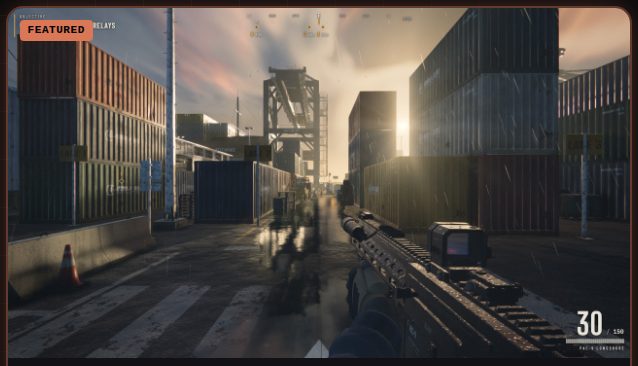
This image illustrates one of the diverse titles, such as the first-person shooter Saltline, that can be created using the one-shot prompt method.

The model can produce a variety of genres, including sports simulations like Pocket Soccer 3D, as described in the workflow section.
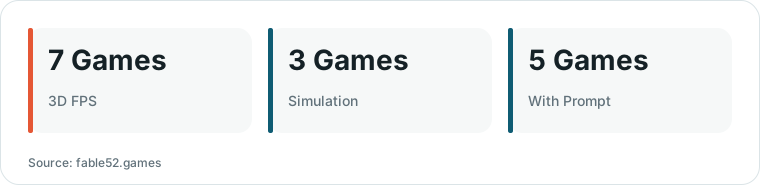
Chart drawn by HN Digest from figures reported by fable52.games; values are shown as written in the source.
“Given one detailed prompt, it can plan, write, test and refine a complete game over several hours of agentic work, with no human writing code in between.”
— Fable 5.2 Games — Play One-Prompt Single-File HTML Games Online
Technical Architecture of Single-File Games
To function as a single-file .html document, the games cannot rely on external images, 3D models, or audio files. Instead, the architecture uses procedural generation to create these assets at runtime. The games primarily utilize Three.js for 3D rendering and the Web Audio API for synthesized sound.
Because everything—including markup, CSS, JavaScript, shaders, and audio—is inlined within the file, the games can be played instantly and even run offline. This approach enables complex experiences, such as 'Tidebell,' a submersible exploration game, to exist within a single file of a few megabytes.
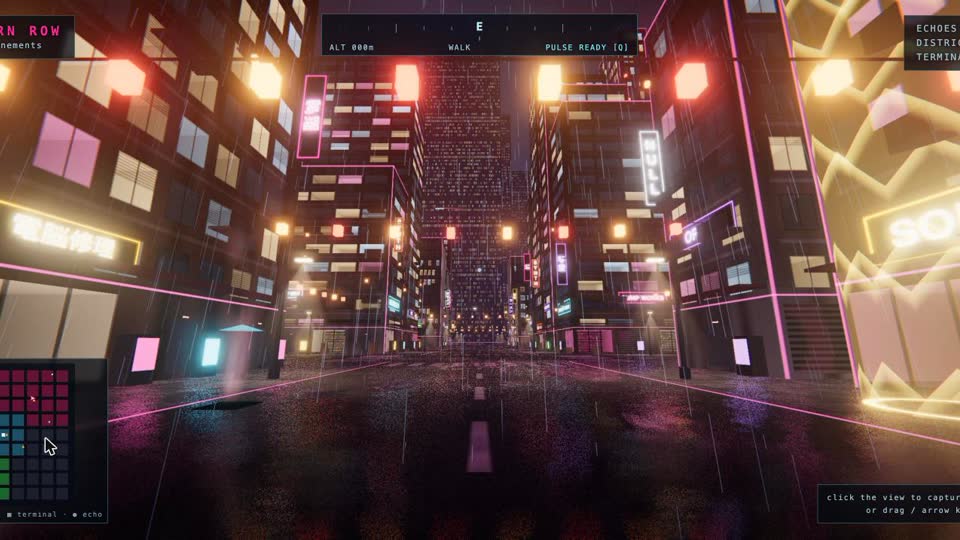
This visual represents the complex experiences, like Tidebell or MOTHLIGHT, that are possible within a single-file HTML structure using procedural generation.
Transparency and Accessibility
The arcade provides a high level of transparency by allowing users to view the original prompt used to generate each game and inspect every line of the source code. This makes the platform a resource for developers to study how AI handles complex logic, 3D math, and procedural generation.
While the games are fully autonomous, they face practical limitations inherent to the web environment. Some users have noted that these single-file builds may lack robust mobile support or full-screen functionality compared to traditional game engines that use multi-asset pipelines.
User Interaction and Remixing
Every game in the arcade includes a 'Download .html' button, allowing users to save the file to their local machine. Once downloaded, the game can be opened in any text editor for modification or local execution.
The platform encourages a 'remix' culture, where users are invited to modify the source code while respecting the original author's license. This provides a direct path for users to experiment with the AI's output and iterate on the game's mechanics or aesthetics.
Uncertainties and Limitations
The source material does not provide specific performance benchmarks or a comparison of the AI's success rate across different game genres. It remains unclear how the model handles extremely complex logic or high-fidelity graphics that might exceed the constraints of a single-file HTML structure.
Additionally, while the 'agentic' workflow is described as autonomous, the specific success rate of these one-shot prompts versus iterative human-guided prompts is not detailed.
What Hacker News readers are saying
- Experience: One commenter who has spent a career making browser games described the technology as both amazing and horrifying. comment ↗
- Skeptical: A commenter pointed out a security issue, noting that the server's certificate was not trusted by the operating system. comment ↗
- Open question: Another user expressed interest in the project but noted that mobile support and the full-screen button appeared to be lacking. comment ↗
Summarized opinions from the Hacker News thread, not verified facts. Read the full discussion ↗