Anthropic has released Claude Fable 5.2 and Claude Mythos 5.2, models specifically engineered to handle high-complexity technical challenges such as software migrations and hardware engineering. During prerelease testing, these models successfully formalized the proof of Fermat’s Last Theorem in just 30 hours and designed three working electronic devices from scratch. These updates aim to provide a more efficient, lower-cost alternative for ambitious, open-ended technical work compared to the standard Claude Opus 5.5.
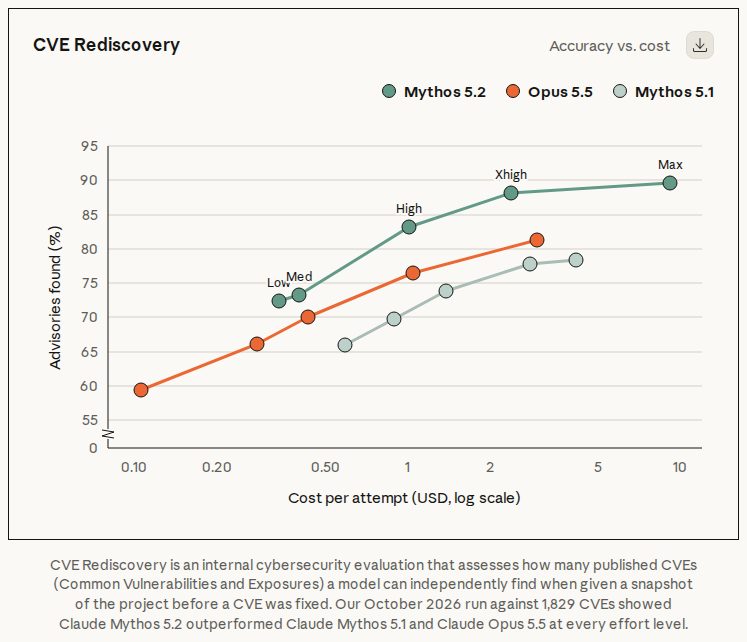
This visual supports the claim regarding the models' capabilities in cybersecurity and high-complexity technical challenges.
Architecture and Access Tiers
Claude Fable and Claude Mythos share the same underlying model architecture but differ in their safety configurations. Fable 5.2 is designed for general availability, featuring strong cybersecurity and biology safeguards to prevent misuse. In contrast, Mythos 5.2 is reserved for organizations pursuing beneficial applications in cybersecurity or biomedical research through Anthropic's Life Sciences and Cyber Verification Programs.
Anthropic positions these models as tools for the most ambitious technical work. While Fable 5.2 can act as an 'Advisor' to help smaller models solve hard problems or as an 'Orchestrator' to delegate simpler tasks, the company still recommends Claude Opus 5.5 as the primary 'daily driver' for most standard coding and knowledge tasks.
Performance and Efficiency Gains
The 5.2 updates provide significant improvements in speed and cost-efficiency. Users can expect outputs up to 30% faster than the 5.1 versions at a lower price point. Additionally, a 'fast mode' is available that can speed up token generation by up to 2.5 times, though it carries a higher price of $16 per million input tokens and $80 per million output tokens.
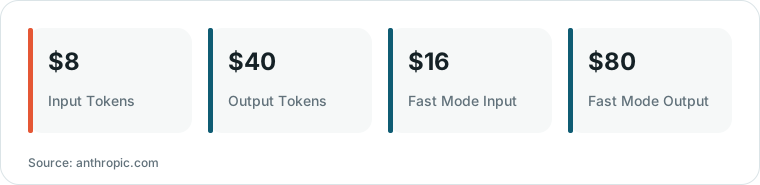
Chart drawn by HN Digest from figures reported by anthropic.com; values are shown as written in the source.
In practical applications, Fable 5.2 has demonstrated high-level engineering judgment. For example, it was used to migrate a production service from Python to Rust, resulting in a service that is more reliable and starts approximately 26 times faster. It also successfully coordinated over 1,000 subagents to build a prototype operating system from an empty folder in eight days.
Benchmark Comparisons and Limitations
Benchmark data shows Fable 5.2 exceeding Opus 5.5 in several categories. In 'Agentic coding' on the FrontierCode 2.0 benchmark, Fable 5.2 reached a score of 49.1% at 'Xhigh effort,' the highest score of any released model tested by Anthropic. It also showed significant leads in hardware engineering (BenchCAD 2.1) and visual chart recognition (Chartography).
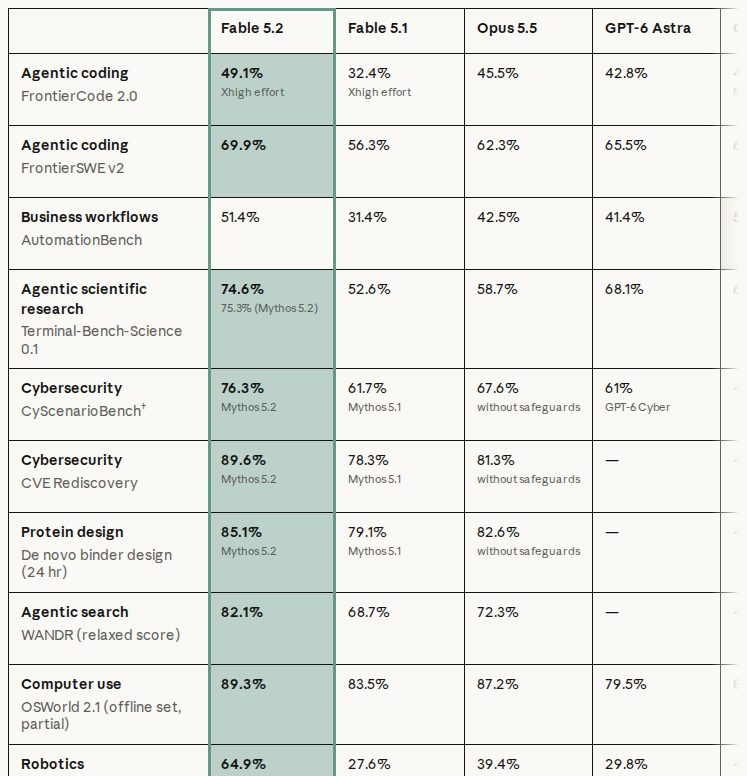
This table provides a comprehensive overview of how the new models perform across different technical benchmarks compared to the standard Opus model.
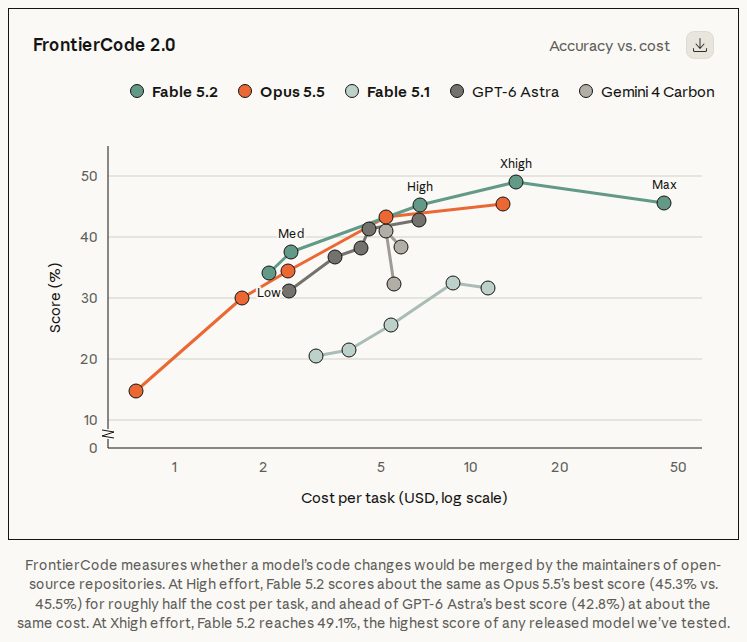
The chart illustrates the specific performance gains and cost efficiencies of Fable 5.2 in agentic coding tasks.
Despite these gains, there are clear trade-offs regarding model selection. Fable 5.2 is optimized for high-effort, complex tasks where it can produce results at roughly half the cost of Opus 5.5. However, for routine workflows, the company suggests that the jump in complexity required to see a distinct advantage over Opus 5.5 may not be necessary for all users.
What Hacker News readers are saying
- Experience: One commenter who has used the model reported that it is significantly faster and more reliable than previous versions, noting that it successfully avoided common issues like slow generation and output token overflows. comment ↗
- Experience: A user shared that they tested the model on an esoteric 600k line Fortran codebase and were surprised by its coding ability, which reportedly accelerated their computational material science work by 36 times. comment ↗
- Skeptical: Several commenters expressed skepticism regarding the reported benchmarks, questioning why certain models were compared against specific competitors and why the effort-intel curves appeared inconsistent with available data. comment ↗
- Open question: One commenter questioned whether the high-capability models are necessary for standard workflows, suggesting that the current version of Opus 5.5 might already be sufficient for aggressive software development on large projects. comment ↗
Summarized opinions from the Hacker News thread, not verified facts. Read the full discussion ↗