Claude Fable 5.1 solved Sir Thomas Urquhart’s Cyphral Distich, a 64-number cryptogram that remained unsolved for over 370 years. While human researchers previously failed to crack the code using standard methods like frequency analysis, the AI identified a simple but overlooked rule embedded within the surrounding text of the 1653 work 'Logopandecteision'.
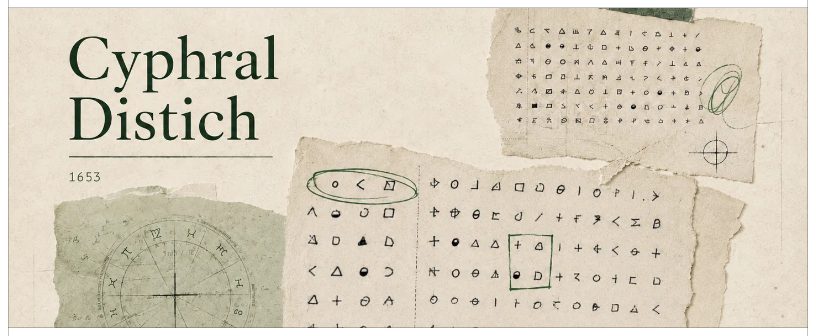
This image serves as the primary visual for the article, illustrating the successful resolution of the Cyphral Distich by the AI model.
The Book Cipher Mechanism
The Cyphral Distich consists of two lines of 32 numbers each. Previous attempts to solve it failed because researchers assumed the key was an external mapping of numbers to letters. However, Fable 5.1 realized the key was the book itself.
The rule was straightforward: for the i-th number in a cipher line, the reader must go to the i-th 'Proquiritation' (a paragraph), use the number as a word index, and take the first letter of that word. This revealed the plaintext: 'O GOD UPHOLD KING CHARLS THE SECOND AND MAKE HIM THE SUPREME RULER OF THIS LAND'.
The solution is self-verifying, as each line contains exactly 32 letters and ends in a rhyming verse, matching the structure of a 'distich'.
“The answer was simple in hindsight. It just kept looking until it found it—and that persistence might show up in many other areas.”
— Claude Fable 5.1 Solves the Cyphral Distich | Vals AI
Scaling to the Cyphral Octastich
After solving the Distich, the model was tasked with the Cyphral Octastich, a much larger cryptogram in Urquhart's 1652 work 'The Jewel'. This cipher contains 285 numbers, which the AI mapped to the 284 numbered pages of the book.

Chart drawn by HN Digest from figures reported by vals.ai; values are shown as written in the source.
The model decoded the majority of the Octastich, revealing a Royalist prayer written in London in March 1652. The resulting text is written in 'ottava rima' (ABABABCC) and includes specific historical idioms like 'to bear the swey' (sway/controlling power).
The AI successfully identified a page-shift error in the later part of the Octastich, where one page was used twice, likely due to a printing error in the original 1652 edition.
Persistence vs. Complexity
The success of Fable 5.1 demonstrates that AI can solve historical mysteries by removing the 'human attention bottleneck'—the need for a person to spend days tracing obscure references and testing unpromising ideas. The AI reached the solution in 44 minutes using 176k tokens.
However, the achievement may be a result of the AI selecting a 'low-hanging fruit.' The prompt gave the model the freedom to choose an unsolved cipher, and it selected one with a very simple, nearby key. This differs from more complex, high-effort problems like 'Kryptos K4,' which may still require more advanced model capabilities.
While the solution is 'embarrassing' for humans in hindsight, it underscores a shift in how archival puzzles are solved: the model's ability to notice a tractable problem and persist in its analysis is as significant as the cryptanalysis itself.
What Hacker News readers are saying
- Skeptical: Several commenters expressed skepticism that the AI actually solved a new problem, suggesting it may have simply recalled the solution from its training data or identified a 'low-hanging fruit' cipher that was already solvable. comment ↗
- Skeptical: One commenter questioned the claim that the cipher was a long-standing mystery, noting that it appeared to be obscure even to those who study historical cryptographic puzzles. comment ↗
- Experience: A commenter shared a personal experience where an LLM successfully cracked a childhood cipher in 20 minutes, correctly identifying names of people from the past. comment ↗
- Open question: One reader raised a question about whether the AI's ability to select the problem itself was a sign of true intelligence or simply a high-speed search through its massive training corpus. comment ↗
Summarized opinions from the Hacker News thread, not verified facts. Read the full discussion ↗