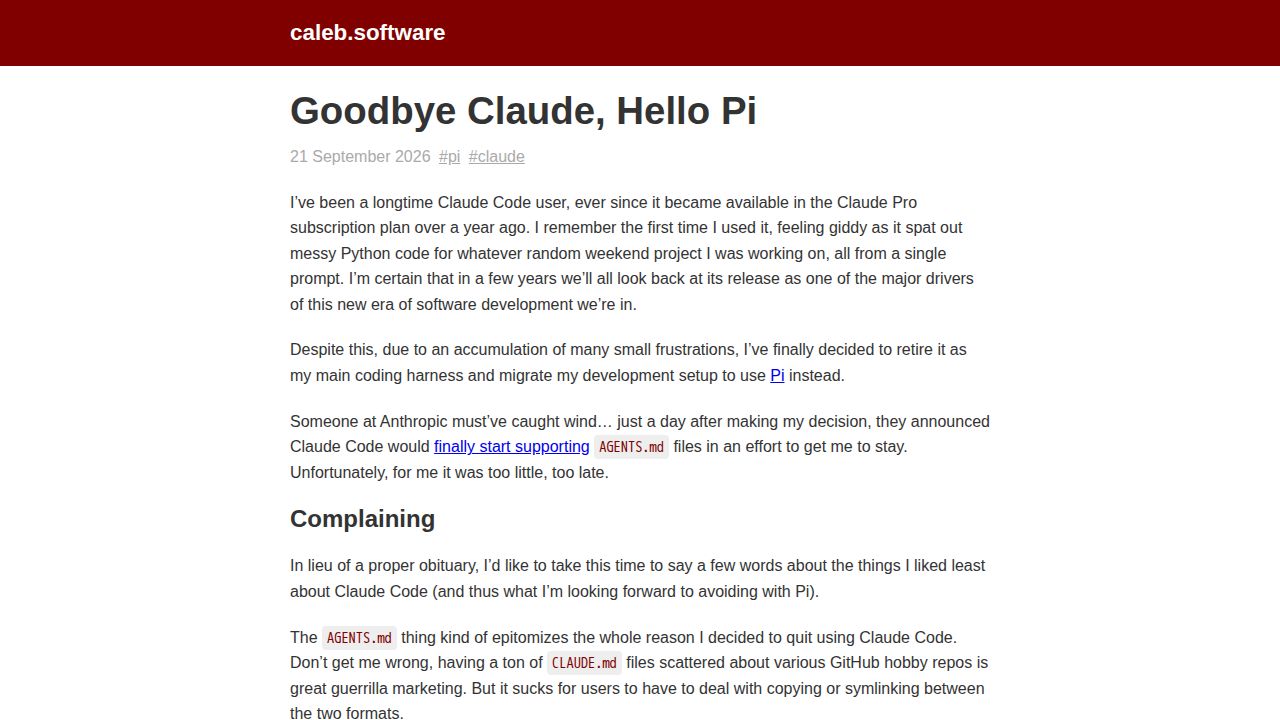
A software developer is retiring Anthropic's Claude Code as their primary coding harness in favor of an open-source tool called Pi. The move is driven by a perceived lack of product vision in Claude Code, characterized by a rapid release cycle that frequently alters system prompts and a technical limitation that prevents multiple active sessions from connecting to a single IDE instance.
Technical Friction in IDE Integration
A primary driver for the migration is how Claude Code interacts with development environments like VSCode. While the tool allows users to highlight text for context, it currently restricts users to a single 'connected' session at a time.
This limitation prevents developers from working on multiple tasks in separate tabs simultaneously, as a second tab cannot receive text selection events from the IDE. While a GUI extension exists to solve this, the author noted it suffers from broken slash commands and disorganized subagent output.
“Claude Code still has way more overhead than Pi for seemingly no benefit.”
— Goodbye Claude, Hello Pi
System Prompt Volatility and Token Overhead
The developer observed that Anthropic's rapid release cycle—244 updates in one year—frequently alters the underlying system prompts and tool descriptions. These changes can substantially shift how the Large Language Model (LLM) performs, sometimes contradicting user prompts or repository conventions.
Furthermore, the author pointed out that Claude Code maintains high overhead compared to Pi. For example, the default Bash tool description uses nearly 3,000 tokens to explain basic git and PR actions, which the author argues the models already know how to perform without such detailed instructions.
The Shift to Open-Source Customizability
In contrast to Claude Code's 'dynamic workflows' and 'agent teams,' the developer is moving toward Pi for its minimalist approach and extreme customizability. This transition was facilitated by Pi's open-source nature, which allowed for the rapid creation of custom extensions to handle specific use cases.
The developer noted that while Claude Code is a sophisticated piece of software, it currently feels like a product lacking a singular direction, whereas Pi provides a stable foundation that can be tailored to the specific needs of a personal development setup.
Uncertainties and Limitations
The source provides a subjective personal account of software frustrations and does not provide independent performance benchmarks or a technical specification for the 'Pi' tool. While the author expresses satisfaction with Pi's stability, the specific technical trade-offs of using a less 'feature-rich' tool compared to Anthropic's enterprise-focused offerings remain a matter of personal preference.
What Hacker News readers are saying
- Experience: One commenter shared their experience using a coding agent on a MacBook, suggesting a specific inference engine combined with the Pi harness to achieve high performance. comment ↗
- Skeptical: A user expressed skepticism about switching, noting that they also experience issues with Claude making mistakes on simple shell aliases and considering building a custom harness instead. comment ↗
- Experience: One commenter reported that a different tool consistently outperformed the one mentioned in the article on various code benchmarking tasks when using local models. comment ↗
Summarized opinions from the Hacker News thread, not verified facts. Read the full discussion ↗