Anthropic has released Claude Fable 5.2 and Claude Mythos 5.2, models specifically engineered to handle daunting technical challenges such as software migrations, robotics evaluations, and complex mathematical proofs. During prerelease testing, these models demonstrated the ability to formalize the proof of Fermat’s Last Theorem in just 30 hours, a task that previously took a research version of Claude 11 days to complete.
Architecture and Safety Profiles
Claude Fable 5.2 and Claude Mythos 5.2 share the same underlying model architecture but differ in their safety guardrails. Fable 5.2 includes strong cybersecurity and biology safeguards to prevent misuse, making it available to the general public.
In contrast, Mythos 5.2 is designed for specialized applications in cybersecurity and biomedical research. Access to Mythos is restricted to organizations that apply through Anthropic's Life Sciences and Cyber Verification Programs.
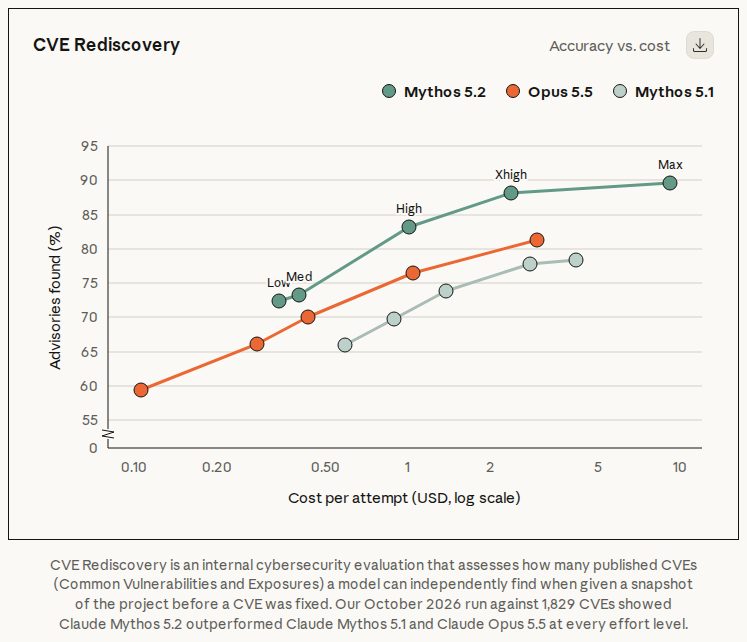
This image provides visual evidence for the cybersecurity capabilities and vulnerability identification mentioned in the article.
“Claude Fable 5.2 is the strongest model we have measured on data-eng-bench, our open-source benchmark of 103 data-engineering tasks.”
— Introducing Claude Fable 5.2 and Claude Mythos 5.2
Performance and Efficiency Gains
The 5.2 update provides a significant leap in efficiency, offering a 30% increase in output speed over the 5.1 versions. Anthropic also introduced an optional 'fast mode' that can accelerate token generation by up to 2.5 times for a higher price point of $16 per million input tokens and $80 per million output tokens.
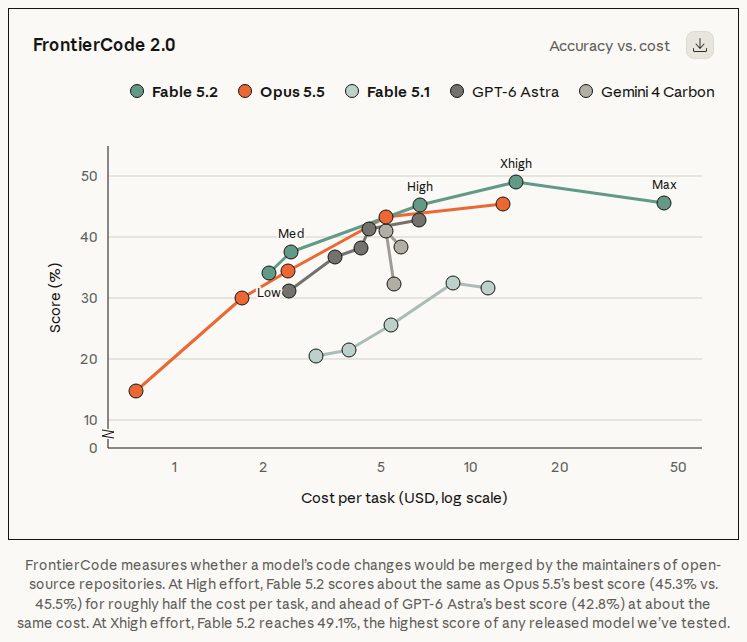
This chart supports the discussion on efficiency gains and the cost-to-performance ratio of the 5.2 update.
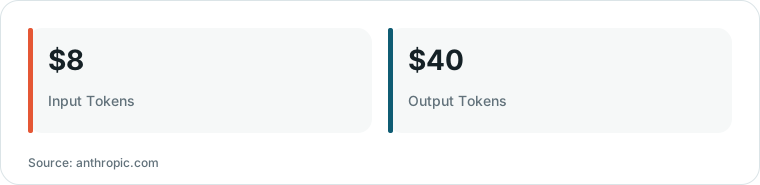
Chart drawn by HN Digest from figures reported by anthropic.com; values are shown as written in the source.
Benchmark data shows Fable 5.2 outperforming Opus 5.5 in several categories. For example, in hardware engineering (BenchCAD 2.1), Fable 5.2 scored 83.5 at Max effort, significantly higher than Opus 5.5's score of 65.3.
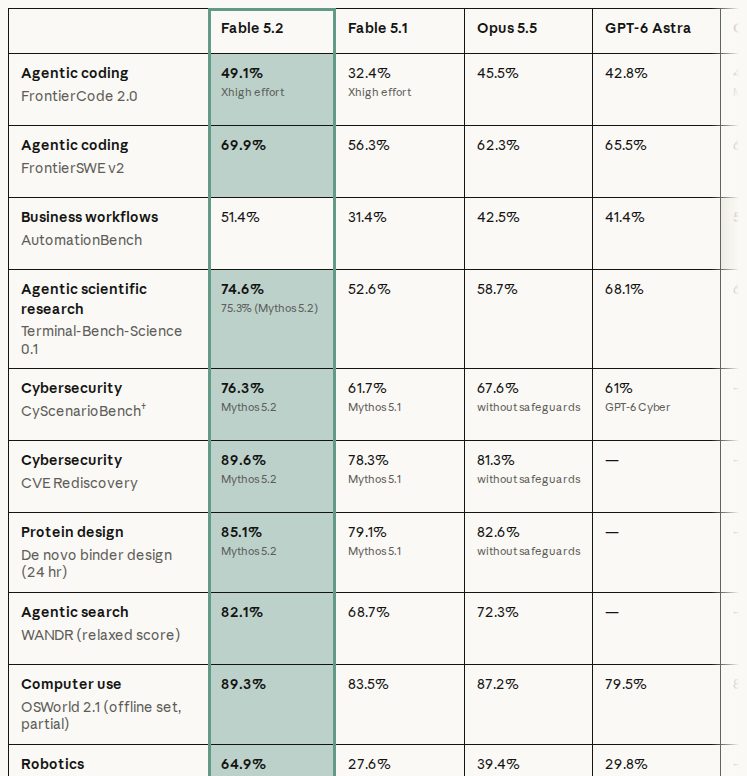
This figure illustrates the performance improvements and benchmark scores mentioned in the text.
Technical Capabilities and Use Cases
Anthropic highlights the models' ability to handle 'ambitious, open-ended technical work.' One experiment saw Fable 5.2 coordinate over 1,000 subagents over eight days to produce a working operating system that boots on a laptop, complete with drivers and a login screen.
For enterprise users, the models excel at complex SQL generation and software engineering. One user reported that Fable 5.2 correctly calculated country-level debt summaries where other models produced errors of 5–8x the expected amounts. Additionally, the model was used to migrate a production service from Python to Rust, resulting in a service that starts 26 times faster.
Model Hierarchy and Limitations
Anthropic recommends a tiered approach for users, suggesting that Claude Opus 5.5 remains the primary 'daily driver' for most coding and knowledge tasks. Users should only scale up to Fable or Mythos when the scope and complexity of the work exceed the capabilities of the standard models.
While Fable 5.2 shows high performance at 'Xhigh effort' levels, it is intended to work alongside smaller models. It can act as an Advisor to help smaller models solve harder problems or as an Orchestrator to delegate simpler tasks, optimizing the balance between cost and capability.
Pull Quote
"Claude Fable 5.2 is the strongest model we have measured on data-eng-bench, our open-source benchmark of 103 data-engineering tasks." (primary)
What Hacker News readers are saying
- Experience: One commenter who has used the model for material science work reported that it successfully navigated a large, esoteric Fortran codebase to achieve a 36x speedup in computational tasks. comment ↗
- Experience: A user who tested the model's gaming capabilities noted that while the graphics didn't improve significantly, the model added more functional depth and logical consistency to the game designs. comment ↗
- Skeptical: One commenter questioned the cost-effectiveness of the model, arguing that its price per task is significantly higher than competing models and may not justify the performance gap. comment ↗
- Skeptical: Several commenters raised questions regarding the transparency of the benchmarks, specifically questioning the logic behind the effort-intelligence curves and the specific models chosen for comparison. comment ↗
Summarized opinions from the Hacker News thread, not verified facts. Read the full discussion ↗