The traditional 'relay' of data requests—where a marketing leader's question passes through analysts and engineers before returning as a dashboard—is being disrupted by multi-turn AI agents capable of executing SQL and interpreting business logic. MotherDuck has proposed a new role, the Data Intelligence Engineer, to manage this shift by focusing on the curation of organizational context and the oversight of automated systems.
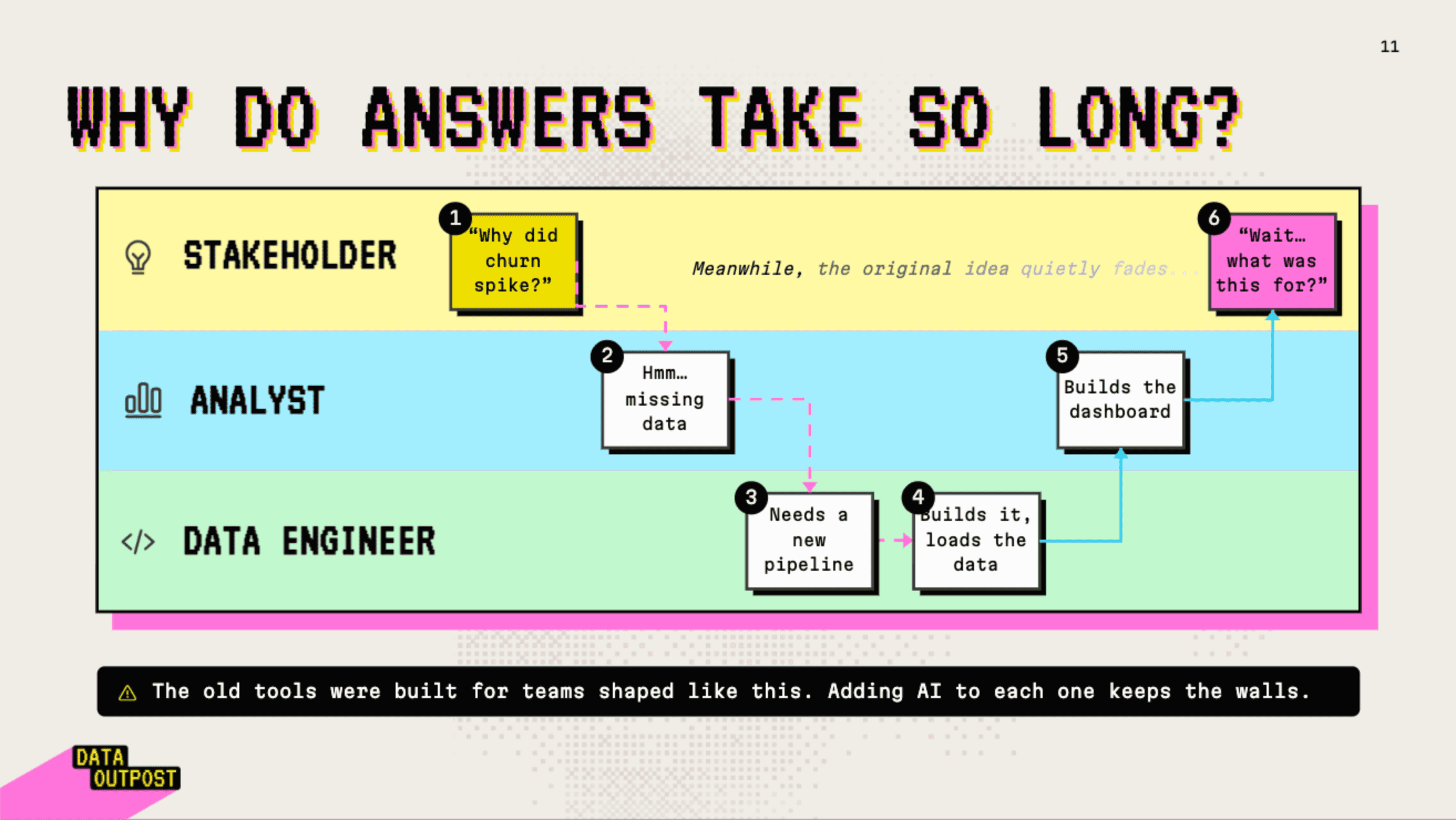
This image illustrates the traditional 'relay' of data requests described in the opening paragraph.
The Shift from Manual Pipelines to AI Agents
Previously, data teams faced a significant bottleneck where every handoff between an analyst and an engineer caused a loss of context and a decay in the ability to act quickly. While early 'co-pilot' tools offered some speed, they did not eliminate the need for these manual handoffs.
Recent advancements in LLMs have changed the landscape by enabling agents to perform multi-turn reasoning. These agents can now attempt a query, analyze the results, and iterate on the logic, making tasks like building dashboards or dbt pipelines 'promptable' for business stakeholders.
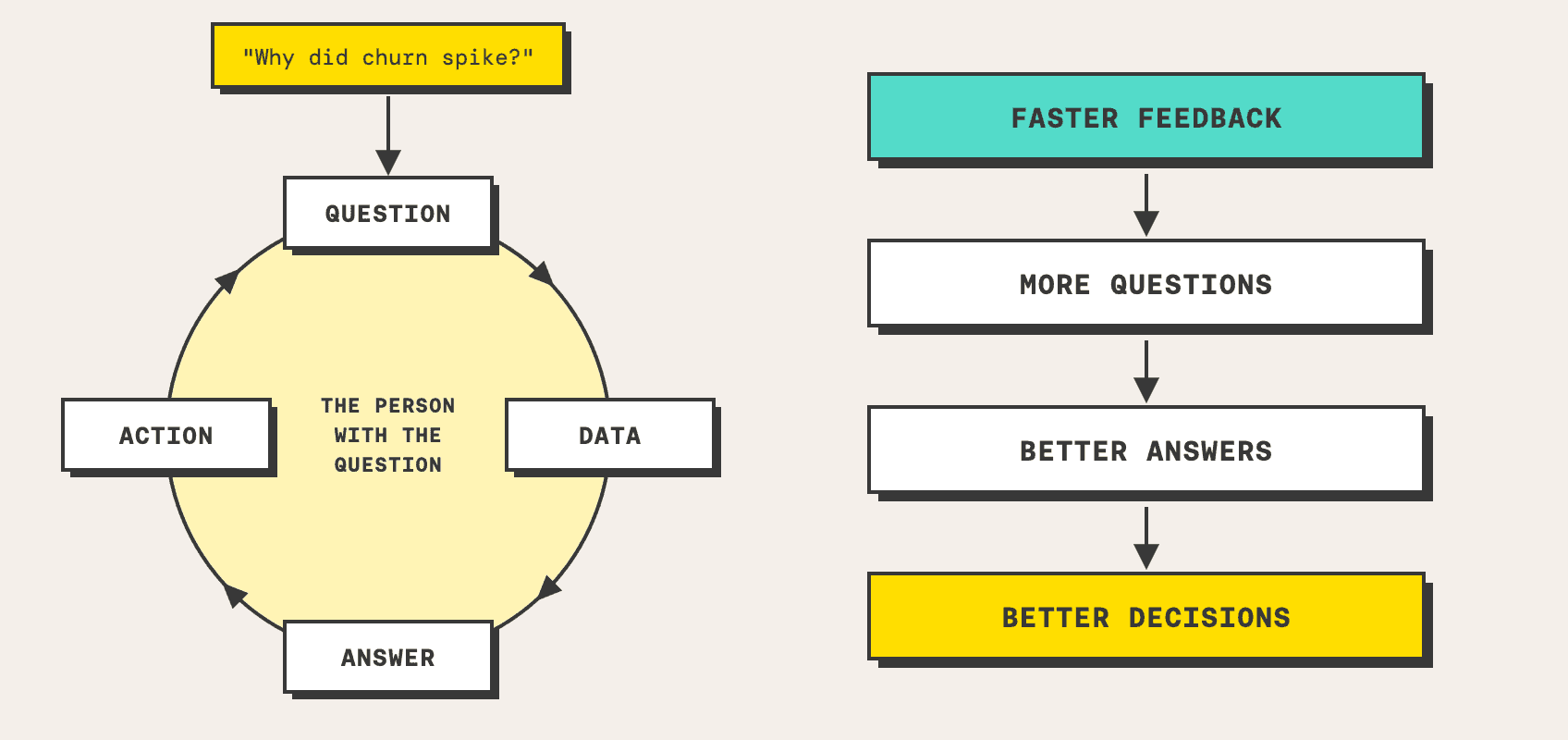
This visual supports the discussion of how LLMs perform multi-turn reasoning to iterate on logic.
“Data eng, regardless of tooling or who does it, is an accountability function.”
— The dawn of the Data Intelligence Engineer | MotherDuck
Defining the Data Intelligence Engineer
The Data Intelligence Engineer is defined as a role that automates the work of traditional data engineers and analytics engineers by conducting software agents. Instead of manually building every pipeline, these engineers encode system knowledge into shared context, such as defining what 'ARR' means or which specific table contains the correct revenue data.
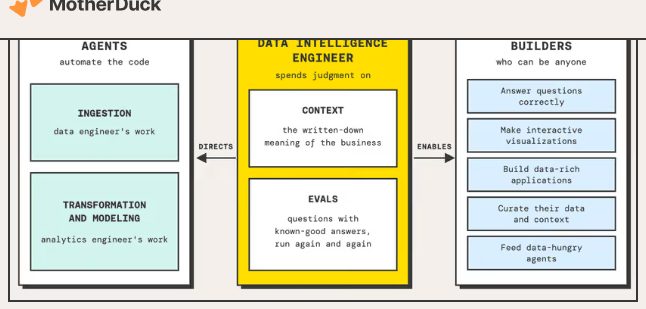
This image provides a visual definition of the Data Intelligence Engineer role as described in the text.
A core responsibility of this role is the creation of 'evals'—system tests that validate whether an agent provides the correct answer to a known question. These evals serve as a confidence mechanism and a way to detect when the underlying data or logic breaks.
Accountability and Proportional Supervision
Despite the automation of SQL and dashboard creation, humans remain necessary for accountability. A model can understand SQL, but it cannot inherently know a company's specific internal definitions or distinguish between similar-looking tables without a clean data model.
To manage the risk of AI-generated errors, the framework proposes three circles of supervision. The 'Wild West' allows for unsupervised experimentation, the 'Curated' set includes important but non-critical dashboards, and the 'Core' contains high-stakes metrics that require the highest level of data team vigilance.
What Hacker News readers are saying
- Alternative: One commenter expressed frustration with the extreme fragmentation of data job titles, suggesting that the narrow focus of different roles makes it difficult to complete projects and advocating for more 'T-shaped' data professionals. comment ↗
- Skeptical: Another user shared a critical perspective on the rapid automation of computer-based work, suggesting that many roles currently performed from a laptop may face significant disruption within a very short timeframe. comment ↗
- Skeptical: One commenter raised questions about the limits of automation, arguing that human society and economics are shaped by human factors that may not be easily replaced by efficiency-focused AI. comment ↗
Summarized opinions from the Hacker News thread, not verified facts. Read the full discussion ↗