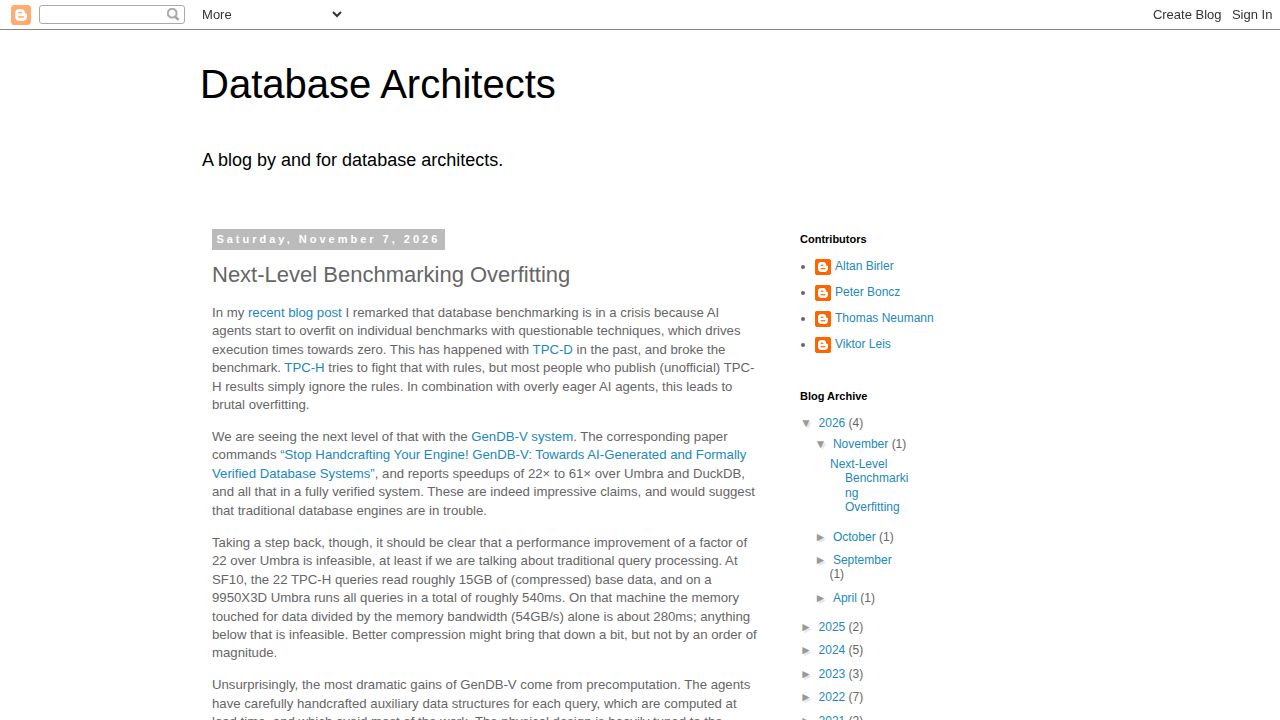
The integration of Large Language Models (LLMs) into software development is enabling engineers to maintain complex 'hotpath' specializations that were previously too expensive to manage manually. While this allows for record-breaking scores on specific graph community benchmarks, it also introduces a risk of 'benchmarking overfitting,' where a system is tuned so specifically to a test that its performance becomes unpredictable in broader contexts.
The Rise of Agentic Optimization
Thomas Neumann's post highlights a shift where AI agents are used to optimize hotpath specializations for specific patterns. One commenter, writing as lmeyerov, noted that LLMs make the cost of maintaining these complex specializations bearable, allowing for 'superpower' performance on specific graph community benchmarks.
This approach is being used to build tools like GFQL, an open-source vectorized CPU/GPU Cypher for dataframes. The goal is to move toward runtime and loadtime specialization, where the system autotunes itself based on the user's top queries.
The Problem of Benchmarking Overfitting
The primary concern raised in the discussion is that letting AI agents optimize for a specific database benchmark makes that benchmark a poor measure of general utility. One commenter, perching_aix, argued that if a benchmark can be 'gamed' by an AI, it should be considered obsolete or heavily disclaimed.
This creates a situation where a product might appear to be a market leader based on a specific test, while its performance on slightly different data access patterns remains unknown. Commenters noted that query performance is highly dependent on runtime access patterns, much like choosing the correct data structure for a specific programming task.
Trade-offs and the 'Not Blowing Up' Criterion
A significant technical hurdle in this optimization trend is the risk of regression. One commenter, artrax, pointed out that an optimization providing a 10x improvement for one query might slow down a slightly different query by 100x.
Because of this, the primary goal for a reliable database optimizer is often to ensure the system does not 'blow up' for the 99% percentile of queries, rather than chasing peak performance for a narrow set of test cases.
The discussion concluded with the sentiment that while these optimizations have a place, customers must eventually learn to disregard deceptive figures and focus on whether a solution actually addresses their specific problem.
Uncertainties in AI-Driven Rigor
There is an ongoing debate regarding who should be responsible for triaging the issues caused by AI-driven optimizations. One commenter, xyzzy_plugh, suggested that the burden of rigor should fall on the first human in the loop rather than being a final stage of peer review.
It remains uncertain how effectively these systems can be audited for 'overfitting' before they are deployed, or how much of the performance gain is a result of genuine architectural improvement versus narrow optimization for a test suite.
pull_quote
Letting AI agents optimize for a given database benchmark makes the benchmark useless. Good! That means the benchmark was always prone to be gamed and misrepresented, and deserves to be obsoleted and ignored, or at the very least heavily disclaimed.
source_id": "perching_aix" (hn-50452496) (Note: The prompt requires the source_id to be the hn-id for discussion digests, but the source_packet uses author names for comments. I will use the author name as the identifier as per the source text provided.)