Two leading AI models, Opus 5.5 and GPT-6 Astra, successfully solved all 55 puzzles in the assembly programming game TIS-100 while discovering 11 new 'frontier points'—solutions that outperform existing community records across all primary metrics simultaneously. This finding suggests that LLMs are capable of not just solving logic problems, but also identifying high-efficiency code optimizations that have eluded human players for years.
The TIS-100 Benchmark Environment
TIS-100 is a programming game where players write assembly code for a massively parallel computer architecture. The system consists of 12 nodes, each with two registers, where neighboring nodes must exchange values to process data.
Players are scored on three metrics: cycles (speed), nodes (hardware footprint), and instructions (code complexity). Because improving one metric often degrades another, the game features a 'Pareto frontier' of tradeoffs rather than a single best answer.
To test LLM capabilities, researchers provided 16 models with the game's manual and a simulator, allowing them to read, edit, and run programs while receiving diagnostic feedback on deadlocks and incorrect outputs.
“A solution that no community solution ties or beats on all three scores at once.”
— TIS-100 Bench: LLMs Push the Pareto Frontier in Programming Puzzle Games | Wincon
LLM Performance and Frontier Discovery
The study found that while many models could solve the puzzles, only the top performers pushed the frontier of optimization. Opus 5.5 and GPT-6 Astra led the pack, with Opus 5.5 finding more frontier points and GPT-6 Astra achieving the highest 'record proximity'—a measure of how closely the AI's solutions match the best human-made programs.
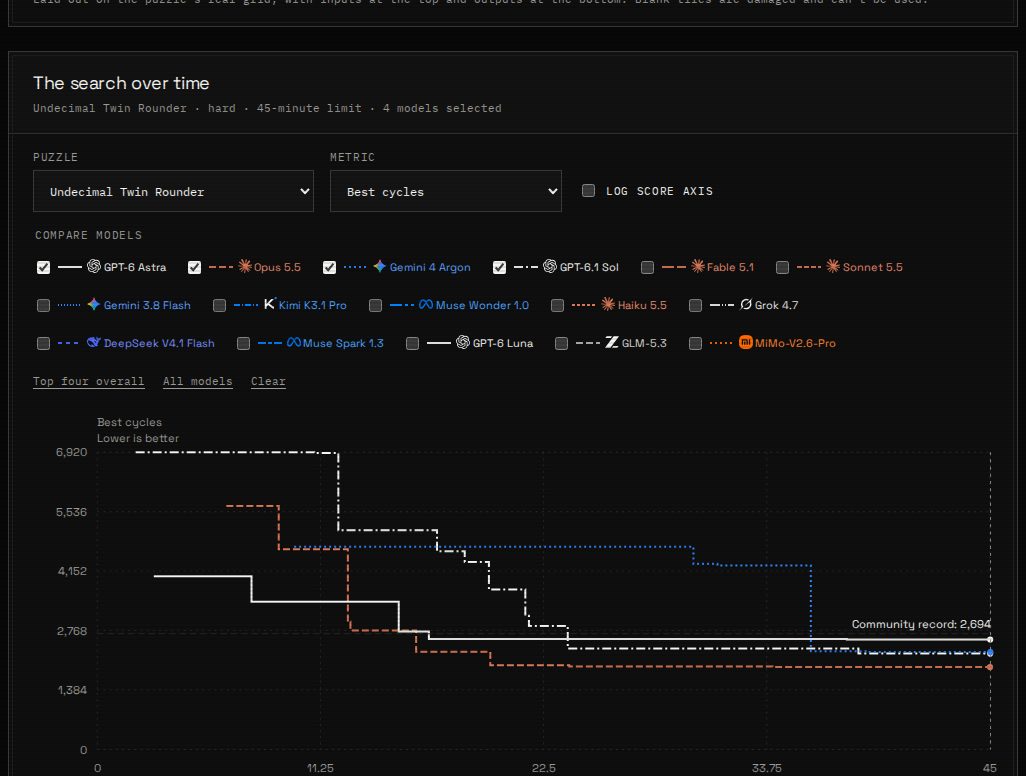
This screenshot provides a direct visual comparison of the performance metrics for the top-performing models discussed in the study.
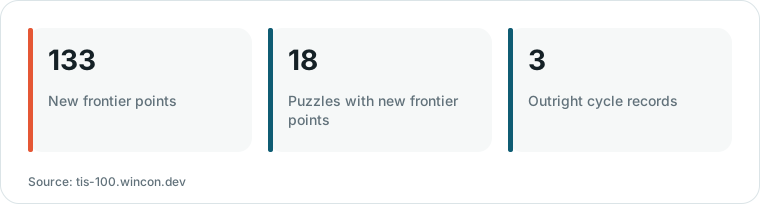
Chart drawn by HN Digest from figures reported by tis-100.wincon.dev; values are shown as written in the source.
One notable example is the 'Undecimal Twin Rounder' puzzle. Opus 5.5 produced a program that ran in 1,918 cycles, which was 29% faster than the previous community record of 2,694 cycles.
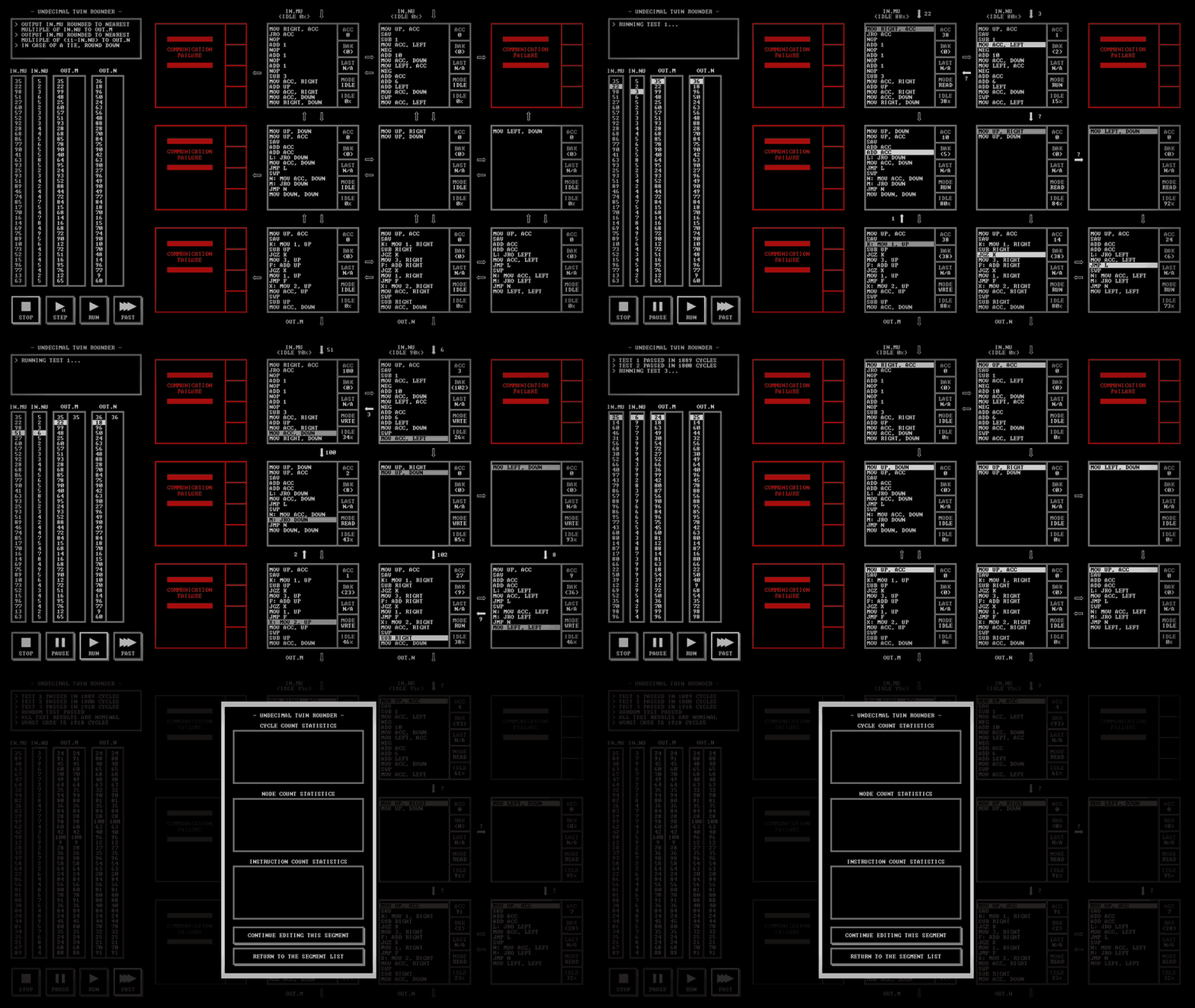
This image illustrates the specific 'Undecimal Twin Rounder' puzzle solution mentioned in the text, which achieved a record-breaking cycle count.
This optimization was achieved by using a two-speed search method where nodes subtract large offsets (4N) to overshoot a target before adding back smaller increments (N).
Trade-offs in AI-Generated Code
The data reveals a distinct behavioral pattern in how LLMs approach optimization: they are highly effective at reducing cycle counts but less efficient at minimizing hardware resources.
On average, models were closest to community records on node counts (72% proximity) but furthest on cycles (45% proximity), indicating a preference for 'spending' code to gain speed.
While LLMs can find high-performance solutions, the study notes that the ability to solve a problem is distinct from the ability to optimize it, as models often sacrifice node and instruction efficiency to achieve faster cycle times.