A new cosmological framework suggests the universe could be 26.7 billion years old, nearly double the age accepted by the prevailing scientific consensus. Developed by Rajendra Gupta and Nikolaos Samaras at the University of Ottawa, the model—known as CCC+TL—aims to explain the cosmos without relying on the existence of dark matter or dark energy.
The Mechanics of CCC+TL
The CCC+TL model stands for 'Covarying Coupling Constants plus Tired Light.' Instead of using dark matter to provide extra gravity or dark energy to drive expansion, it modifies the Einstein and Friedmann equations to account for changes in fundamental physical constants over time.
The 'Tired Light' component of the theory proposes that light loses energy as it travels across vast distances. This mechanism implies that light from the most distant reaches of the universe took significantly longer to reach Earth than current models assume, effectively extending the calculated age of the universe.
“A new model must not conflict with the pillars of cosmology and astrophysics, and our findings meet that challenge, including the yet-to-be-published Cosmic Microwave Background challenge.”
— Scientists claim the universe is twice as old as believed
Testing Against Astronomical Observations
To validate the framework, the researchers tested it against several pillars of modern cosmology. The model accurately predicted the abundance of hydrogen and helium created during the Big Bang, matching the results produced by the standard cosmological framework.
The team also used the model to reproduce the rotation curves of 175 galaxies. These curves describe how quickly stars and gas orbit at different distances from a galaxy's center; under conventional gravity, visible matter alone is insufficient to explain these motions, which is the primary evidence for dark matter.
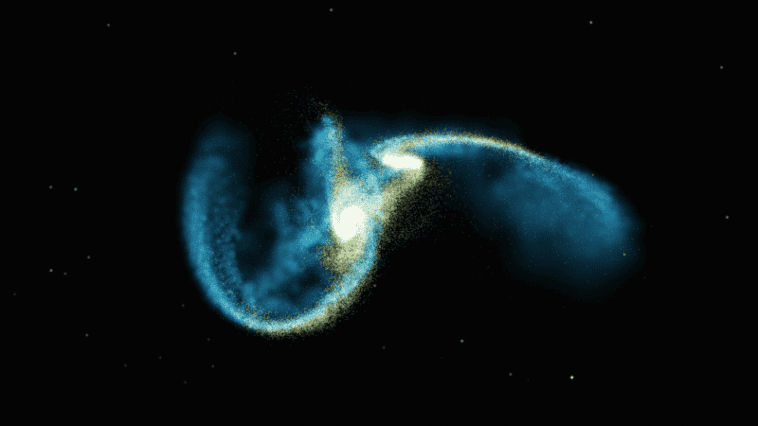
This image provides a visual representation of the types of galactic interactions and structures that the CCC+TL model aims to explain without dark matter.
Additionally, the model matched cosmic chronometer measurements, which allow astronomers to reconstruct the history of cosmic expansion by comparing the ages of galaxies at different distances.
Addressing the Early Galaxy Paradox
One of the most significant implications of a 26.7 billion-year-old universe is its ability to resolve a puzzle raised by the James Webb Space Telescope. The telescope has identified galaxies that appear far too large and developed for their early position in cosmic history.
If the universe is significantly older than 13.8 billion years, these galaxies would have had more time to grow and mature, potentially removing the need for radical adjustments to the standard model to explain their existence.
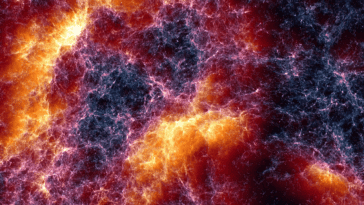
This visual supports the discussion regarding the early universe and the growth of galaxies over billions of years.

Chart drawn by HN Digest from figures reported by sciencedaily.com; values are shown as written in the source.
Current Status and Limitations
While the CCC+TL model shows promise in matching specific observations, it remains outside the mainstream scientific consensus. Much of the team's work is still undergoing peer review, and the standard ΛCDM model continues to explain a wide range of observations successfully.
The researchers noted that while the model meets several challenges, including the yet-to-be-published Cosmic Microwave Background challenge, independent testing by other scientists is required to verify the findings. Upcoming observations from the James Webb Space Telescope will be critical in determining if the model holds up against even more distant galactic data.
What Hacker News readers are saying
- Alternative: One commenter noted that this model shares similarities with previous attempts to recalculate fundamental constants, which suggested an inverse relationship between the age of the universe and the gravitational constant. comment ↗
- Skeptical: Several commenters expressed skepticism regarding the claim that the age of the universe is being significantly revised, arguing that the scientific consensus on these bounds has remained relatively stable for decades. comment ↗
- Open question: One reader suggested that while radical ideas are necessary to solve cosmological paradoxes like the Hubble tension, they questioned which specific expansion rate this new model actually matches. comment ↗
Summarized opinions from the Hacker News thread, not verified facts. Read the full discussion ↗