Jane Street has released a 'Socratic Tutor' skill within its agent_skills repository, designed to move users from initial awareness to genuine mastery of a topic through a structured, question-based loop. Unlike standard AI interactions where a model provides a direct answer to a prompt, this skill forces the user to reason, predict, and explain concepts, ensuring they can handle edge cases and teach the material themselves.
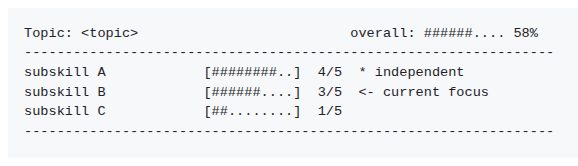
This screenshot shows the source documentation for the Socratic Tutor skill, illustrating the structured instructions and logic used to guide the AI's pedagogical behavior.
Diagnostic Placement and Skill Mapping
The tutoring session begins with a diagnostic phase rather than immediate instruction. The AI asks 3-5 probing questions ranging from easy to hard to determine the user's starting level across a set of 4-10 concrete subskills.
Once the diagnostic is complete, the system renders an ASCII skill map. This map tracks progress from 'unaware' (0) to 'can teach it' (5), providing a visual representation of the user's current focus and overall progress.
“Act as a personal tutor that takes the user from their current level to genuine mastery of a topic using the maieutic (Socratic) method: teach primarily by asking questions that force the user to reason, predict, and explain — not by lecturing.”
— agent_skills/socratic-tutor/SKILL.md at master · janestreet/agent_skills
The Maieutic Teaching Loop
During the teaching loop, the AI is instructed to ask only one question at a time, ending the message immediately to wait for a user response. It avoids providing hints or example answers, instead focusing on questions that require the user to find flaws in claims or apply ideas to new cases.
If a user provides an incorrect answer, the AI does not give the solution. Instead, it asks a narrower question to expose the specific contradiction in the user's reasoning. Direct explanations are only provided after 2-3 failed attempts, followed by an immediate re-test of the concept from a different angle.
To ensure true mastery, the AI occasionally plays 'devil's advocate,' challenging the user's correct answers to see if they can defend their logic under pressure.
Strict Evaluation and Spaced Review
The skill employs a rigorous 'earned, not given' policy for leveling up. A user only advances a level after demonstrating performance across at least two independent checks, one of which must be an unprompted recall of the information.
The system also interleaves 'spaced reviews,' where it periodically re-tests earlier subskills without warning. If a user fails a review, the system automatically lowers their level for that subskill and revisits the material.
The course concludes only when every subskill reaches the target level. At that point, the AI runs a final mixed assessment covering everything, including at least one question per subskill and one integrative problem.
What Hacker News readers are saying
- Skeptical: One commenter expressed skepticism about the novelty of the approach, suggesting it resembles common AI consulting trends and noting that some organizations have rejected similar implementations in their codebases. comment ↗
- Alternative: Another commenter pointed out that the specific skills used by Jane Street are more complex than standard Socratic questioning, which they noted has been independently implemented in many public repositories. comment ↗
Summarized opinions from the Hacker News thread, not verified facts. Read the full discussion ↗