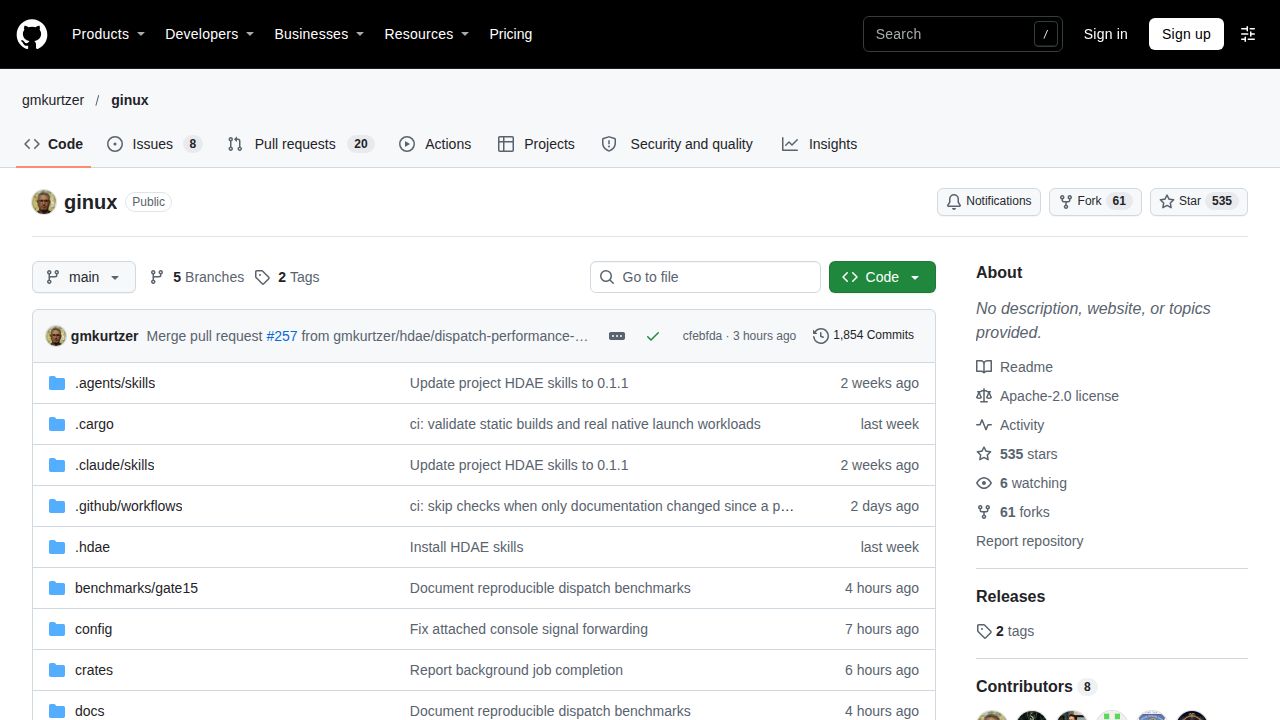
Greg Kurtzer has developed Ginux, a project that implements a userspace kernel to provide isolation for user processes without requiring the full overhead of a virtual machine. By shifting kernel-like functionality into userspace, the project seeks to mitigate the security risks inherent in the massive attack surface of the standard Linux kernel.
The Ginux Project Overview
Greg Kurtzer's Ginux project is presented as a userspace kernel designed to handle task-specific operations. The core idea is to use indirection to avoid the gargantuan task of replacing the entire Linux kernel, instead providing a specialized interface for specific workloads.
The project's primary goal is to offer a more contained environment for processes. By running the 'kernel' in userspace, the system can theoretically limit the amount of host kernel code that a process can interact with directly.
Community Perspectives on Isolation Models
In the Hacker News discussion, commenters debated the technical positioning of Ginux. One commenter, writing as stingraycharles, observed that the approach sits between cgroups and virtual machines, though they questioned if it provides the same security guarantees as micro-VMs like Firecracker.
Another commenter, weinzierl, argued that the standard Linux kernel is a 'gigantic attack surface' with legacy code that modern applications do not need. They suggested that while namespaces do not fully solve this, userspace kernels like Ginux could potentially offer superior isolation for modern concerns like AI agents.
Technical Questions and Trade-offs
The discussion also highlighted several technical uncertainties regarding the implementation. For instance, the commenter ajasmin asked how the system handles syscalls and manages multiple isolated address spaces for leaf user processes.
While some participants viewed the project as a promising use of indirection, others expressed caution. One commenter, frevib, noted that while such systems can be developed with AI assistance, they still require significant human verification to be considered 'battle-tested' for secure environments.
Comparison to Existing Technologies
The project is often compared to existing container technologies and virtualization. While Docker-like containers rely on namespaces, Ginux's userspace approach aims to provide a different layer of separation.
The trade-off involves balancing the ease of use of containers against the heavy isolation of virtual machines. Ginux attempts to occupy the space in between, though its specific performance and security benchmarks relative to tools like gVisor or Firecracker remain points of interest for the community.
Unresolved Implementation Details
Several key technical details remain unconfirmed in the current documentation. Specifically, it is not yet clear if the system uses eBPF or other mechanisms to capture syscalls from the leaf processes.
The community remains divided on whether this approach is the 'right' path compared to rootless namespaces, which some argue already provide a full spectrum of isolation for many use cases.