Starting with .NET 11, the framework will no longer run on older hardware that lacks modern instruction sets, such as those requiring the x86-64-v1 baseline. This shift moves the minimum requirement to x86-64-v2 across all operating systems, a change designed to align with the hardware requirements of modern operating systems like Windows 11 and to reduce the complexity of supporting legacy processors.
Modernizing Hardware Requirements
The .NET 11 runtime updates its minimum hardware requirements to favor modern instruction sets on x86/x64 and Arm64 architectures. For x86/x64 systems, the baseline moves from v1 to v2, which guarantees support for instruction sets such as CX16, POPCNT, SSE3, SSSE3, SSE4.1, and SSE4.2.
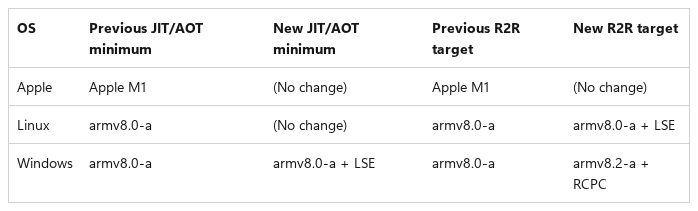
This image illustrates the specific hardware baseline shifts and instruction set requirements described in the hardware modernization section.

Chart drawn by HN Digest from figures reported by learn.microsoft.com; values are shown as written in the source.
On Arm64 architectures, the update introduces a new requirement for the LSE (Large System Extensions) instruction set on Windows and Linux. For Windows specifically, the ReadyToRun (R2R) target has been updated to armv8.2-a + RCPC, covering the majority of hardware officially supported by the OS.
“The update to the minimum baseline was made to reduce the maintenance complexity of the codebase and to better align with the documented (and often enforced) hardware requirements of the underlying operating system.”
— What's new in .NET 11 runtime
Transition to Runtime-Native Async
A significant architectural shift in .NET 11 is the introduction of 'Runtime Async V2.' This feature moves away from the traditional model where the compiler emits state-machine classes to handle asynchronous tasks. Instead, the runtime itself now tracks async execution, suspension, and resumption.
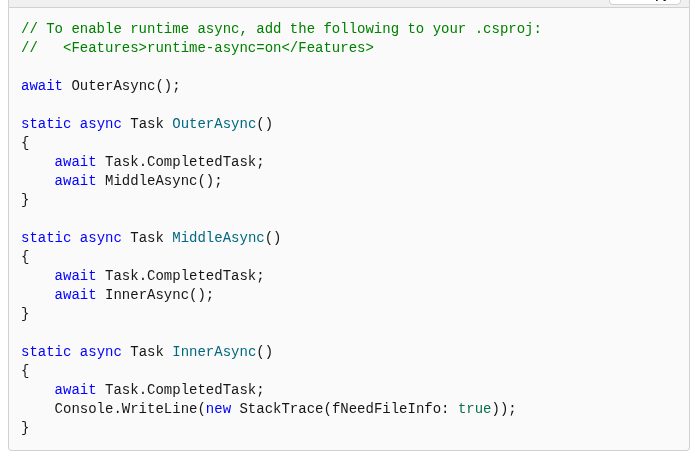
This screenshot provides a concrete example of the 'Runtime Async V2' feature which replaces compiler-generated state machines.
This change produces cleaner stack traces because the actual methods appear directly on the call stack during live execution. It also improves debuggability by allowing debuggers to step through await boundaries without jumping into compiler-generated infrastructure. The runtime libraries themselves are now compiled with this feature enabled, allowing for a smoother migration of entire applications.
Performance and Optimization Gains
The new Runtime Async model includes several performance optimizations, such as JIT-compiled dedicated versions of synchronous methods that return tasks. The JIT also tail-merges async suspension points to reduce code size and caches continuations to reduce allocation pressure in async-heavy code.
Additionally, the runtime now detects when a continuation has nothing to restore and skips the capture/restore cycle for ExecutionContext. This reduces overhead in high-throughput paths, particularly for applications that use AsyncLocal values sparingly and call ConfigureAwait(false).
Maintenance and Compatibility Trade-offs
Microsoft states that the move to a higher hardware baseline reduces the complexity of the codebase by removing support for older hardware that is unlikely to be in use. This also helps define a 'lowest common denominator' for AOT targets, which can improve performance by avoiding the need to default to the oldest possible instruction sets.
However, this change means that applications targeting .NET 11 will fail to run on older CPUs, potentially printing a message stating that the CPU is missing baseline instruction sets. For ReadyToRun-capable assemblies, some supported hardware that does not meet the new expected support may experience additional startup overhead.
What Hacker News readers are saying
- Technical note: One commenter pointed out a specific change in how decimals are handled, noting that a value of 0.1 results in a different representation in .NET 11 compared to .NET 10. comment ↗
- Technical note: A user expressed surprise at the runtime async support, noting that while they expected improved stack traces, they were impressed that the change could maintain equivalent performance. comment ↗
- Technical note: One commenter raised an open question regarding the underlying implementation of runtime async, asking if it implies the use of stackful coroutines. comment ↗
- Technical note: A commenter clarified that .NET 11 is a Standard Term Support release, noting that it actually has a shorter support window than .NET 10. comment ↗
Summarized opinions from the Hacker News thread, not verified facts. Read the full discussion ↗