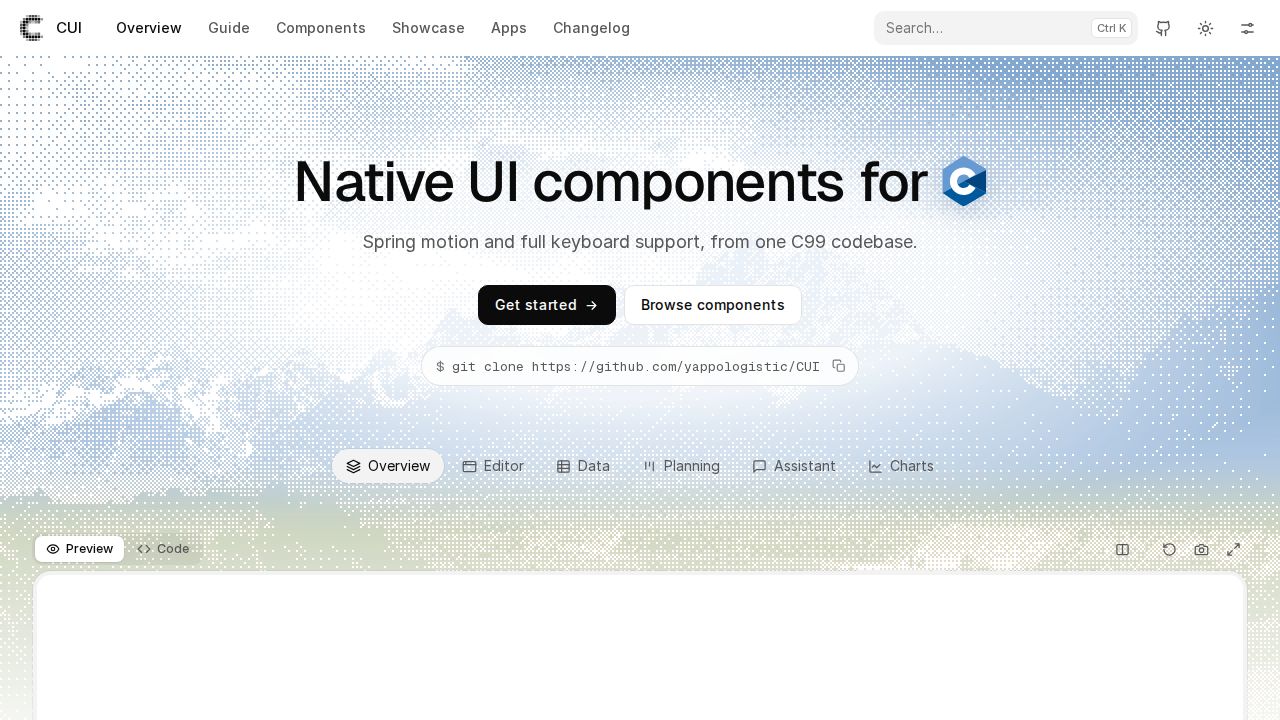
CUI is a new UI framework designed to provide native-feeling components for the C programming language, utilizing an immediate-mode architecture to deliver a modern aesthetic. The project has quickly gained attention for its ability to produce clean interfaces that some observers compare to the popular ShadCN web component library.
Project Overview and Aesthetic
The submitter presented CUI as a toolkit for native UI components in C, emphasizing its ability to produce clean, modern interfaces. One commenter noted that the framework's small footprint makes it an attractive alternative to Electron-based apps, which can often exceed 300MB in size.
The framework's immediate-mode architecture and web-centric design have prompted debate over its suitability for traditional desktop UX constraints. Some observers noted that the UI primitives, such as 'chips' and 'ratings,' may prioritize aesthetics over functional constraints like precise positioning or physical keyboard interactions.
The 'Vibecoding' Debate
A central theme in the Hacker News discussion is the project's origins, with several commenters identifying it as 'vibecoded'—a term used to describe software primarily generated by AI. One commenter pointed out that the first commit was entirely written by Claude, leading to questions about whether the project incorporates 20 years of C and UI engineering knowledge.
Critics of this approach argued that while AI removes the bottleneck of writing code, it can create 'nightmare fuel' for long-term maintenance. They suggested that the framework's design might reflect the specific aesthetic biases of the LLM used to generate it, rather than the intentional design of a human engineer.
Native Wrappers vs. Custom Components
The term 'native' in the context of CUI was clarified by commenters to mean binary code running directly on the machine, rather than using system-provided UI components. One commenter pointed out that CUI provides custom components rather than wrapping native widgets like Cocoa NSButton or Microsoft.UI.Xaml.Controls.Button.
This distinction is important for developers who may expect a framework to adhere to specific platform guidelines. The discussion highlighted a trade-off: CUI offers a consistent, modern look across platforms, but it may lack the deep integration and accessibility features provided by true native OS widgets.
Unresolved Technical Questions
The discussion also raised questions regarding the framework's internal mechanics, such as how it handles widget ID generation and dynamic UIs. Some commenters expressed curiosity about how the framework would perform on embedded devices, such as an ESP32, where smooth animations and a high-quality UI are desirable but resource-constrained.