From the 1947 distinction between mathematicians and 'coders' to the 2025 emergence of 'AI Agent / Context Engineers,' software job titles have undergone a constant cycle of centralization and distribution. A new project by Ian Miell maps these shifts across seven distinct families, including Development, Operations, and Data & AI, to illustrate how the industry's priorities have evolved over eight decades.
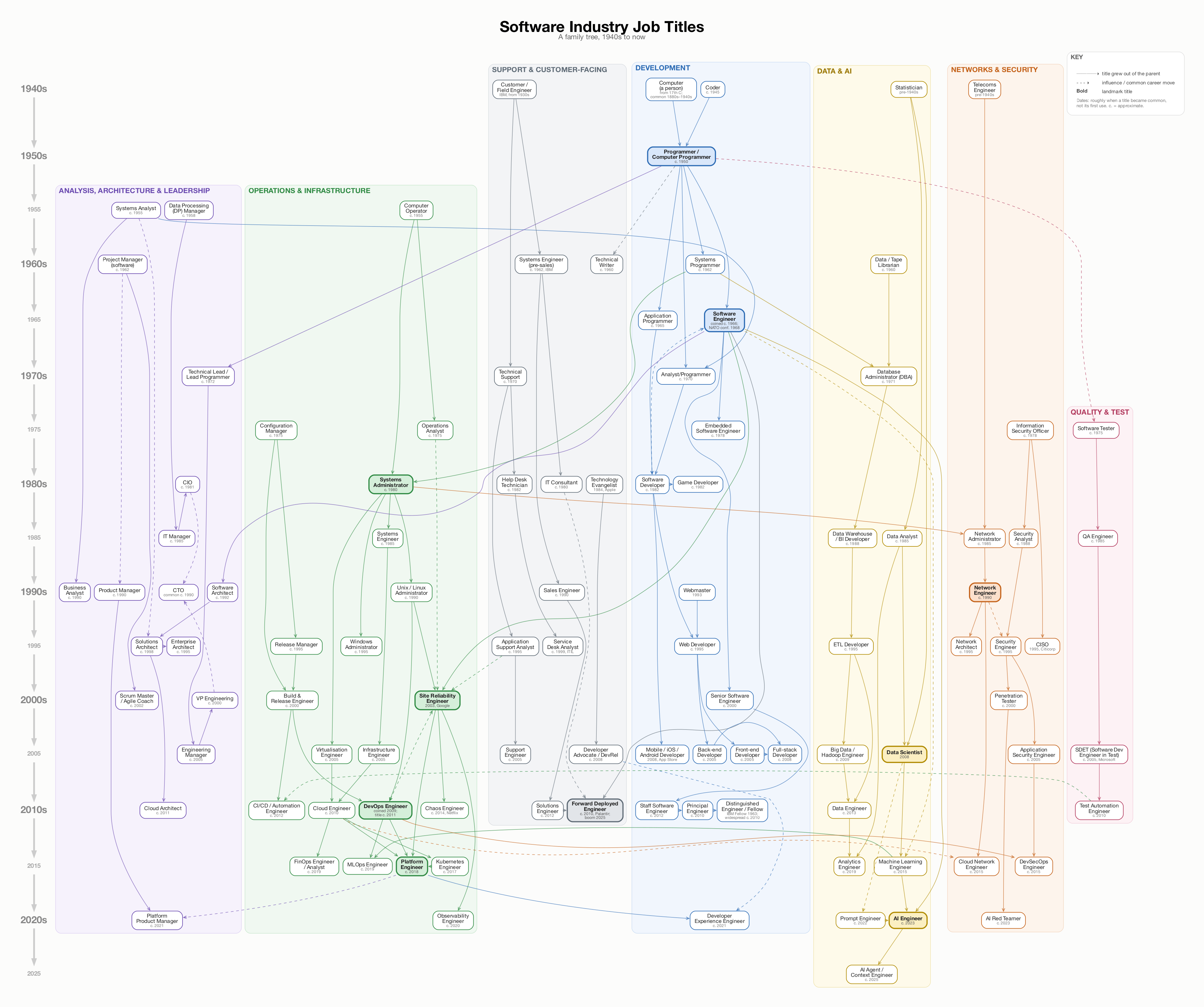
This image provides the primary visual evidence for the project's mapping of 104 unique titles across seven software domains.
The Evolution of Coding and Planning
In 1947, the work of using a computer was split into two distinct roles: mathematicians planned the problems, while coders translated those plans into machine instructions. At the time, coding was treated as lower-status clerical work, often performed by women.
Over time, coding evolved into the hard, creative component of software creation, eventually merging with the role of the programmer. The author notes that this cycle is repeating today as AI shifts the focus of development once again.
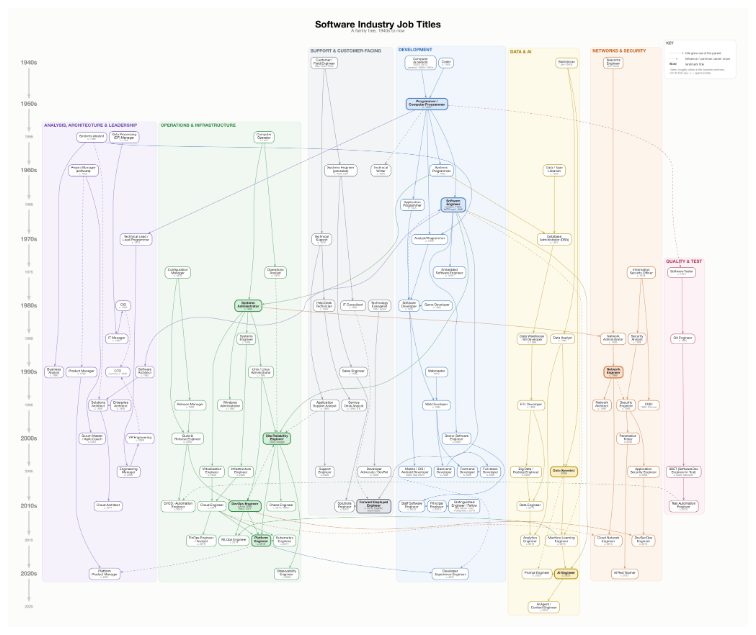
This screenshot captures the specific figure illustrating the evolution of coding and planning roles discussed in the article.
“The Dev/Ops divide has never been resolved. It just keeps getting new names.”
— A Family Tree of Software Job Titles – zwischenzugs.com
Centralization and the Distribution See-Saw
Job titles often reflect a 'centralization/distribution see-saw.' For example, the 'webmaster' role in the 1990s combined HTML, server management, and content editing into a single position.
By the mid-2000s, this role fractured into web developers, sysadmins, and designers. However, the trend reversed around 2008 with the rise of 'full-stack' developers, who rejoined those disparate responsibilities into a single title.
Recycled Titles and Short-Lived Roles
Some titles are recycled across decades without direct lineage. 'Systems Engineer' referred to a pre-sales role at IBM in the 1960s but became a senior sysadmin title in the 1990s due to Microsoft certifications.
Conversely, some titles are transient. The 'prompt engineer' and 'scrum master' roles peaked briefly before being absorbed into broader engineering management or delivery roles as the skills became standard parts of other jobs.
The Ongoing DevOps and Platform Engineering Debate
The relationship between SRE (Site Reliability Engineering), DevOps, and Platform Engineering remains a point of industry debate. While SRE was defined as asking a software engineer to design an operations team, DevOps was originally a culture of collaboration.
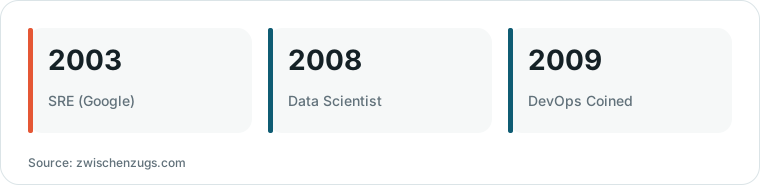
Chart drawn by HN Digest from figures reported by zwischenzugs.com; values are shown as written in the source.
By 2011, 'DevOps Engineer' became a specific job title for automation. Platform engineering emerged around 2022 as a successor to DevOps, though the underlying divide between development and operations continues to manifest in new names.
What Hacker News readers are saying
- Experience: One commenter who has held an Operations Manager title for over a decade noted that the role was missing from the provided lineage. comment ↗
- Experience: A commenter with a background in infrastructure argued that many modern titles like DevOps Engineer or SRE are often meaningless, as they frequently describe a generalist who manages ambiguity and high-level credentials. comment ↗
- Skeptical: Another user suggested that the current software titles are less accurate than they appear, proposing that roles should be renamed to reflect the work of interpreting and building upon existing human-created conventions. comment ↗
Summarized opinions from the Hacker News thread, not verified facts. Read the full discussion ↗