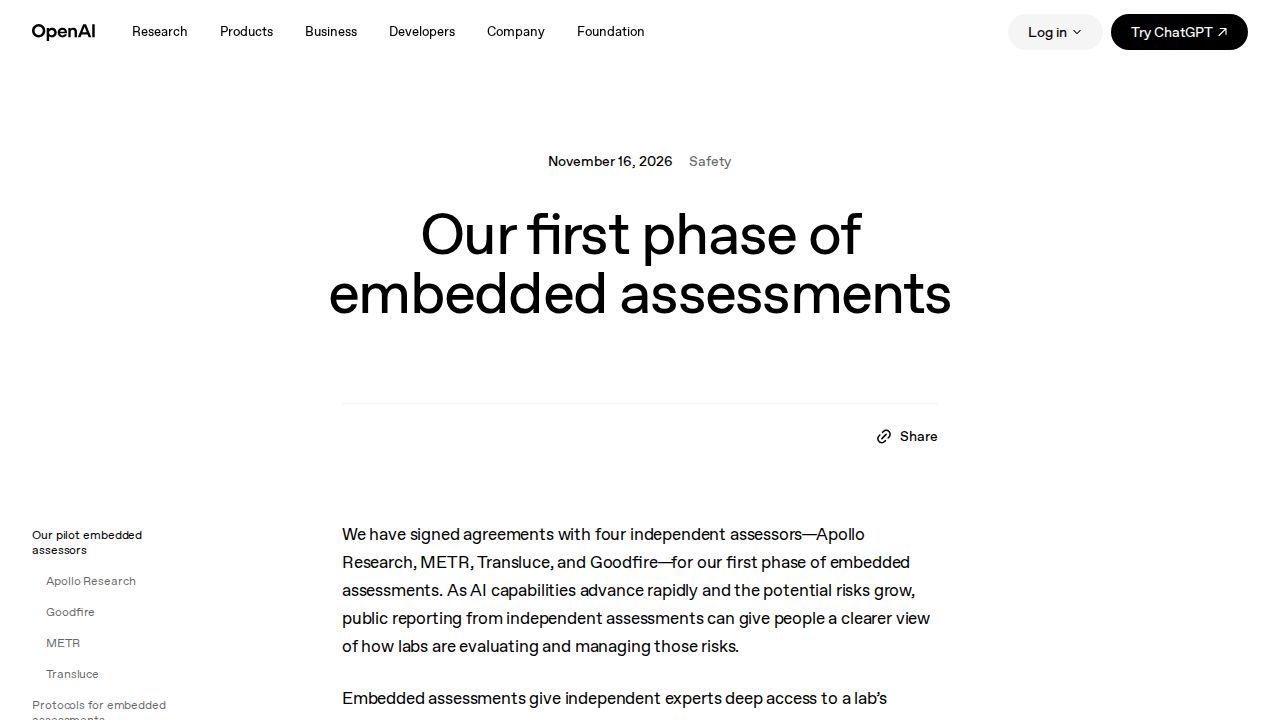
OpenAI has launched the first phase of 'embedded assessments,' a specialized auditing framework designed to provide safety evaluators with deeper access to internal tools and resources than traditional external audits. This initiative marks a significant pivot in how the company manages the risks associated with its rapidly advancing artificial intelligence models.
The Embedded Assessment Framework
OpenAI's new initiative involves deploying assessors who are integrated into the development process. According to the primary source, this first phase of embedded assessments is intended to provide a more comprehensive safety review than a 'hobbled' external audit.
Commenters on Hacker News noted that this approach likely grants auditors more access to internal tooling and resources. One commenter, writing as kenferry, suggested that the framework appears to be an external audit with significantly expanded permissions to use internal systems.
“First phase of embedded assessments at OpenAI”
— First phase of embedded assessments at OpenAI
Shift Toward a Safety-Centric Culture
The initiative is seen by some as a reaction to recent industry incidents and the need to manage liability. One commenter, writing as mvkel, argued that OpenAI has adopted a culture of 'safetyism' rooted in a fear of public backlash, contrasting this with Anthropic's long-standing safety-first approach.
This shift may have significant implications for OpenAI's competitive standing. One commenter, writing as vessenes, suggested that while OpenAI may be slowing down to address existential safety problems, this could allow faster-moving rivals to gain ground in the short term.
Terminology and Strategic Trade-offs
The choice of the word 'embedded' has sparked discussion regarding its implications. One commenter, writing as mentalgear, suggested using 'on-site' to avoid the 'baggage' of the term 'embedded,' while another, writing as esseph, argued that 'embedded' is a standard technical term for integrated systems.
The overarching trade-off involves balancing rapid innovation with rigorous safety protocols. Commenters on Hacker News discussed whether these measures are a necessary response to potential existential risks or a defensive move to manage legal liability and public perception.
Uncertainties and Future Outlook
While the first phase is underway, the specific technical criteria and the full scope of the assessments remain largely internal. It is currently unclear how these assessments will specifically impact the release timelines for upcoming models.
The long-term effect on OpenAI's 'techno-optimist' culture remains a point of contention. Observers are waiting for debriefs to determine if these assessments will successfully mitigate risks without stifling the company's core innovation engine.
Discussion Summary
The Hacker News discussion centered on the practical and cultural implications of OpenAI's new safety measures. Commenters debated whether the move is a proactive safety measure or a reactive one driven by fear of backlash.
One commenter, writing as e12e, expressed skepticism about the 'guardedly formulated' nature of the announcement, questioning if it is merely a restricted version of a full audit. Others, such as petesergeant, expressed a more positive view, stating they found it hard to see the initiative negatively.