Despite Rust's reputation for memory safety, Microsoft’s FORGE Lab discovered several instances where the language's standard library (std and core) fails to uphold its safety guarantees. These bugs occur because much of the standard library's foundational infrastructure relies on 'unsafe' blocks to manage raw pointers and operating system interactions. When these internal blocks break their safety contracts, they can expose the system to undefined behavior, potentially affecting billions of users who rely on Rust-based software like the Linux kernel, Android, and Cloudflare's infrastructure.
The Mechanics of Unsafe Rust
Rust achieves its safety guarantees through a rich type system and ownership model, but it allows 'unsafe' blocks for low-level operations. In these blocks, the programmer assumes responsibility for invariants that the compiler cannot automatically verify. For a library to be 'sound,' it must ensure that no matter how a user interacts with its safe API, the underlying unsafe code never triggers undefined behavior.
“When that code breaks its safety contract, even safe Rust can encounter behavior the language is designed to prevent.”
— Memory Safety Bugs in Rust Standard Library
Patterns of Misplaced Trust
One primary failure pattern involves 'panic safety.' If a function breaks a safety invariant and then calls code that panics, the program unwinds before the invariant can be restored. This leaves the system in a broken state where destructors might run on invalid memory. The FORGE Lab identified this in MapWindows::clone, where a panic during a clone operation would cause the destructor to access uninitialized values.
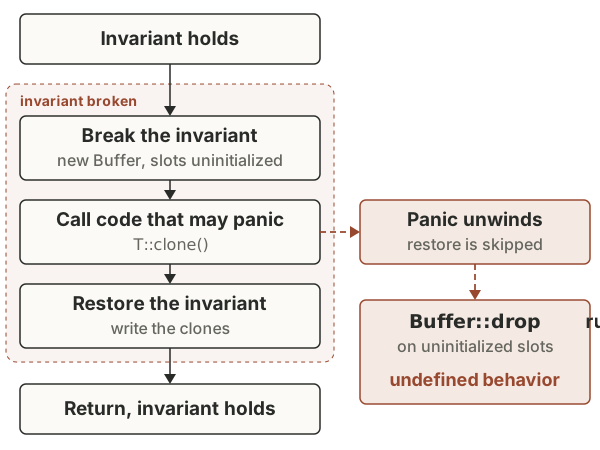
This diagram explains the 'panic safety' failure pattern where a program unwinds before a safety invariant can be restored.
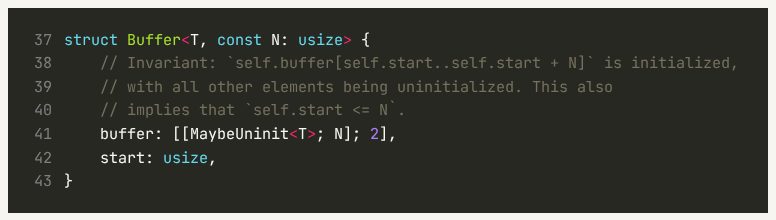
This screenshot provides the specific code context for the MapWindows::clone panic safety bug mentioned in the text.
A second pattern involves trusting user-provided implementations. For example, the researchers found that str::replace could be tricked by a custom pattern into creating a non-UTF-8 String. Because the library assumed a one-byte string pattern must be ASCII, it bypassed certain checks, allowing a custom pattern to inject invalid UTF-8 bytes into a String object.

This screenshot illustrates the second failure pattern where str::replace was tricked by a custom pattern.
Systemic Implications and Open Issues
These vulnerabilities are significant because Rust is increasingly used for critical infrastructure. Microsoft has designated Rust as a Tier-1 internal language, and major projects like the Linux kernel and Bun are migrating code to it. A bug in a foundational library like 'std' can have consequences that propagate far beyond the specific line of code where the error originated.
The research team worked with Rust maintainers to report and fix these issues, but the process revealed the inherent difficulty of auditing every allocation and trait implementation. As of the report, some issues remain open, highlighting the ongoing challenge of maintaining perfect soundness in a language that balances high-level safety with low-level performance.