Carnegie Mellon University (CMU) has launched CS Learn, an online platform that provides free access to select courses from its top-ranked computer science program. By leveraging existing classroom recordings and new AI-assisted production tools, the university aims to share its 'cutting edge' expertise in fields like generative AI and computational biology with a global audience.

The article mentions CMU's top-ranked computer science program and its goal to share expertise.
Expanding Educational Reach
The Kenneth C. Griffin School of Computer Science is making select lectures from its most popular courses available on YouTube and the CS Learn website. This initiative is designed to put CMU's teaching expertise in front of learners who would not otherwise have the opportunity to attend the university in Pittsburgh.

This visual represents the student experience and the academic environment of the school's program.
The initial lineup focuses on high-demand topics such as Software Architectures and Machine Learning in Production. Phillip Compeau, an assistant dean for innovation in computing education, noted that the goal is to share the 'cutting edge of the interdisciplinary nature' of the school's research.
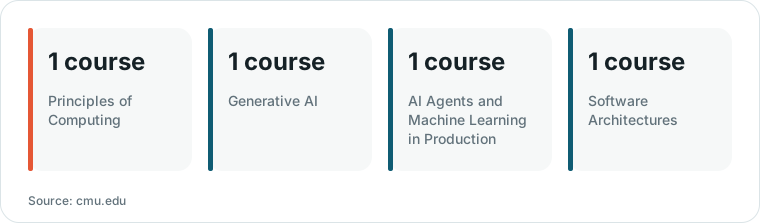
Chart drawn by HN Digest from figures reported by cmu.edu; values are shown as written in the source.
“We're taking this recording of a course that is cutting edge or on a topic that largely isn't taught elsewhere, and we'll make the recording available for free," Compeau said.”
— CMU Opens Access to Top Computer Science Classes Through Free CS Learn Platform
AI-Assisted Production and Privacy
To move content from the classroom to the web quickly, CMU utilizes a production pipeline involving the Software and Societal Systems Department's videography team and ScottyLabs, a student-run organization. ScottyLabs developed an AI-assisted system that optimizes raw recordings for online learning by focusing the video on the professor and presentation slides.
To protect student privacy, the system automatically blurs visible faces and cuts audio during student questions. To ensure online learners can still follow the classroom dialogue, the system converts those questions into on-screen text, allowing the educational context to remain intact without compromising individual identities.
Origins and Future Growth
The concept for CS Learn originated years ago when Phillip Compeau pitched the idea during his MBA studies at CMU's Tepper School of Business. The project relies on the school's existing infrastructure for recording popular courses, which were previously restricted to on-campus students.
While the current offering is a starting point, the university plans to expand the number of courses and types of content available in the spring and beyond. This expansion aims to keep pace with the rapid advancements in the computer science field.
What Hacker News readers are saying
- Experience: One commenter noted that many universities previously removed free online courses due to legal liabilities regarding accessibility, such as a lack of auto-captioning. comment ↗
- Open question: A commenter expressed interest in seeing more advanced topics like database internals and distributed systems, as well as supplementary materials like slide decks and notes. comment ↗
- Alternative: One user suggested checking out the university's existing database YouTube channel as an additional resource. comment ↗
Summarized opinions from the Hacker News thread, not verified facts. Read the full discussion ↗