Aristotle, a mathematical reasoning model developed by Harmonic, can now prove that Rust code contains no undefined behavior and adheres strictly to its specifications. This expansion follows the tool's previous support for C and Verilog, targeting high-stakes software where a single bug can result in catastrophic failures or the loss of millions of dollars in decentralized finance.
This image illustrates the core functionality of the Aristotle model in providing formal verification for complex systems.
Moving Beyond Traditional Testing
Unlike standard testing, which attempts to catch flaws by running specific inputs, Aristotle uses formal verification to provide a mathematical proof of correctness. This means the tool can guarantee that code does exactly what its specification says across all possible inputs.
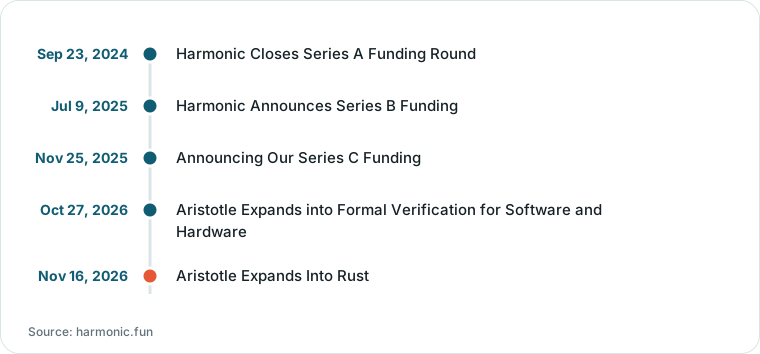
Chart drawn by HN Digest from figures reported by harmonic.fun; values are shown as written in the source.
A significant advancement in this release is the ability to verify code inside 'unsafe' blocks. These blocks allow developers to bypass some of Rust's standard safety guarantees, but Aristotle can still prove they behave as intended, providing a new level of certainty for systems developers.
This visual represents the expansion of the Aristotle tool to support Rust code, specifically targeting 'unsafe' blocks.
“Aristotle makes formal verification more accessible to Solana developers, helping teams check critical properties of their programs before launch and keep verifying them with every update.”
— Aristotle Expands Into Rust | Harmonic
Real-World Verification on Solana
The tool has already been applied to live Solana programs to identify critical vulnerabilities. For example, on the Manifest open-source order book, Aristotle proved 28 different results across the entire book and successfully identified a rounding bug that the team has since corrected.
At Project 0, a prime broker, the tool proved that the books remained consistent through a variety of operations, including deposits, withdrawals, borrows, repayments, and liquidations, regardless of the order in which they occurred.
Continuous Verification and Trade-offs
Harmonic's approach addresses the limitations of manual security audits, which are often performed once and can become obsolete as soon as the next code change is made. Aristotle is designed to run on every new line of code, ensuring that security keeps pace with every update.
While the tool provides a higher level of certainty, the source material does not specify the computational overhead or the time required to perform these formal proofs compared to standard unit testing. This remains an open question regarding the practical workflow for developers integrating the tool into rapid deployment cycles.
What Hacker News readers are saying
- Alternative: One commenter pointed out that several other tools exist in the Rust ecosystem for formal verification, noting that the field is currently a very active area of research. comment ↗
- Skeptical: Another user expressed skepticism regarding the general suitability of Rust for all use cases, arguing that the borrow checker can be a hindrance for certain architectures compared to garbage-collected languages. comment ↗
- Experience: One commenter noted that the ability to prove the absence of undefined behavior within unsafe blocks is a unique capability they have not seen in other systems. comment ↗
Summarized opinions from the Hacker News thread, not verified facts. Read the full discussion ↗