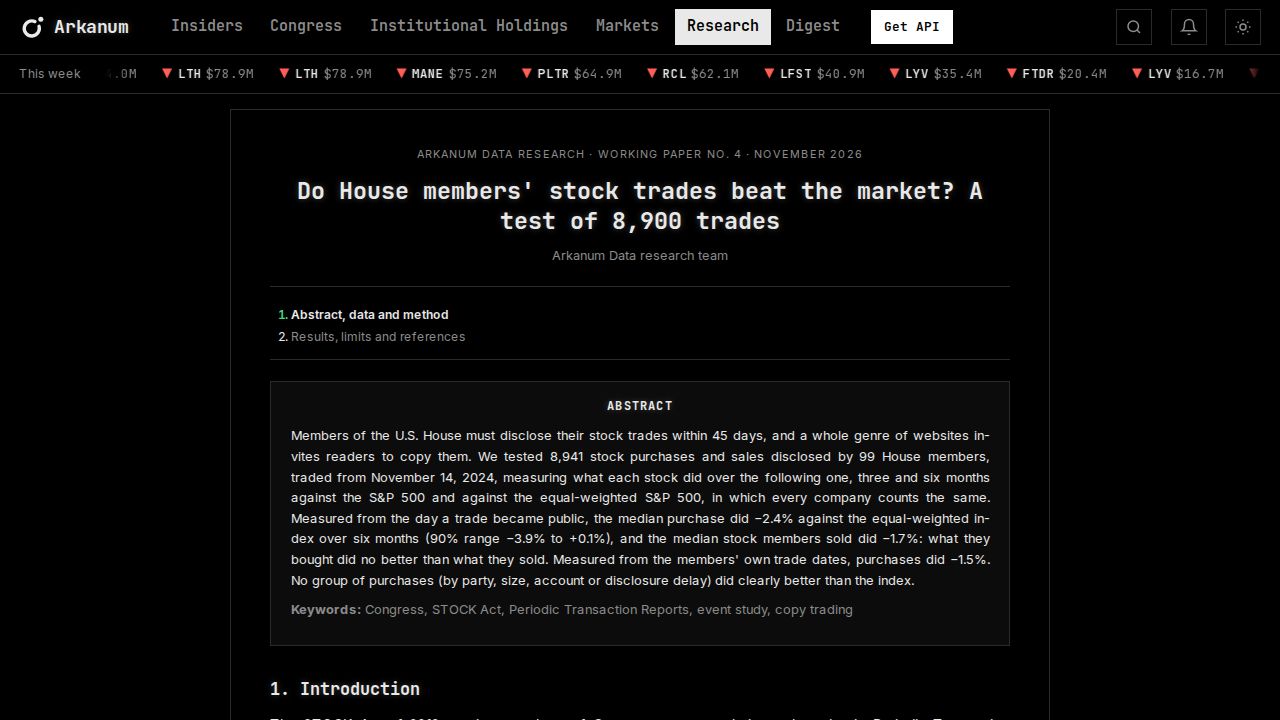
A test of 8,900 stock trades by members of the U.S. House of Representatives suggests that the median performance of these trades fails to beat the market. The analysis, provided by Arkanum Data, examines whether legislative positions provide an informational advantage that translates into superior investment returns.
Findings from the Arkanum Data Study
The primary source reports on a test of 8,900 stock trades to determine if House members' investment activities outperform the market. The analysis suggests that the typical or median trade made by a representative does not yield a significant advantage over standard market returns.
The study highlights a trend where the median performance often results in negative alpha. This indicates that, on a per-transaction basis, the average trade by a member of the House does not consistently beat the market benchmarks used for comparison.
“Do House members' stock trades beat the market? A test of 8,900 trades”
— Do House members' stock trades beat the market? A test of 8,900 trades
Data Limitations and Disclosure Gaps
A significant constraint on the analysis is the level of detail provided in public disclosures. Commenters on Hacker News pointed out that members often do not disclose the exact date and hour of a purchase or sale, making it difficult to track intra-day trading or very tight timelines.
Because of these gaps, it is currently impossible to measure whether members are profiting from short-term movements or trades occurring within a 45-day window. This lack of granularity means the study may not capture the full scope of high-frequency or rapid-turnover trading activity.
Discussion on Alpha and Market Dynamics
Participants in the Hacker News discussion argued that median performance is an imperfect metric for identifying insider advantages. One commenter, writing as ummonk, suggested that most 'alpha'—or excess return—might come from a few well-timed buys or sales rather than the median transaction.
Others echoed this sentiment, noting that a few high-profit trades could be hidden within thousands of ordinary ones. This perspective suggests that while the 'typical' trade might underperform, the study's structure might not be designed to catch the specific trades that would indicate a legislative information advantage.
Socioeconomic Context of Legislative Trading
The discussion also touched on the socioeconomic background of the individuals making these trades. One commenter, matteoraso, observed that many wealthy members were already affluent before entering politics, noting that legislative positions often pay relatively little.
Another commenter, mchristen, added that because these positions are not high-paying, they tend to self-select for individuals who already possess significant personal wealth. This context suggests that the ability to trade and hold positions may be more a function of pre-existing wealth than returns generated by the trades themselves.