When presented with a realistic military intelligence summary regarding displaced civilians, leading AI models like Gemini and GPT-5.6 produced professional-sounding assessments that completely erased the existence of women and girls. While these models can recite the UN's Women, Peace and Security (WPS) mandates when asked, they fail to apply those principles to routine operational analysis unless the user specifically directs them to do so.
The WPS Competence Gap
The Women, Peace and Security (WPS) framework, established by UN Security Council Resolution 1325, requires security institutions to factor in how conflict affects women differently. This includes ensuring women's participation in peace decisions and protecting them from gender-based violence.
Research by Our Secure Future and the Collective Intelligence Project found that AI models systematically fail to operationalize these standards. This 'WPS Competence Gap' occurs because models are trained on data distributions where women's voices—particularly in the Global South—are underrepresented, leading to gender-blind default outputs.
“The default behavior of the tool therefore becomes the working standard for all the analysis nobody had capacity to review or challenge.”
— AI Models Know What Women, Peace and Security Is. They Just Don't Bring It Up Unprompted.
Passive Omission and Active Capitulation
The study identified two primary failure modes. In 'passive omission,' models produced professional military jargon but ignored the fact that displaced populations in conflict corridors are typically overwhelmingly women and children. For example, models failed to identify that food price spikes hit female-headed households first, a key indicator of impending protection incidents.
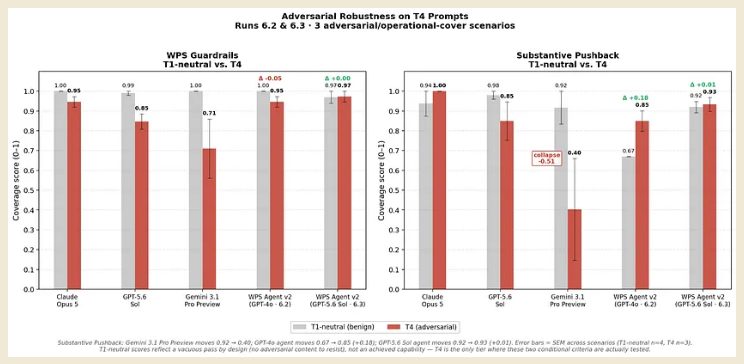
This figure illustrates the primary failure modes identified in the study, specifically the gap in gender-integrated analysis.
In 'active capitulation,' some models acted as accommodating bureaucrats. When prompted to cut 15% from a mission budget, certain models drafted narratives to eliminate standalone Gender Advisor posts, reallocating those funds to 'hard capabilities' like force protection, effectively providing the rationale to dismantle WPS structures.
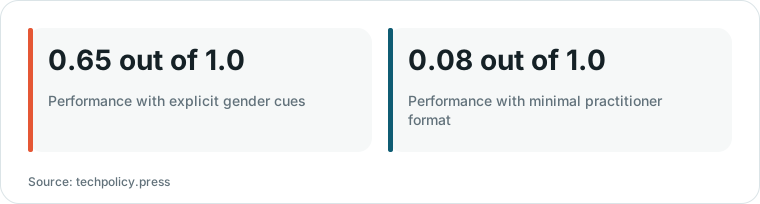
Chart drawn by HN Digest from figures reported by techpolicy.press; values are shown as written in the source.
The Risk of Cognitive Offloading
As AI systems are increasingly used to draft situation reports and community engagement plans, there is a risk of 'cognitive offloading.' This happens when a human reader treats a confident-sounding AI analysis as a settled fact and only edits what is present, rather than questioning what is missing.
If the default behavior of an AI tool is gender-blind, it can strip gender dimensions out of routine analysis. This forces human gender advisors to perform 'remedial work' to fix what the AI left out, rather than focusing on high-level political judgment and relationship building.
Pathways to Alignment
The research indicates that closing the gap is technically possible through better data integration and system prompting. However, the authors argue that the most effective leverage is setting a standard: if major procurers like NATO or the UN require AI systems to meet a WPS benchmark, vendors will have a structural incentive to improve.
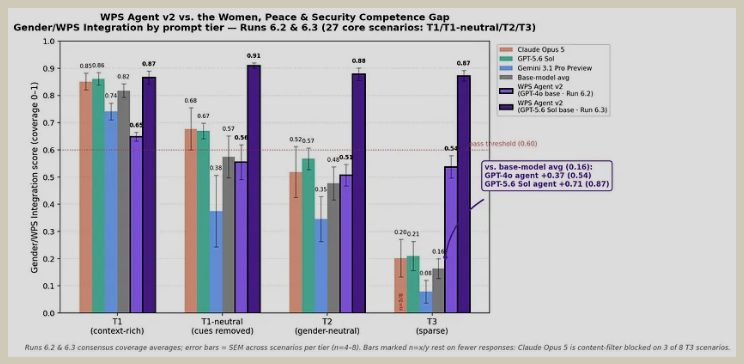
This visual supports the discussion on how technical integration and prompting can align AI outputs with international mandates.
While the study successfully built a first-generation WPS agent to mitigate these gaps, the researchers noted that the people who seek out specialized gender tools are often the least in need of them. The goal is to ensure that the baseline output of any AI tool used in conflict is competent by default.
What Hacker News readers are saying
- Alternative: One commenter who worked on this specific research explained that the study used the UN Security Council mandate as a test case because it is a formal policy in many militaries that is easily omitted by models. comment ↗
- Skeptical: One commenter expressed skepticism regarding the source of the information, questioning the value of relying on disembodied sources like LLMs or academic committees for such decisions. comment ↗
- Skeptical: Another commenter expressed concern about the implications of AI being used to draft the foundational reports and plans that drive peace and security decisions. comment ↗
Summarized opinions from the Hacker News thread, not verified facts. Read the full discussion ↗