In the 1940s, the first 'radiosity' images were not rendered on screens but were painstakingly constructed by hand using Munsel paper samples. Professors Parry Moon and Domina Eberle Spencer used applied mathematics to calculate global lighting models, then physically cut and ironed together paper pieces to match their mathematical output because no digital display mechanism existed at the time.
From Analog Mechanisms to Early Digital Systems
During the 1950s, artists and engineers began using analog computers to create graphic artwork. Ben Laposky used oscilloscopes to generate art, while pioneers at Bell Labs used analog devices to produce plotter output.
By the mid-1960s, digital computers and film recorders began producing some of the earliest CG animated films. This era saw the introduction of the first true light pens, such as those used in the SAGE system at MIT's Lincoln Lab in 1955.
The Rise of Academic and Industrial Research
The 1960s and 1970s were defined by rapid growth in academic centers like MIT, the University of Utah, and Cornell. This period saw the development of the TX-2 computer system, which was used to manipulate drawn pictures and eventually led to the Sketchpad system.
Industrial applications also took hold during this time. At Boeing, William Fetter and Robert Woodruff led important applications of vector-generated CG, while General Electric produced a prototype visualization system for NASA to train astronauts for the moon landing.
Mainframe Dependency and the Shift to Personal Computing
Early computer graphics research was heavily dependent on massive mainframe machines and required significant funding, often from the government's Advanced Research Project Agency (ARPA). This environment allowed researchers to focus on foundational toolsets without heavy bureaucracy.
A significant shift occurred in the mid-1980s when personal computer hardware allowed artists to create abstract computer animation at home. This transition removed the need for sponsored grants and large company-owned mainframes, moving the technology toward the modern era of production and entertainment.
Technical Limitations and Historical Gaps
A primary limitation of early systems was the lack of real-time display, forcing researchers to use time-lapse film photography to capture CRT outputs. Additionally, the provided history focuses on the transition from analog to early digital systems but does not detail the specific technical shift from vector to raster graphics.
The source material also omits later pivotal developments such as James T. Kajiya's Rendering Equation (1986) or the invention of shadow mapping, focusing instead on the foundational era of the 1940s through the 1980s.
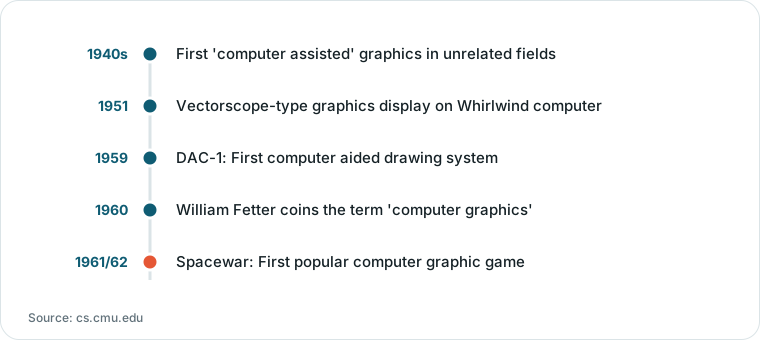
Chart drawn by HN Digest from figures reported by cs.cmu.edu; values are shown as written in the source.
What Hacker News readers are saying
- Technical note: One commenter who studied historical computer graphics papers argued that the site omitted several key milestones, such as the rendering equation, radiosity papers, and the invention of shadow mapping. comment ↗
- Experience: A reader shared their personal experience of being limited to 2D graphics by early hardware constraints before finding success with 3D tools like OpenSCAD. comment ↗
- Experience: Another user recalled trying to use OpenGL in the mid-1990s and expressing skepticism about its ability to handle serious applications beyond simple screensavers. comment ↗
- Experience: One commenter recalled the atmosphere of early computer labs in the late 1960s, describing the intense environment of students sharing limited access to graphics input computers. comment ↗
Summarized opinions from the Hacker News thread, not verified facts. Read the full discussion ↗