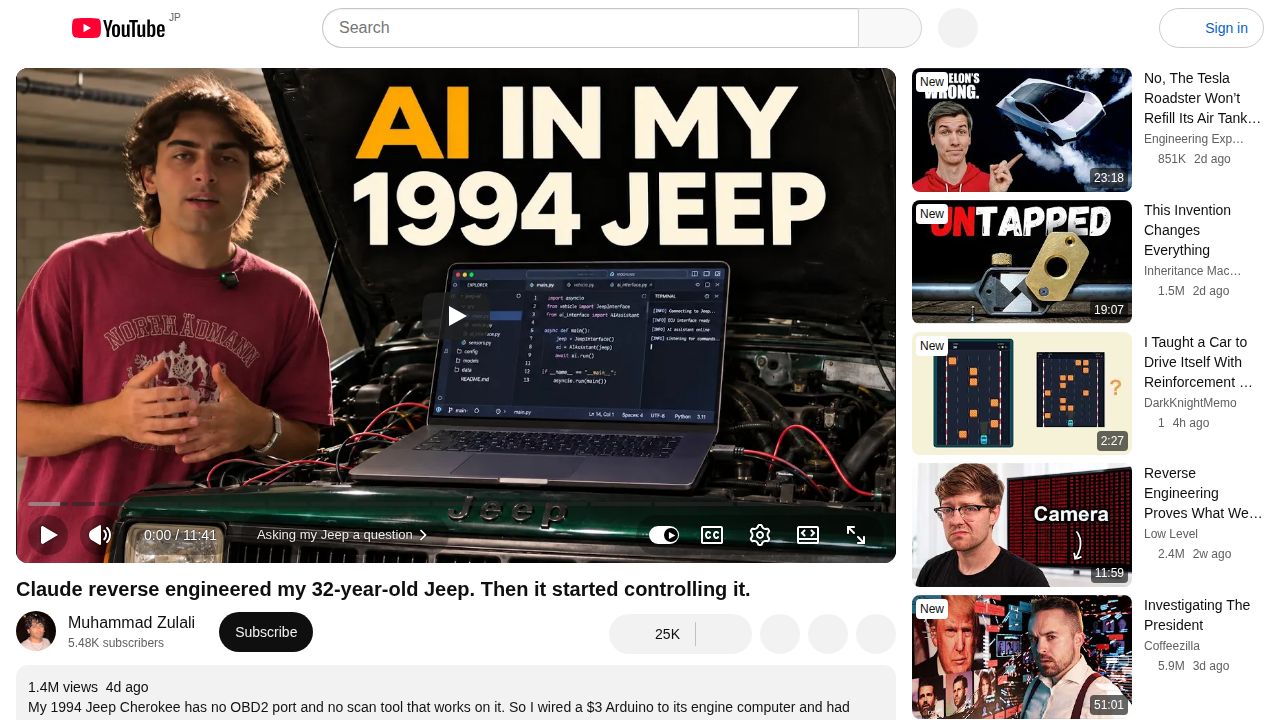
By leveraging Claude Code and Codex, a hobbyist successfully reverse engineered the Engine Control Unit (ECU) of a 1994 Jeep using a $3 Arduino microcontroller. This project demonstrates how large language models (LLMs) can simplify complex hardware hacking tasks, allowing individuals to interact with and modify legacy automotive systems that were previously difficult to access without specialized equipment.
The Reverse Engineering Process
The project owner reported using Claude Code and Codex to decode the 1994 Jeep's ECU. This process involved using the AI to interpret the hardware's signals and logic, ultimately allowing the user to interface with the vehicle's electronics via a low-cost Arduino board.
Beyond the engineering itself, the poster noted that the AI was also responsible for creating the animations and writing the script for the project's demonstration video. This highlights the role of LLMs as 'meat proxies' for complex multi-step technical workflows.
Community Perspectives on Ownership
Commenters on Hacker News discussed how this technology could shift the consumer market by returning ownership to the customer. One commenter suggested that these tools could eventually eradicate the aftermarket key market by allowing users to program their own keys through software interfaces.
The discussion also touched on the practical implications for modern vehicles. While a 1994 Jeep is relatively accessible, some participants noted that newer vehicles might be more difficult to modify due to more sophisticated security layers.
Technical Skepticism and Manufacturer Response
Some participants expressed skepticism regarding the efficacy of the software fix. They argued that if a car fails a smog test, the root cause is often a mechanical issue, and that overwriting the ECU with a richer fuel mix might only be a temporary workaround rather than a permanent repair.
The project also sparked a debate on future security. Commenters suggested that manufacturers may respond to these AI-assisted capabilities by implementing cryptographic locks and software checks that could disable vehicles if they detect unauthorized alterations.
Unresolved Questions
The specific technical steps and the exact code used to bridge the Arduino with the 1994 ECU were not fully detailed in the provided materials. Additionally, it remains unclear how these AI-driven methods would scale to modern vehicles equipped with encrypted communication protocols.