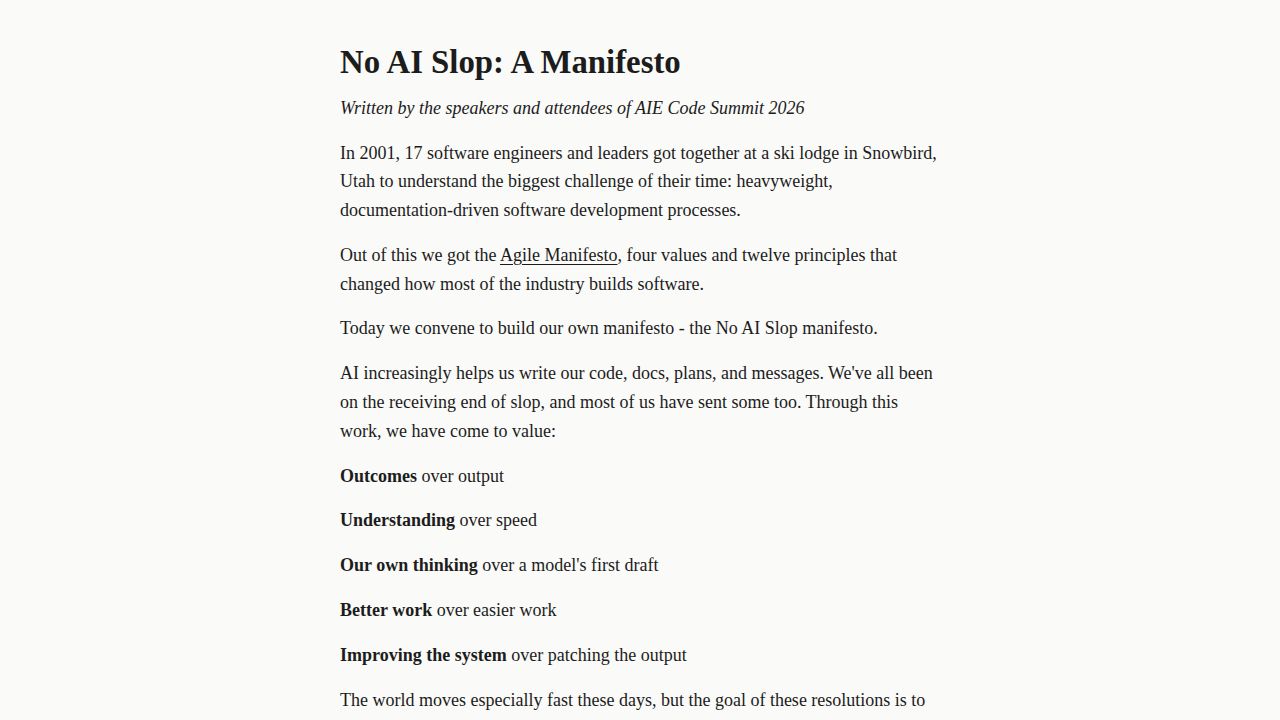
Software engineers and leaders at the AIE Code Summit 2026 have issued a manifesto to address the proliferation of 'slop'—a term they use to describe AI-generated content that requires more effort to understand than it took to produce. The manifesto argues that while AI is a powerful tool, passing along unreviewed model outputs creates an asymmetric cost where production approaches zero while human review costs remain constant.
Defining the Problem of Slop
The manifesto identifies slop as a byproduct of the current AI landscape, where the cost of generating a thousand-line pull request or a ten-page document is nearing zero. Because human review time remains constant, this creates a massive asymmetry that can overwhelm teams and degrade the quality of software.
The authors argue that slop is not inherent to using AI; rather, it occurs when humans pass AI output along without taking responsibility for the quality or the reader's experience. It is a failure of judgment rather than a failure of the technology itself.
“Slop is when we put less effort into producing something than we ask the consumer to spend understanding it.”
— No AI Slop: A Manifesto
The Compounding Effect on Systems
A central concern of the manifesto is how slop compounds within a technical ecosystem. When low-quality AI output sits in a team's knowledge base or chat history, it becomes the training data for the next generation of agents, which then copy and replicate those same errors.
This cycle can lead to a gradual erosion of communication and quality. The manifesto suggests that the more slop circulates within a team, the less will be done to fight it, potentially leading to a downward spiral of maintainability.
Proposed Resolutions and Human Role
To combat this, the manifesto proposes several resolutions, including optimizing systems for the efficient elicitation of human intent and prioritizing 'better work' over 'easier work.' It encourages developers to do their own thinking by exploring prior art and resources before starting a task with a model.
The authors emphasize that while 'vibe coding' and one-shot prompts are high-leverage tools, they should not be used if they undermine the final outcome. They advocate for a system where any AI-generated content is clearly disclosed and checked for accuracy in the parts that matter most to the user.
Trade-offs and Uncertainties
The manifesto acknowledges that there is no single right answer and that the industry is still relearning what to accept. While the goal is to create value for everyone, the authors admit that the rapid pace of AI development makes it difficult to establish permanent guardrails.
A key remaining question is how to balance the immediate business pressure to produce results with the long-term necessity of maintaining a high-quality, human-understandable codebase. The manifesto serves as a starting point for a community-led evolution of these beliefs.
What Hacker News readers are saying
- Skeptical: One commenter argued that the manifesto's definition of 'slop' might inadvertently cap AI productivity, noting that groundbreaking mathematical proofs generated by AI could be classified as slop under these criteria. comment ↗
- Skeptical: Another reader suggested that the manifesto might struggle to gain industry traction because companies often reward those who prioritize rapid output and 'slopping' over the human-centric concerns raised in the document. comment ↗
- Experience: A commenter shared a practical approach for managing large AI-generated pull requests by requiring contributors to include their original prompts and breaking down the review into specific components like specs, production code, and evidence. comment ↗
- Skeptical: Some observers expressed skepticism about the long-term viability of human-centric workflows, suggesting that the industry is moving toward an 'agentic' future where agent-to-agent workflows will replace human review and validation. comment ↗
Summarized opinions from the Hacker News thread, not verified facts. Read the full discussion ↗