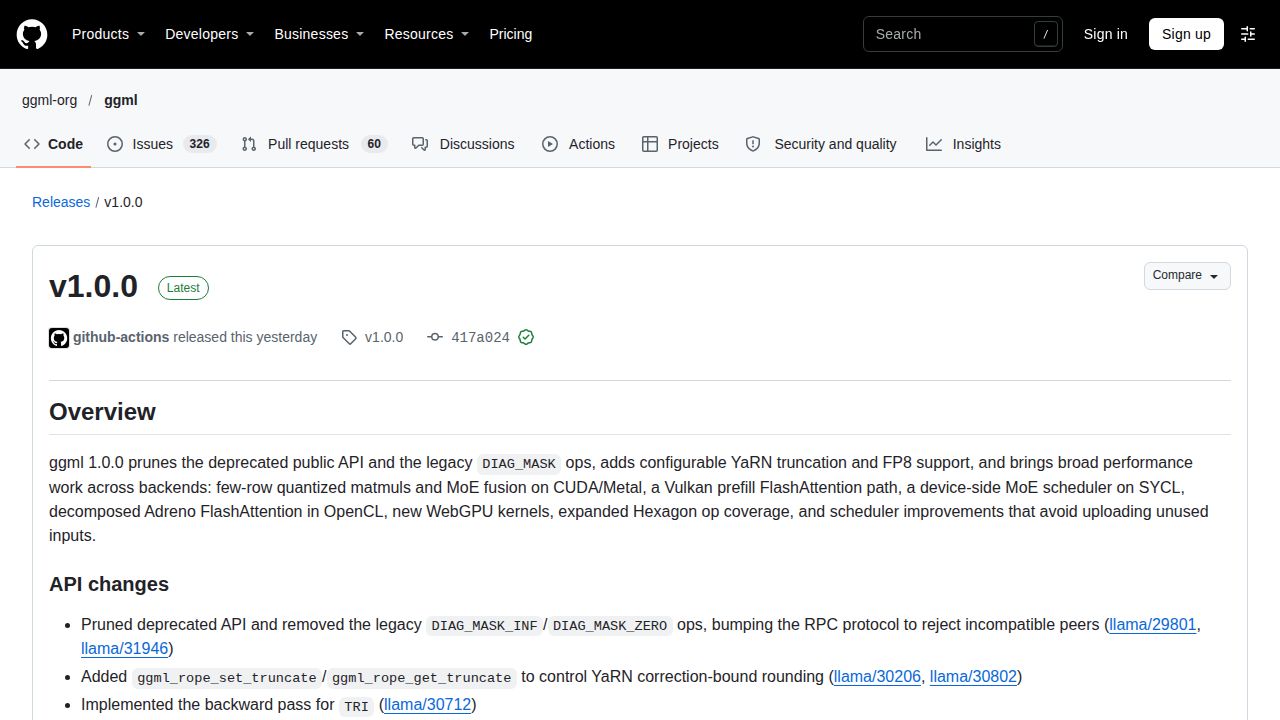
The release of GGML version 1.0.0 marks a significant milestone for a C library designed to facilitate high-performance, local machine learning inference. Developed by Georgi Gerganov (whose initials form the 'GG' in the project name), the library serves as a foundational layer for tools like llama.cpp, enabling users to run large language models on a wide variety of hardware, from legacy systems to modern architectures.
The GGML Project and Version 1.0.0
The primary source, a GitHub release, announces the official 1.0.0 version of GGML. The project is a C library for machine learning that focuses on driving local inference 'one bit at a time.'
As a core component of the llama.cpp ecosystem, GGML is designed to be a 'one-stop-shop' for getting models to run on almost any hardware. This makes it a critical tool for developers and enthusiasts who prioritize local execution over cloud-based APIs.
Community Feedback and Performance
Commenters on Hacker News highlighted the project's ability to provide consistent performance improvements. One user reported a specific runtime reduction from 4:22 to 3:59 when processing a 50K token prompt, noting that frequent updates often yield 5% to 10% speed boosts.
The discussion also emphasized the library's accessibility for users with non-standard hardware. For example, one commenter noted that GGML and llama.cpp made it possible to run models on an AMD card that only supports the Vulkan API.
Hardware Compatibility and Trade-offs
A key strength of GGML is its broad hardware support, which includes both older systems and the RISC-V architecture. This versatility allows it to serve as a bridge between different computing environments.
However, some users pointed out a trade-off regarding raw speed. While GGML is praised for its reliability and ease of use, specialized inference engines with kernels specifically optimized for a particular piece of hardware may still outperform it in terms of peak execution speed.
Discussion Summary
The Hacker News discussion centered on the engineering achievements of the project. Commenters described it as a 'genuine engineering product' and compared its role in the AI world to that of Linux.
While the community largely praised the project's utility, some users suggested that the project's landing page could benefit from more professional design to match the high quality of the underlying software.